Why Your Pond Develops A Rotten Egg Smell
That smell is a warning sign your pond is dying. When water sits still, it loses oxygen. Anaerobic bacteria take over and produce hydrogen sulfide—that rotten egg smell. Aeration keeps the water moving so it stays fresh.
Stagnation in any aquatic system triggers a shift in metabolic pathways. In a healthy, well-oxygenated environment, aerobic microbes decompose organic matter into carbon dioxide and water. This process is efficient and odorless. However, when dissolved oxygen (DO) levels drop below a critical threshold—typically 2.0 mg/L—the system enters an anoxic state.
This shift favors anaerobic organisms that utilize alternative electron acceptors for respiration. Sulfates are reduced to hydrogen sulfide gas, which remains trapped in the lower depths until physical disturbance or seasonal turnover releases it into the atmosphere. Aeration serves as a mechanical intervention to disrupt this "Static: The Sulfur Trap" and transition the system into a "Dynamic: The Fresh Flow" state.
Understanding the mechanical and chemical drivers behind this process is essential for effective pond management. Managing a pond requires more than aesthetic upkeep; it involves the precise control of gas exchange and nutrient cycling.
Why Your Pond Develops A Rotten Egg Smell
Hydrogen sulfide ($H_{2}S$) production is a byproduct of anaerobic decomposition within the benthic zone. This region, often referred to as the "muck" or sediment layer, accumulates organic debris such as leaf litter, fish waste, and decaying algae. When oxygen cannot penetrate this compacted material, sulfate-reducing bacteria (SRB), such as Desulfovibrio, thrive.
These microbes perform cellular respiration by reducing sulfate ($SO_{4}^{2-}$) to sulfide. In water, sulfide exists in a pH-dependent equilibrium between un-ionized $H_{2}S$ and the bisulfide ion ($HS^{-}$). At a pH below 7.0, the toxic, volatile $H_{2}S$ form is dominant. This gas is highly soluble in water but has a low vapor pressure, causing it to accumulate in stagnant bottom layers known as the hypolimnion.
Thermal stratification exacerbates this issue. During warmer months, the sun heats the surface water (epilimnion), making it less dense than the cooler water below. A distinct barrier called the thermocline forms, preventing atmospheric oxygen from mixing into the depths. This creates a closed loop where oxygen is consumed by decomposition but never replenished, turning the bottom of the pond into a sulfur-rich, toxic environment.
Real-world implications of this process are severe. Beyond the olfactory nuisance, $H_{2}S$ is a potent neurotoxin for fish and aquatic invertebrates. Concentrations as low as 0.1 ppm can cause physiological stress, while levels exceeding 4 ppm are often immediately lethal to sensitive species.
How Aeration Systems Work to Restore Balance
Aeration functions through the principle of oxygen transfer across the air-water interface. This process is governed by the two-film theory, which states that gas must diffuse through a stagnant film of gas and a stagnant film of liquid to reach equilibrium. Mechanical aeration accelerates this by increasing the surface area of contact and decreasing the thickness of the liquid film through turbulence.
Subsurface aeration systems utilize a shore-based compressor to pump air through weighted tubing to diffusers located at the pond floor. These diffusers release millions of micro-bubbles. As these bubbles rise, they perform two critical functions: oxygenation and destratification.
Oxygenation occurs as the bubble travels through the water column. According to Henry's Law, the solubility of a gas is proportional to the partial pressure of that gas. Because the pressure is higher at the bottom of the pond, oxygen transfer is often more efficient at depth. Small bubbles—specifically fine-bubble diffusion—maximize the surface-area-to-volume ratio, increasing the Standard Oxygen Transfer Rate (SOTR).
Destratification is the physical movement of water. As bubbles rise, they create an upward current known as an air-lift. This current pulls cold, oxygen-depleted water from the bottom to the surface, where it can vent $H_{2}S$, $CO_{2}$, and methane while absorbing atmospheric oxygen. Continuous mixing eliminates the thermocline, ensuring a uniform temperature and DO profile throughout the entire water column.
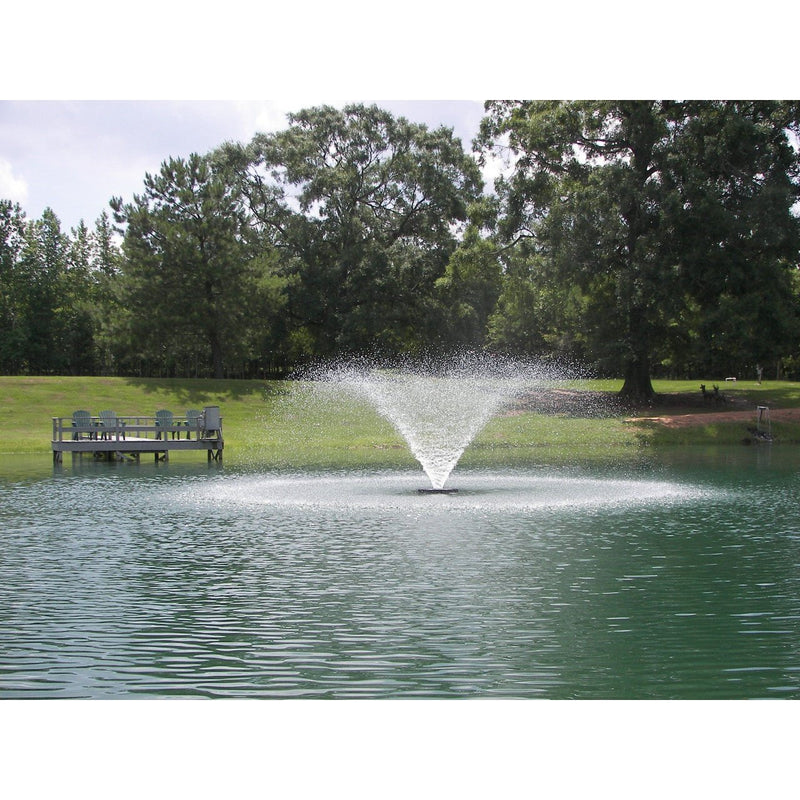
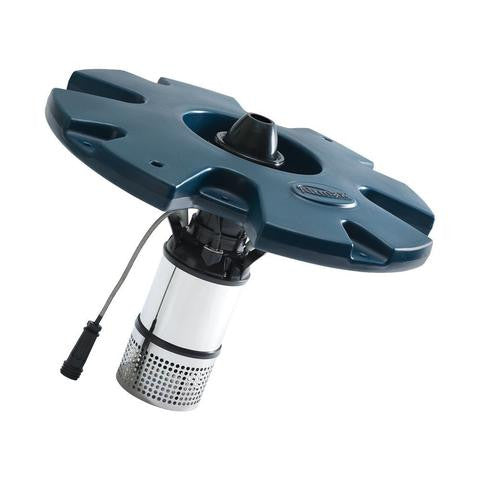
Surface aerators, conversely, work by agitating the top layer of water. They use high-speed impellers to spray water into the air, creating a turbulent plume. This method is highly effective for rapid localized oxygenation and gas stripping, making it ideal for shallow ponds where bottom diffusion is less efficient due to short bubble travel time.
Benefits of Mechanical Aeration
The primary benefit of a well-designed aeration system is the stabilization of dissolved oxygen levels. Maintaining DO above 5.0 mg/L ensures that aerobic bacteria can outcompete anaerobic strains. Aerobic microbes digest organic matter up to ten times faster than their anaerobic counterparts, leading to a significant reduction in muck accumulation over time.
Nitrogen cycling is also enhanced through aeration. Ammonia ($NH_{3}$), a toxic byproduct of fish waste, must be converted to nitrite ($NO_{2}^{-}$) and then to nitrate ($NO_{3}^{-}$) through nitrification. This is an obligate aerobic process. Without sufficient oxygen, ammonia builds up, leading to "New Pond Syndrome" or chronic toxicity. Aeration provides the necessary environment for Nitrosomonas and Nitrobacter to thrive.
Phosphorus management is another measurable advantage. Under anaerobic conditions, phosphorus bound to iron in the sediment is released back into the water column, fueling harmful algal blooms (HABs). Maintaining an aerobic sediment-water interface keeps phosphorus "locked" in the soil, effectively starving algae and improving water clarity.
From an operational standpoint, aeration reduces long-term maintenance costs. Faster decomposition of organic solids means less frequent dredging. Furthermore, by preventing thermal stratification, the risk of a "pond turnover"—a catastrophic event where the entire water column mixes suddenly, causing total oxygen depletion and fish kills—is virtually eliminated.
Challenges and Common Pitfalls
Installing an aeration system without proper sizing is a frequent error. Sizing is not merely a matter of pond surface area; it must account for Biological Oxygen Demand (BOD) and Chemical Oxygen Demand (COD). A pond with high fish density or heavy leaf litter requires a higher Standard Aeration Efficiency (SAE) than a clean, decorative feature.
Startup timing presents a significant risk for existing stratified ponds. If a powerful aeration system is turned on in the middle of a hot summer in a pond that has been stagnant for months, it may cause an immediate turnover. This forces the toxic, $H_{2}S$-laden bottom water into the surface layer all at once. This sudden surge in oxygen demand can drop DO levels to zero in minutes, killing the entire fish population.
Maintenance of mechanical components is often overlooked. Compressors require regular filter changes and vane or diaphragm replacements. Diffuser membranes can become fouled by mineral deposits or "bio-fouling" from algae and bacteria. Fouled diffusers increase backpressure on the compressor, reducing airflow and potentially leading to premature motor failure.
Power delivery to remote pond sites can be technically challenging. Long runs of electrical wire result in voltage drops, which can damage motors. Using air-line runs of up to 1,000 feet is often a more efficient solution, allowing the compressor to be housed near a power source while the diffusers are placed strategically throughout the pond.
Limitations of Aeration Technology
Aeration is not a panacea for all water quality issues. It cannot compensate for massive nutrient loading from external sources, such as fertilizer runoff or septic seepage. If the rate of nutrient input exceeds the rate of microbial processing, the pond will remain eutrophic regardless of oxygen levels.
Shallow ponds—those less than 5 feet deep—limit the effectiveness of subsurface diffusers. The bubbles reach the surface too quickly to transfer significant amounts of oxygen or create strong circulation currents. In these environments, surface aerators or horizontal circulators are technically superior.
Extreme water temperatures also impact efficiency. The solubility of oxygen decreases as water temperature rises. At 25°C, water can hold approximately 8.2 mg/L of oxygen at saturation, whereas at 5°C, it can hold nearly 12.7 mg/L. During heatwaves, even a high-capacity system may struggle to maintain DO levels if the biological demand is excessive.
Chemical interference can reduce oxygen transfer efficiency. The Presence of surfactants (soaps, oils) or high salinity alters the "Alpha Factor," which is the ratio of oxygen transfer in process water versus clean water. In industrial or wastewater applications, the Alpha Factor can be as low as 0.5, meaning the system is only 50% as effective as its laboratory rating suggests.
Surface vs. Subsurface Aeration Comparison
Selecting the correct system requires an analysis of pond geometry and management goals. The following table illustrates the technical differences between these two primary methods.
| Metric | Surface Aerators | Subsurface Diffusers |
|---|---|---|
| Optimal Depth | 1 to 5 feet | 6 to 40+ feet |
| Primary Mechanism | Atmospheric Splashing | Rising Micro-bubbles |
| SAE (lb O2/hp-hr) | 1.5 to 3.0 | 1.0 to 4.0 (Depth dependent) |
| Gas Stripping | High Efficiency | Moderate (Circulation driven) |
| Energy Cost | Higher per cubic foot | Lower per cubic foot |
Surface aerators are the preferred choice for emergency aeration. Because they add oxygen directly to the top layer where fish reside, they can provide immediate relief during a crash. Subsurface systems are the gold standard for long-term ecosystem health and muck reduction in deeper bodies of water.
Practical Tips for System Optimization
Optimizing a system starts with a "slow-start" procedure for stratified ponds. Run the system for only 30 minutes the first day, 1 hour the second, and double the time each subsequent day until 24-hour operation is achieved. This gradual mixing allows for the safe oxidation of accumulated $H_{2}S$ and organic acids without crashing the DO levels.
Placement of diffusers should target the deepest points of the pond. Because the air-lift current creates a cone of influence that widens as it rises, placing the diffuser at the deepest point ensures the maximum volume of water is moved. For irregularly shaped ponds, multiple smaller diffusers are more effective than a single large unit, as they eliminate "dead zones" where stagnation can persist.
Monitoring is essential for serious practitioners. Using a handheld DO meter or a permanently installed probe allows for data-driven decisions. If DO levels drop significantly at night—when photosynthesis stops and plants begin to consume oxygen through respiration—increasing the aeration runtime is necessary.
Compressors should be housed in ventilated, weather-proof cabinets to prevent overheating. Operating a compressor in a sealed box will lead to internal temperature spikes, thinning the lubricant and causing mechanical seize. Sound-dampening materials can be used, but they must not obstruct the intake or exhaust airflow.
Advanced Considerations in Aeration Engineering
Serious practitioners should understand the "Alpha Factor" and the "Beta Factor." The Alpha Factor ($?$) accounts for how much harder it is to transfer oxygen into "dirty" pond water compared to clean tap water. The Beta Factor ($?$) adjusts for the difference in oxygen solubility due to dissolved salts and solids. Calculating the Actual Oxygen Transfer Rate (AOTR) requires these variables:
AOTR = SOTR × ? × [(? × C_sat_alt_temp - C_actual) / C_sat_std] × ?^(T-20)
In this equation, $?$ (Theta) is the temperature correction factor, usually 1.024. $C_{sat}$ represents the oxygen saturation concentration at a given altitude and temperature. This level of calculation is common in municipal wastewater treatment but is increasingly being applied to large-scale aquaculture and industrial stabilization ponds to minimize energy expenditure.
Another advanced technique involves Pulsed Aeration. By cycling the aeration system on and off, managers can create alternating aerobic and anoxic conditions. This can promote "simultaneous nitrification-denitrification," a process that removes nitrogen from the system entirely by converting it into $N_{2}$ gas, rather than just shifting it between ammonia and nitrate.
The Reynolds number ($Re$) of the water movement also matters. In larger systems, ensuring turbulent flow ($Re > 4000$) is necessary to prevent the settling of solids. If the flow is laminar, organic matter will still settle in the benthic zone despite the presence of oxygen, leading to slower decomposition rates.
Examples of Aeration in Practice
Consider a 1-acre pond with an average depth of 8 feet, containing approximately 2.6 million gallons of water. In the height of summer, this pond might have a BOD of 10 mg/L due to organic loading. To satisfy this demand, the system must deliver roughly 216 lbs of oxygen per day.
Using a 1 HP surface aerator with an SAE of 2.5 lbs $O_{2}$/hp-hr, the system would produce 60 lbs of oxygen in 24 hours ($1 \times 2.5 \times 24$). This is insufficient to meet the 216 lbs demand. In this scenario, either four surface aerators are required, or a move to a high-efficiency subsurface system is necessary.
A subsurface system with four fine-bubble diffusers and a 1/2 HP compressor might move 4,000 gallons of water per minute. While its direct oxygen transfer might be lower than the surface aerator, its ability to move 5.7 million gallons of water to the surface every 24 hours provides a massive "indirect" aeration benefit via atmospheric contact. This illustrates why subsurface systems are often more efficient for large-scale destratification.
In a different scenario, a wastewater lagoon experiencing high $H_{2}S$ levels may use a "Static: The Sulfur Trap" design. By installing high-speed aspirating aerators, the facility can inject air at a 45-degree angle, creating a horizontal current that both aerates and keeps solids in suspension. This prevents the formation of the anaerobic sludge layer that produces the sulfur smell in the first place.
Final Thoughts
The transition from a stagnant, odorous pond to a healthy aquatic ecosystem depends entirely on the management of dissolved oxygen. That rotten egg smell is more than a nuisance; it is a chemical indicator of a system that has lost its ability to self-regulate. Implementing a mechanical aeration strategy addresses the root cause of $H_{2}S$ production by disrupting thermal layers and fueling aerobic decomposition.
Selecting the right system requires balancing depth, organic load, and energy efficiency. While surface aerators provide excellent gas stripping and localized oxygenation, subsurface diffusers offer superior destratification and long-term muck reduction for deeper ponds. Understanding the underlying metrics like SOTR and SAE allows for a professional-grade approach to water management.
Maintaining a healthy pond is an ongoing technical challenge. Regular monitoring of oxygen levels, seasonal adjustments to runtimes, and diligent equipment maintenance are the hallmarks of a successful strategy. By moving water from a "Static" trap to a "Dynamic" flow, you ensure the longevity and stability of the entire ecosystem.