

What Size Fountain Do I Need for a 1-Acre Pond?
Is your fountain too small for your pond's personality? Don't let your pond swallow your fountain. Learn how to match horsepower to acreage for the perfect visual impact.
Sizing a pond fountain for a 1-acre body of water requires a shift from aesthetic preference to mechanical optimization. To achieve both visual presence and biological efficacy, the selection process must be governed by data—specifically horsepower-to-surface-area ratios, gallons per minute (GPM), and electrical load capacity.
What Size Fountain Do I Need for a 1-Acre Pond?
For a 1-acre pond, the standard technical recommendation is a motor with 1 to 2 horsepower (HP). This specific range is calculated based on the surface area of 43,560 square feet, which constitutes one surface acre. A fountain with less than 1 HP often lacks the necessary "throw" to maintain visual scale, causing the unit to appear undersized relative to the water’s expanse.
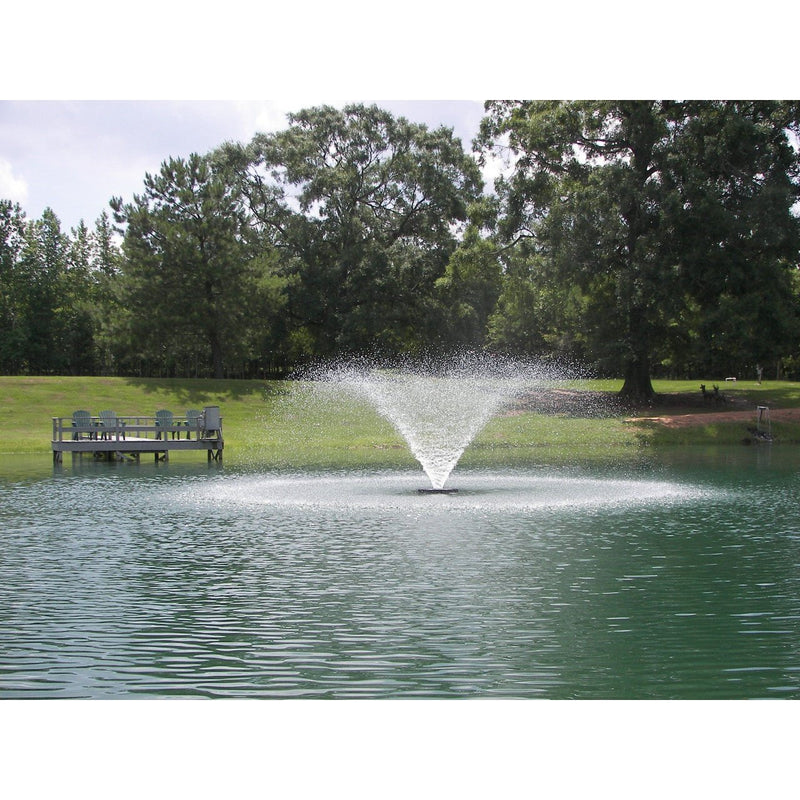
In mechanical terms, the sizing depends on whether the primary goal is visual display or aeration. If the objective is standard aeration, a 1 HP unit is the baseline. However, for ponds with high organic loading or those requiring a "high-performance" visual display, 2 HP is the preferred benchmark. This ensures the spray height and width occupy a sufficient percentage of the pond's visual field without being "swallowed" by the surrounding environment.
Real-world application shows that a 1 HP motor typically provides a spray height of 12 to 18 feet, depending on the nozzle configuration. A 2 HP motor can push this to 20 or 25 feet. Selecting the correct size prevents the common error of "Artificial Under-Scaling," where the equipment's mechanical output is statistically negligible compared to the pond's total volume and oxygen demand.
Mechanical Principles: How Fountain Sizing Works
The functionality of a pond fountain is a product of fluid dynamics and electrical efficiency. To understand which unit is appropriate, you must analyze the relationship between motor output, GPM, and head pressure.
GPM and Nozzle Restriction
Fountains function by moving a specific volume of water through a nozzle. There is an inverse relationship between spray height and GPM. Decorative fountains use restricted nozzles to create high-pressure, high-elevation displays. Aerating fountains use open propellers to maximize GPM with lower elevations. For a 1-acre pond, a 1 HP aerating fountain might move 130 GPM, while a decorative 1 HP unit might only move 90 GPM due to the friction loss and head pressure created by the nozzle.
The Horsepower-to-Acreage Ratio
Professional lake managers use the 1.5 HP to 2 HP per acre rule when biological oxygen demand (BOD) is high. For a standard 1-acre residential pond with average fish density, a 1 HP unit is often sufficient for surface circulation. If the pond is irregularly shaped (e.g., L-shaped or kidney-shaped), multiple smaller units (two 1/2 HP units) are often more efficient than one large unit, as they eliminate stagnant "dead zones" where oxygen levels drop.
Benefits of Proper Technical Sizing
Selecting a fountain based on mechanical metrics rather than just price or "look" provides measurable improvements to the aquatic ecosystem.
- Oxygenation Efficiency: Properly sized units maximize the Standard Oxygen Transfer Rate (SOTR). This is the rate at which oxygen is introduced into the water column. A 1.5 HP unit can maintain dissolved oxygen (DO) levels above the 5 mg/L threshold required for most temperate fish species.
- Thermal De-stratification: In summer, ponds separate into layers (stratification). A sufficiently powerful fountain creates enough surface turbulence to break this barrier, mixing the oxygen-rich surface water with the cooler, stagnant bottom water.
- Energy Optimization: A 1 HP motor running at its peak efficiency curve consumes less power relative to its work output than an undersized 1/2 HP motor that fails to move the water effectively.
- Reduction in Bio-Loading: Increased circulation accelerates the aerobic decomposition of organic "muck" at the pond bottom, reducing noxious odors like hydrogen sulfide.
Challenges and Common Mistakes
The most frequent error in fountain procurement is underestimating the "visual drift" of a 1-acre pond.
Under-Sizing for Aesthetics
A 1/2 HP fountain in a 1-acre pond is often invisible from a distance of more than 100 feet. This is a failure of scale. Because 1 acre is a significant surface area, the spray pattern must be large enough to break the horizon. Small units look like "ripples" rather than focal points.
Electrical Undersizing
Fountains are high-draw mechanical devices. A common mistake is using standard 14-gauge extension cords for a 1 HP motor. This leads to voltage drop. If the voltage drops below the motor's operating threshold, the motor generates excess heat, leading to premature winding failure. For a 1-acre pond, where the fountain is likely 100+ feet from the shore, cable gauge must be calculated precisely.
Ignoring Pond Depth
Floating fountains are surface agitators. They typically only circulate the top 6 to 8 feet of water. If your 1-acre pond is 20 feet deep, a fountain alone will not prevent bottom-level stagnation. In these cases, the fountain must be considered a decorative addition rather than a primary aeration system.
Limitations: When a Fountain is Not Enough
While effective for surface movement, fountains have technical boundaries.
| Metric | Floating Fountain | Sub-Surface Diffuser |
|---|---|---|
| Primary Function | Aesthetics & Surface Aeration | Deep Water De-stratification |
| Effective Depth | 0–8 Feet | 8–40+ Feet |
| Energy Consumption | High (Amps/GPM) | Low (CFM/PSI) |
| Maintenance | Frequent (Cleaning Nozzles) | Low (Filter Changes) |
If the pond exceeds 12 feet in depth, a 1 HP fountain will provide "Integrated Natural Scale" for the surface, but the biological health of the bottom will suffer. In these scenarios, a combination of a 1 HP decorative fountain and a 1/2 HP bottom-diffused aerator is the technically superior solution.
Practical Tips and Best Practices
To optimize a 1 HP or 2 HP system for a 1-acre pond, follow these mechanical best practices:
- Voltage Selection: For 1 HP units and above, always opt for 230V service if available. 230V motors draw half the amperage of 115V motors, allowing for longer cable runs with less voltage drop and lower heat generation.
- Cable Gauge Calculation: Measure the distance from the breaker panel—not the shoreline—to the fountain. For a 1 HP motor at 200 feet, 12 AWG cable is the minimum, though 10 AWG is preferred for efficiency.
- Anchor Placement: Use a two-point anchoring system. Position the anchors at a distance 2 to 3 times the depth of the pond to ensure the unit stays centered during high wind events.
- GFI Protection: Every fountain must be connected to a Class A Ground Fault Circuit Interrupter (GFCI). This is a non-negotiable safety requirement for submerged electrical equipment.
Advanced Considerations: Electricity and Flow Metrics
For serious practitioners, the decision is driven by the motor's "Total Dynamic Head" and "Amperage Load."
Voltage Drop and Motor Life
The formula for voltage drop is: Vd = (2 * L * R * I) / 1000. (Where L = length, R = resistance, and I = current). If your calculated drop exceeds 5%, you are damaging your motor. On a 1-acre pond, where the run could be 300 feet, the resistance of the copper wire becomes a critical variable in the fountain's lifespan.
Standard Oxygen Transfer Rate (SOTR)
A 1 HP aerating fountain can transfer approximately 1.5 to 2.0 lbs of oxygen per hour. A 1-acre pond in mid-summer may require 10 to 15 lbs of oxygen per day just to offset the respiration of algae and fish. If your pond is "green" with algae, you must size your fountain toward the 2 HP mark to ensure the oxygen input exceeds the biological demand.
Technical Example: The 1-Acre Optimization
Consider a 1-acre rectangular pond with a maximum depth of 10 feet. The goal is a high-visual display visible from a house 150 feet away.
Calculated Solution:
A 1.5 HP decorative fountain running on 230V power.
- Visual Impact: The 1.5 HP motor provides a 15-foot high, 20-foot wide tiered spray pattern, which maintains a 1:10 ratio with the pond's 150-foot width, satisfying the "Natural Scale" requirement.
- Electrical Setup: 10 AWG submersible cable. The motor draws roughly 7.5 amps. At 250 feet of total run, the voltage drop remains under 2.5%, ensuring the mechanical seals and windings operate within design specifications.
- Aeration: The unit moves approximately 110 GPM. Over a 24-hour cycle, this achieves a significant surface turnover, disrupting mosquito breeding cycles and suppressing surface algae mats.
Final Thoughts
Selecting the correct fountain size for a 1-acre pond is a matter of matching mechanical output to environmental volume. A 1 HP unit is the technical minimum for maintaining visual and biological presence, while a 2 HP unit offers the robust performance required for deeper or high-nutrient ponds.
By prioritizing voltage efficiency, cable gauge, and GPM over mere aesthetics, you ensure the longevity of the motor and the health of the aquatic ecosystem. Avoid the pitfall of under-scaling; a 1-acre pond is a large mechanical system that requires a commensurate level of power.
Focus on the data, verify your electrical capacity, and choose a unit that commands the space it occupies. This technical approach guarantees that your fountain remains a functional asset rather than a submerged liability.