

Should You Put an Aeration Diffuser in the Deepest Part of a Pond?
Deepest isn't always best. Discover the 'Sweet Spot' for aeration. Putting your diffuser at the absolute bottom might be killing your pump. Learn why the 10-15 foot range is the aeration gold mine.
Aeration efficiency is fundamentally a matter of fluid dynamics and mechanical resistance. While it is a common assumption that placing a diffuser at the absolute deepest point of a pond maximizes results, the empirical data suggests a more nuanced reality. Mechanical optimization requires balancing oxygen transfer rates with the operational limits of the compressor system.
The goal of any aeration system is to maintain aerobic conditions throughout the water column to support biological decomposition and fish respiration. However, every foot of water depth introduces specific physical variables that can either enhance or degrade system performance. Understanding the relationship between hydrostatic pressure and airflow is essential for long-term pond management.
Selecting the correct depth for a diffuser is not just about moving water; it is about managing energy consumption and equipment longevity. In many cases, the "maximum depth" of a pond represents a point of diminishing returns where the cost of operation outweighs the marginal gain in oxygen saturation. This guide analyzes the technical specifications required to identify the optimal placement for your aeration hardware.
Should You Put an Aeration Diffuser in the Deepest Part of a Pond?
The technical answer is rarely a simple "yes." In professional pond management, placing a diffuser at the absolute deepest point is often counterproductive. While deep placement increases the "rise time" of bubbles—allowing for more contact with the water—it also forces the compressor to work against maximum hydrostatic pressure. This pressure is a fixed physical constraint: for every 2.31 feet of water depth, the system must overcome 1 PSI of backpressure.
In a pond with a 25-foot hole, a diffuser placed at the bottom creates approximately 10.8 PSI of resistance before accounting for friction loss in the tubing or the resistance of the diffuser membrane itself. Most high-efficiency compressors, particularly linear diaphragm models, are not designed to operate continuously at these levels. Pushing a pump to its mechanical limit results in excessive heat generation, which degrades internal components and leads to premature failure.
Furthermore, the deepest part of an older pond is often a "muck pocket" filled with years of organic sediment. Placing a diffuser directly into this material can resuspend fine solids, leading to increased turbidity and a temporary spike in biological oxygen demand (BOD). This sudden mixing of anoxic sludge with the water column can occasionally trigger a localized fish kill if not managed with a strict slow-start protocol.
How Subsurface Aeration Works: The Physics of Depth
Subsurface aeration relies on the "airlift" effect. When a compressor forces air through a diffuser, thousands of micro-bubbles are released. As these bubbles rise, they displace water, creating a vacuum that pulls deoxygenated water from the lower layers up to the surface. This process is governed by three primary factors: hydrostatic pressure, CFM (Cubic Feet per Minute) output, and the cone of influence.
Hydrostatic Pressure and PSI: The compressor must generate enough pressure to "crack" the diffuser and push air against the weight of the water. If a pond is 15 feet deep, the water alone exerts 6.5 PSI. Most professional-grade rocking piston compressors are rated for these depths, but they will still see a reduction in total CFM as the pressure increases. A pump that produces 4.0 CFM at 0 PSI might only produce 2.5 CFM at 10 PSI.
The Cone of Influence: As bubbles rise, they expand in a V-shaped pattern. The deeper the diffuser is placed, the wider the "cone" becomes by the time it reaches the surface. This means a single diffuser at 15 feet can move significantly more water than the same diffuser at 5 feet. However, once you exceed 20 feet, the energy required to move that volume of air increases exponentially, often leading to what engineers call "Wasted Energy Depth."
Friction Loss: The depth of the diffuser is only half of the pressure equation. The length and diameter of the airline tubing also contribute to backpressure. Using a 3/8-inch ID (inner diameter) hose for a 500-foot run to a deep diffuser can add several PSI of friction loss, potentially pushing the compressor beyond its safe operating range even if the water depth itself is manageable.
Benefits of Strategic Depth Placement
Optimizing diffuser depth between 10 and 15 feet offers measurable advantages in both mechanical efficiency and biological health. This "Sweet Spot" provides enough rise time for high oxygen transfer efficiency (OTE) without overloading the compressor motor.
- Extended Equipment Life: Operating at moderate PSI levels keeps the compressor's internal temperature within design parameters. This prevents the hardening of diaphragms and the scoring of piston cylinders, doubling the interval between required maintenance kits.
- Maximized Oxygen Transfer: Fine-bubble diffusers typically achieve an oxygen transfer efficiency of approximately 6.9% per meter of depth. Placing diffusers in the 10-15 foot range captures a significant portion of this transfer while maintaining a high CFM flow to ensure total pond turnover.
- Thermal Refuge Preservation: In very deep ponds, keeping the diffuser slightly above the absolute bottom allows a small "cold water" layer to remain. This can be vital for certain fish species that require a thermal refuge during peak summer heat.
- Energy Cost Efficiency: Pumping air into shallower water requires less wattage. By avoiding the extreme pressures of the deepest holes, operators can often use smaller, more energy-efficient compressors to achieve the same or better oxygenation results.
Challenges and Common Mistakes
The most frequent error in pond aeration is ignoring the compressor's performance curve. Every pump has a specific limit where the airflow drops to zero (the "dead head" point). If a user places a linear diaphragm pump in 12 feet of water, the pump might still produce bubbles, but the internal heat will likely melt the valves within months.
Another common mistake is the "Instant On" error in stratified ponds. If a pond has been stagnant for years, the bottom water is likely saturated with hydrogen sulfide and carbon dioxide. Turning on a high-powered diffuser at the bottom and running it 24/7 immediately will bring all those toxic gases to the surface at once. This rapid destratification is a leading cause of "aeration-induced fish kills."
Placement in the "muck zone" is also a frequent failure point. If a diffuser is dropped directly into soft silt, it will eventually sink into the mud. Once the membrane is covered in muck, the backpressure spikes, the bubble size increases (reducing efficiency), and the system eventually fails. Professional installations always use a weighted base or a riser to keep the diffuser 6-12 inches above the pond floor.
Limitations: When Deep Placement Isn't Possible
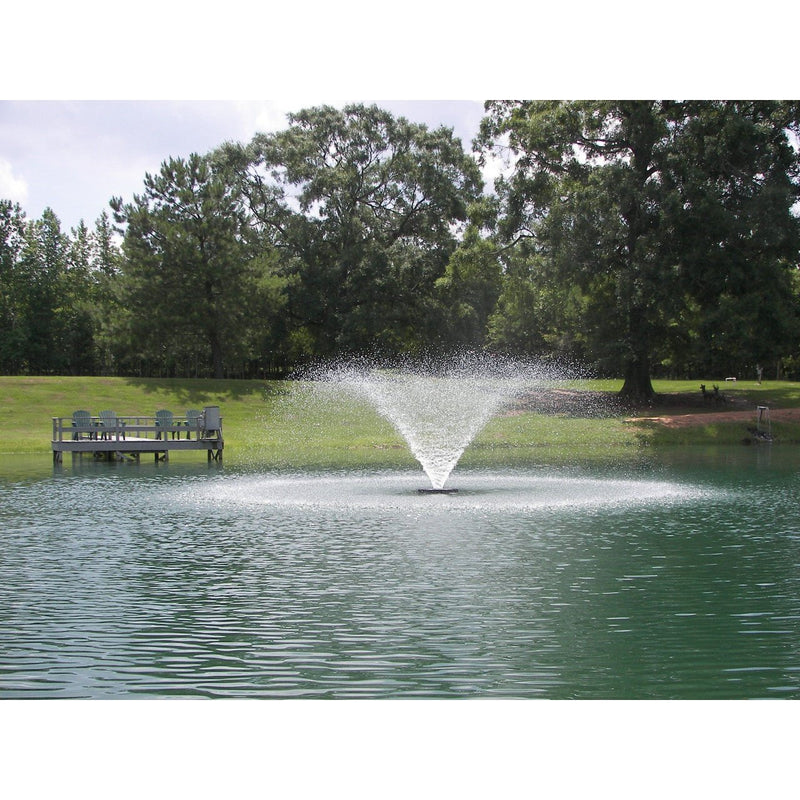
Not every pond is a candidate for deep-diffuser aeration. In shallow environments (under 5 feet), the "rise time" of the bubbles is so short that very little oxygen is transferred during the ascent. In these cases, the primary benefit of the diffuser is surface agitation, but a surface aerator or fountain may actually be more efficient at moving the required volume of water.
Environmental constraints also play a role. In ponds with high levels of suspended solids or heavy clay, aggressive deep-water mixing can keep the water permanently "chocolate milk" brown. This prevents sunlight from reaching beneficial submerged plants and can disrupt the sight-feeding of predator fish like Largemouth Bass.
Finally, there are mechanical limits to the technology. Even the best rocking piston compressors generally top out at 40-50 feet. For reservoirs deeper than this, specialized industrial systems or liquid oxygen injection may be required, as the energy cost to pump atmospheric air against 20+ PSI becomes economically unfeasible for most private owners.
Wasted Energy Depth vs Maximum Oxygen Gain
The following table illustrates the typical trade-off between depth, pressure, and the resulting efficiency for a standard 1/2 HP rocking piston compressor using a 100-foot airline.
| Placement Depth (ft) | Hydrostatic Pressure (PSI) | Estimated CFM Output | Oxygen Transfer Efficiency | Efficiency Status |
|---|---|---|---|---|
| 5 | 2.2 | 4.2 | Low (Short Rise Time) | Inefficient (Too Shallow) |
| 12 | 5.2 | 3.5 | High (The Sweet Spot) | Optimal |
| 20 | 8.7 | 2.1 | Very High | Diminishing Returns |
| 30 | 13.0 | 0.8 | Maximum per Bubble | Wasted Energy Depth |
As indicated, the 12-foot mark represents the most efficient use of electricity and hardware. While the oxygen transfer per bubble is technically higher at 30 feet, the total volume of air (CFM) being delivered is so low that the overall oxygenation of the pond decreases.
Practical Tips for Best Results
To optimize your setup, you must move beyond guess-work and use basic diagnostic tools. Applying these best practices will ensure the system operates at peak mechanical efficiency.
- Install a Pressure Gauge: A 0-30 PSI gauge at the compressor outlet is the most important tool you can own. It allows you to see the exact load on the pump. If the pressure rises over time, you know your diffusers are clogging and need cleaning.
- Use a Slow-Start Protocol: When starting a system in a stratified pond, run the compressor for only 30 minutes on Day 1. Double the time every day (1 hour, 2 hours, 4 hours, etc.) until you reach 24-hour operation. This allows gases to vent slowly.
- Opt for Sinking Tubing: Avoid using "poly pipe" or weighted tubing that isn't specifically designed for aeration. High-quality weighted PVC stays on the bottom without weights and resists kinking, which reduces friction-induced backpressure.
- Verify the Depth: Use a weighted string or an electronic fish finder to map the pond bottom before dropping diffusers. A 2-foot difference in placement can change your pump's lifespan by years.
Advanced Considerations: Alpha Factors and BOD
Serious practitioners must account for the biological oxygen demand (BOD) and the "Alpha Factor" of the water. The Alpha Factor is a ratio that compares oxygen transfer in pond water to oxygen transfer in clean, tap water. In ponds with high organic loads or tannins, the Alpha Factor can be as low as 0.5, meaning your system is only 50% as effective as the manufacturer's spec sheet suggests.
Additionally, the "Total Turnover" metric is critical. A healthy pond generally requires one complete turnover of the water volume every 24 hours. If your pond is 10 acres and 20 feet deep, but you only have two diffusers at 10 feet, you may not be achieving the necessary turnover to keep the bottom aerobic. In these scenarios, adding more diffusers at a shallower "Sweet Spot" depth is often more effective than trying to put one diffuser in a 25-foot hole.
Example Scenario: The 1-Acre Pond
Consider a 1-acre pond with a maximum depth of 22 feet in one small corner and an average depth of 8 feet. The owner has a choice: place one diffuser in the 22-foot hole or two diffusers at 12 feet in different areas of the pond.
Placing a single diffuser at 22 feet creates high backpressure (9.5 PSI), reducing the airflow of a standard compressor. The "cone of influence" is wide, but the volume of air is low. Conversely, placing two diffusers at 12 feet reduces the pressure to approximately 5.2 PSI. This allows the compressor to run much cooler and push a higher total volume of air. The result is better overall circulation, more uniform dissolved oxygen levels, and a significantly lower risk of equipment failure.
Final Thoughts
Maximizing pond health is a balance of physics and biology. While it is tempting to reach for the deepest part of the pond, the data confirms that the 10-15 foot range is the aeration gold mine for most residential and commercial systems. This depth provides the ideal intersection of high oxygen transfer efficiency and manageable mechanical load on your compressor.
By monitoring your system's PSI and avoiding the "Wasted Energy Depth," you protect your investment and ensure a stable environment for your aquatic ecosystem. Remember that the goal is not just to see bubbles on the surface, but to move the maximum amount of water with the minimum amount of mechanical stress.
For those managing complex or highly stratified water bodies, investing in a bathymetric map and a dissolved oxygen meter is the next logical step. These tools allow you to verify that your "Sweet Spot" placement is achieving the total turnover required to keep your pond clear and your fish thriving year-round.