

What Causes Sudden Fish Death In Ponds?
Don't wake up to a floating disaster. It's usually not disease. It's a sudden drop in dissolved oxygen, often happening at night. A simple aeration system is the ultimate insurance policy for your fish.
Understanding the mechanics of gas exchange in aquatic environments is critical for any serious pond manager or aquaculturist. While many enthusiasts focus on filtration or water chemistry parameters like pH and KH, the fundamental driver of survival is dissolved oxygen (DO). When DO levels crash, the biological support system of the pond fails almost instantly.
This article provides a technical deep-dive into the causes of oxygen depletion, the physics governing gas solubility, and the mechanical optimization of aeration systems. By focusing on data-driven metrics and mechanical efficiency, you can move from reactive crisis management to proactive environmental control.
What Causes Sudden Fish Death In Ponds?
Sudden fish mortality is almost always an environmental event rather than a pathogen-driven one. The primary catalyst is a rapid depletion of dissolved oxygen, a phenomenon often referred to as a "summer kill" or "nighttime crash."
The diurnal oxygen cycle is the most common driver. During daylight hours, phytoplankton and aquatic plants perform photosynthesis, absorbing carbon dioxide and releasing oxygen as a byproduct. This process can lead to oxygen supersaturation, where DO levels exceed 100% of the air-saturated value. However, at night, photosynthesis ceases, but respiration continues. Fish, plants, and bacteria all consume oxygen simultaneously. If the biological oxygen demand (BOD) exceeds the pond's storage capacity, oxygen levels can plummet to lethal concentrations (below 2 mg/L) before sunrise.
Another significant cause is the "phytoplankton crash." Dense algal blooms are inherently unstable. A few consecutive cloudy days or a sudden change in temperature can cause a mass die-off of these microscopic plants. As aerobic bacteria decompose the dead organic matter, they consume massive quantities of oxygen, creating an acute deficit that kills fish within hours.
Thermal stratification also plays a role. In summer, ponds often separate into a warm, oxygen-rich upper layer (the epilimnion) and a cold, oxygen-depleted bottom layer (the hypolimnion). If a cold rain or high wind event causes these layers to mix suddenly—an event known as "turnover"—the anoxic water from the bottom can dilute the oxygen in the upper layer to critical levels, while also releasing toxic gases like hydrogen sulfide.
The Physics of Gas Exchange: Henry's Law and Solubility
To optimize an aeration system, one must understand the physics of how oxygen enters water. Henry’s Law states that the amount of dissolved gas in a liquid is proportional to the partial pressure of that gas above the liquid. In a pond, this means that increasing the contact time and surface area between air and water is the primary method for increasing DO.
Temperature is the most critical variable in this equation. Oxygen solubility has an inverse relationship with temperature. Cold water is physically capable of holding significantly more oxygen than warm water. For example, at sea level, fresh water at 0°C (32°F) can hold approximately 14.6 mg/L of oxygen at 100% saturation. At 30°C (86°F), that capacity drops to roughly 7.6 mg/L.
This physical limitation creates a paradox: as water warms, the metabolism of the fish increases, requiring more oxygen, yet the water’s ability to hold that oxygen decreases. This is why aeration becomes non-negotiable during peak summer months. Systems must be designed to overcome the "Standard Oxygen Transfer Rate" (SOTR) required by the pond's specific biomass and temperature profile.
Mechanical Aeration Technology and Efficiency Metrics
Aeration systems are categorized by their method of oxygen transfer. For technical optimization, we use the "Standard Aeration Efficiency" (SAE) metric, which measures the kilograms of oxygen transferred per kilowatt-hour of energy consumed (kg O2/kWh).
Diffused Aeration Systems
Diffused aeration involves pumping air through a compressor to diffusers at the bottom of the pond. These systems are generally the most efficient for deep ponds (over 8 feet) because they utilize the "airlift" effect. As bubbles rise, they drag oxygen-depleted water from the bottom to the surface, facilitating both gas exchange and thermal destratification.
Fine-bubble diffusers are superior to coarse-bubble diffusers for oxygen transfer. A fine-bubble system creates a massive surface area for gas exchange and allows for a slower bubble rise time, increasing the duration of the air-water contact. High-quality EPDM membranes can achieve an SAE of 3.5 to 4.0 kg O2/kWh, making them the most energy-efficient choice for large-scale operations.
Surface Aerators and Paddlewheels
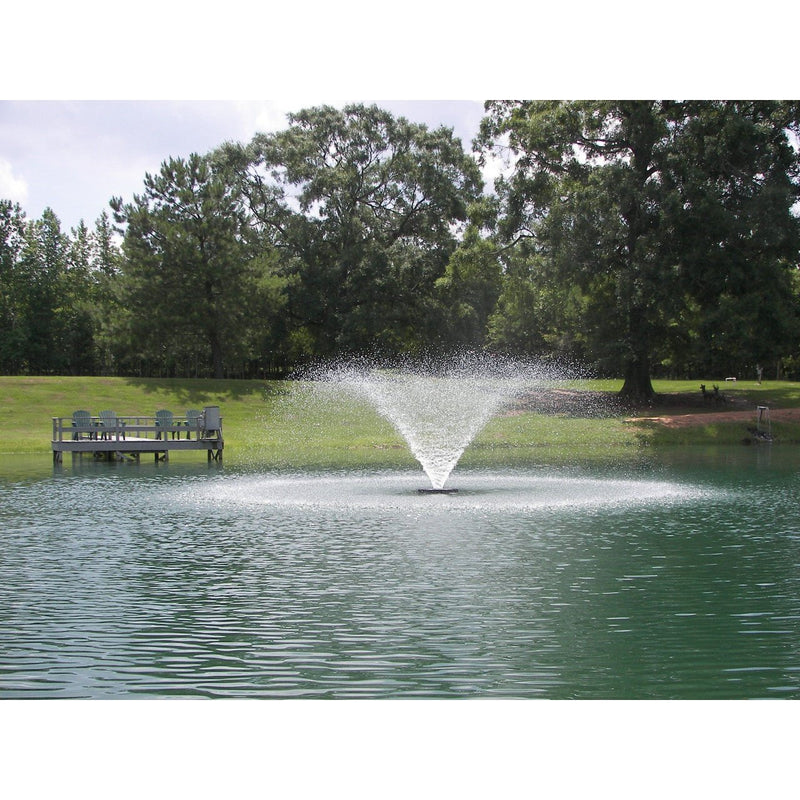
Surface aerators work by splashing water into the air, creating droplets that absorb oxygen before falling back into the pond. These are highly effective for shallow ponds or emergency situations. Paddlewheel aerators are specifically designed to create horizontal water movement, which is excellent for large, rectangular aquaculture ponds. However, their SAE typically ranges from 1.5 to 2.5 kg O2/kWh, making them less efficient than fine-bubble diffusers in deeper water columns.
The Anoxic Kill Zone vs The Saturated Life Zone
In unmanaged ponds, a vertical divide often forms. The "Saturated Life Zone" is the upper layer where light penetrates and photosynthesis occurs. This layer is generally safe for fish but is subject to the diurnal fluctuations mentioned earlier.
The "Anoxic Kill Zone" exists at the bottom. In stratified ponds, this layer is completely devoid of oxygen (0 mg/L). Organic matter, such as fallen leaves, fish waste, and dead algae, settles here and undergoes anaerobic decomposition. This process produces methane, ammonia, and hydrogen sulfide—gases that are highly toxic to aquatic life.
The primary goal of a bottom-diffused aeration system is to eliminate the Anoxic Kill Zone by forcing vertical mixing. By breaking the thermocline (the barrier between the warm and cold layers), the system ensures that the entire water column remains aerobic. This not only protects the fish from sudden turnover events but also allows aerobic bacteria to process waste at the bottom, reducing sludge buildup and nutrient loading.
Sizing an Aeration System: PSI and CFM Calculations
Designing a system requires precise calculations to ensure the compressor can overcome "backpressure" and deliver sufficient air volume.
Calculating Pressure (PSI)
The compressor must produce enough pressure to push air through the tubing and out of the diffuser at depth. The baseline calculation is 0.433 PSI for every foot of water depth.
Total System Pressure = (Depth in feet × 0.433) + Friction Loss + Diffuser Resistance
For a 10-foot deep pond, the water pressure alone is 4.33 PSI. Adding 0.5 PSI for diffuser resistance and approximately 1 PSI for friction loss in the air lines results in a requirement for a compressor rated at 5.8 to 6.0 PSI at the desired airflow.
Calculating Airflow (CFM)
Airflow is measured in Cubic Feet per Minute (CFM). For standard pond management, a turnover rate of 1 to 2 times per 24-hour period is recommended. A common technical benchmark for koi ponds or heavily stocked systems is 1 CFM of air per 1,000 to 2,000 gallons of water. For larger lakes, the metric shifts to 1 to 2 CFM per surface acre, depending on the depth and biological load.
| Pond Type | Recommended Airflow (CFM) | Preferred Compressor Type |
|---|---|---|
| Shallow Koi Pond (< 6ft) | 1 CFM per 1,000 gal | Linear Diaphragm |
| Moderate Pond (6-12ft) | 2-4 CFM per acre | Rocking Piston |
| Deep Lake (> 12ft) | 4-6 CFM per acre | Rotary Vane / Rocking Piston |
Benefits of Managed Aeration Systems
The implementation of a mechanically optimized aeration system provides measurable improvements in pond health beyond mere fish survival.
First, it enhances the efficiency of the nitrogen cycle. Nitrifying bacteria (Nitrosomonas and Nitrobacter) are obligate aerobes, meaning they require oxygen to convert toxic ammonia into nitrite and then into relatively harmless nitrate. In a well-oxygenated environment, ammonia levels are typically 60-80% lower than in stagnant systems.
Second, aeration accelerates the decomposition of organic solids. Aerobic decomposition is approximately 20 times faster than anaerobic decomposition. By maintaining DO levels at the sediment-water interface, you reduce the accumulation of "muck" or pond sludge, which effectively extends the lifespan of the pond and reduces the need for mechanical dredging.
Third, it stabilizes the pH level. By facilitating the venting of carbon dioxide (CO2), aeration prevents the buildup of carbonic acid, which can cause dangerous pH swings. A stable pH environment reduces physiological stress on the fish, improving their immune response and growth rates.
Challenges and Common Mechanical Pitfalls
Even the best hardware can fail if the installation or maintenance is ignored. One of the most frequent errors is using undersized tubing. If the airflow (CFM) is high but the tubing diameter is too small, friction loss increases exponentially. This forces the compressor to work at higher pressures, leading to premature diaphragm failure or overheated motor windings. Always use weighted, large-bore tubing (typically 3/8" or 1/2" ID) for long runs.
Diffuser fouling is another common challenge. In ponds with high mineral content or heavy algae growth, the pores of the diffuser can become clogged with calcium carbonate or biofilm. This increases backpressure and reduces the "SOTE" (Standard Oxygen Transfer Efficiency). Regular inspection and cleaning of diffusers—often with a mild acid solution—are necessary to maintain system performance.
Finally, the mistake of "seasonal shutdown" can be fatal. Many operators turn off aeration in the winter. While this is acceptable in some climates, in regions with ice cover, an aeration system is vital for keeping a hole open in the ice. This allows for the "off-gassing" of methane and CO2. Without this vent, fish can die from gas toxicity even if oxygen levels remain moderate.
Limitations of Aeration
Aeration is not a panacea for poor pond design or extreme overstocking. One major limitation is "super-saturation" risk. While rare in standard diffused systems, high-pressure water injection or certain types of venturi aerators can force so much gas into the water that it exceeds 100% saturation. This can lead to Gas Bubble Disease in fish, where nitrogen or oxygen bubbles form in the bloodstream or tissues.
Furthermore, aeration cannot compensate for extreme chemical oxygen demand (COD). If a pond has received a massive influx of organic pollutants—such as manure runoff or a massive herbicide-induced plant kill—the rate of oxygen consumption may simply exceed the mechanical capacity of any standard system. In these cases, water exchange or chemical oxidation may be required in conjunction with aeration.
Practical Tips for Best Performance
To maximize the life of your equipment and the health of your pond, follow these technical best practices:
- Place diffusers in the deepest part of the pond: This maximizes the contact time of the bubbles and ensures full vertical turnover.
- Use a manifold for multiple diffusers: This allows you to balance the airflow. If one diffuser is shallower than the others, it will take all the air due to lower resistance unless you use valves to restrict its flow.
- Install the compressor in a ventilated enclosure: Heat is the number one killer of aeration pumps. Ensure there is adequate airflow to keep the motor cool.
- Monitor Dissolved Oxygen: Use a digital DO meter to check levels at 5:00 AM. This is when oxygen is at its lowest point. If you are consistently above 5 mg/L at dawn, your system is properly sized.
Advanced Considerations: Variable Frequency Drives (VFD)
For large-scale or commercial operations, integrating a Variable Frequency Drive (VFD) with a DO sensor can lead to significant energy savings. Instead of running the compressor at 100% capacity 24/7, a VFD adjusts the motor speed based on real-time oxygen levels. During the day, when photosynthesis is providing natural oxygen, the system can ramp down. At night, as levels drop, the system ramps up to maintain a specific set point (e.g., 6.0 mg/L). This precision management reduces mechanical wear and can cut electricity costs by up to 40%.
Case Scenario: Summer Algae Bloom
Consider a 1-acre pond with an average depth of 6 feet. In mid-July, the pond develops a heavy "pea soup" algae bloom. During the day, the DO meter reads 12 mg/L (supersaturated). Without aeration, by 4:00 AM, the respiration of the algae and fish could pull the DO down to 1.5 mg/L.
By installing a 1/2 HP rocking piston compressor with two fine-bubble diffusers, the operator introduces approximately 4.5 CFM of air. This system provides a total water turnover roughly 1.5 times per day. The continuous vertical mixing ensures that the oxygen produced during the day is distributed more evenly and that the BOD is handled more efficiently. With the system running, the 4:00 AM DO reading stays at a stable 5.5 mg/L, well above the danger zone for the fish.
Final Thoughts
Maintaining high dissolved oxygen levels is the single most effective way to prevent catastrophic fish loss and manage the long-term health of a pond. By understanding the physics of solubility and the efficiency of different mechanical systems, you can build a resilient environment that thrives even in the harshest conditions.
Focus on the data: calculate your required PSI, choose diffusers based on their SAE ratings, and monitor your morning DO levels. A well-engineered aeration system is not just an accessory; it is the fundamental mechanical component that separates a stagnant, at-risk pond from a vibrant, aerobic ecosystem.
Applying these technical principles ensures that your pond remains in the Saturated Life Zone, providing a stable habitat for your fish and a clear, functional water body for years to come. For those looking to optimize further, exploring automated monitoring and high-efficiency diffused air systems is the next logical step in advanced pond management.