

The Hidden Danger Of Pond Turnover And Fish Kills
The hidden layer at the bottom of your pond could be a ticking time bomb. Stagnant water layers are a nuisance that can turn deadly in a single storm. Pond turnover causes massive fish kills, but it is 100% preventable with the right circulation.
In technical terms, a pond is not a single body of water but a collection of distinct fluid layers with varying densities. When these layers remain isolated, the bottom environment becomes anoxic, accumulating lethal concentrations of hydrogen sulfide and methane. Understanding the fluid dynamics of pond stratification is the first step in transition from managing a liability to maintaining an oxygenated asset. This guide provides the mechanical and biological data required to optimize pond aeration and eliminate the risk of catastrophic turnover.
The Hidden Danger Of Pond Turnover And Fish Kills
Pond turnover is the rapid mixing of thermally stratified water layers. In most deep ponds, water separates into three distinct zones: the epilimnion (warm, oxygen-rich top layer), the metalimnion (the transition zone or thermocline), and the hypolimnion (cold, oxygen-depleted bottom layer).
During the summer, the sun heats the surface water, reducing its density. This lighter water floats on the colder, denser water below. Because these layers do not mix, the hypolimnion is cut off from atmospheric oxygen. Bacteria at the bottom continue to consume oxygen as they decompose organic matter—leaves, fish waste, and dead algae—leading to a state of total anoxia.
The danger occurs when a sudden weather event, such as a cold rainstorm or high winds, rapidly cools the surface layer. As the surface water cools, its density increases until it becomes heavier than the water below. It then sinks, forcing the anoxic, toxic bottom water to the surface. This instantaneous mixing, or "turnover," can drop the total dissolved oxygen (DO) of the entire pond to levels below 2 parts per million (ppm), which is insufficient for fish survival.
The Fluid Dynamics of Thermal Stratification
To mitigate turnover, one must understand the relationship between temperature and water density. Water reaches its maximum density at 39.2°F (4°C). As it warms above this point, it expands and becomes lighter.
In a stratified pond, the density gradient acts as a physical barrier. The energy required to mix these layers is known as "relative thermal resistance." In deep systems (typically 8 feet or more), wind energy alone is rarely sufficient to overcome this resistance. Consequently, the hypolimnion remains stagnant for months.
Biological Oxygen Demand (BOD) in the hypolimnion further complicates the situation. Without a constant supply of dissolved oxygen, anaerobic bacteria take over the decomposition process. This produces hydrogen sulfide (H2S), a gas that is highly toxic to fish even at low concentrations. When turnover occurs, fish are hit with a "double-tap": a sudden loss of oxygen and a spike in chemical toxicity.
Mechanical Aeration Systems and Oxygen Transfer Efficiency
Preventing turnover requires mechanical intervention to disrupt the density gradient. There are two primary categories of technology used for this purpose: bottom-diffused aeration and surface aeration.
Bottom-Diffused Aeration
Bottom-diffused systems utilize a shore-based compressor to pump air through weighted tubing to diffusers located at the pond's deepest point. These systems do not rely on the air bubbles themselves to provide oxygen; instead, they use the "airlift" principle. As bubbles rise, they entrain (pull) large volumes of cold, dense water from the bottom to the surface.
Technical metrics for these systems include:
- Standard Oxygen Transfer Efficiency (SOTE): Fine-bubble diffusers typically achieve 25–35% SOTE, or approximately 6.9% per meter of depth.
- Laminar Flow: By creating a vertical current, the system ensures the entire water column remains at a uniform temperature, effectively eliminating the thermocline.
Surface Aeration
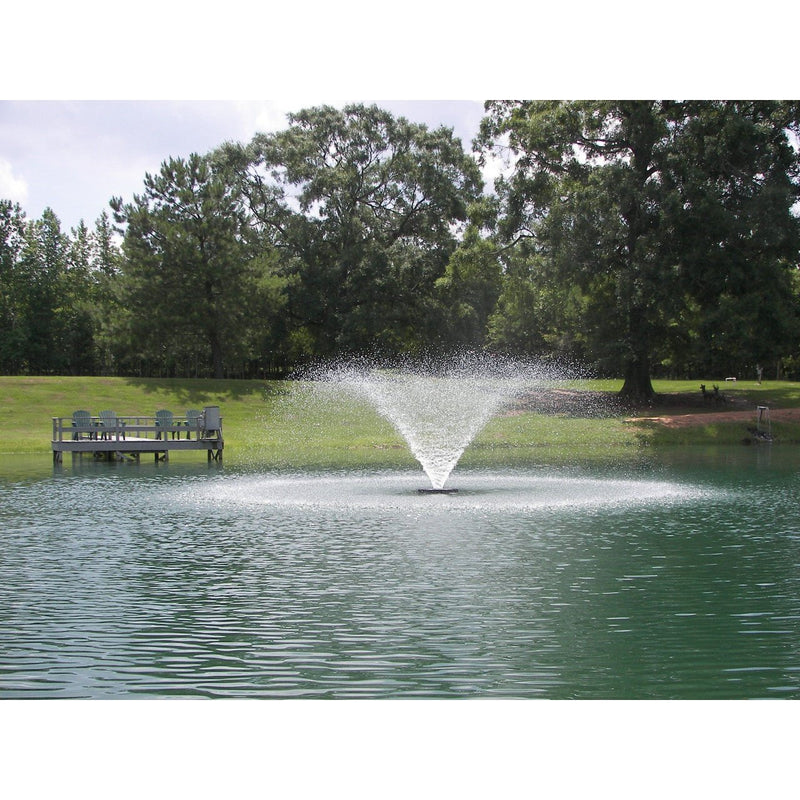
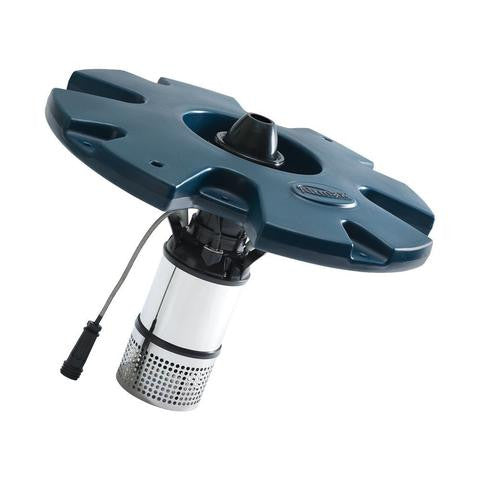
Surface aerators, such as paddlewheels or vertical pump aerators, work by splashing water into the air. This increases the surface area for gas exchange. While highly effective at adding oxygen to the top 2–4 feet of water, they are less efficient at destratifying deep ponds.
- Efficiency: Surface aerators typically have a SOTE of 8–15%.
- Application: These are ideal for shallow ponds (under 8 feet) or for emergency oxygenation during an active fish kill.
Benefits of Continuous Circulation
The primary benefit of a properly engineered circulation system is the elimination of the "dead zone." By maintaining aerobic conditions at the pond floor, you change the fundamental chemistry of the ecosystem.
Improved Nutrient Cycling: In an aerobic environment, beneficial bacteria can efficiently break down organic muck. This reduces the levels of phosphorus and nitrogen that would otherwise fuel harmful algal blooms.
Increased Habitat Volume: Stratification restricts fish to the upper layer. Destratification allows fish to utilize the entire volume of the pond, including the cooler bottom waters during the peak of summer heat, provided those waters are oxygenated.
Oxidation of Toxic Gases: Continuous mixing allows hydrogen sulfide and methane to vent into the atmosphere safely rather than accumulating to lethal levels.
Common Mistakes in Pond Aeration
The most frequent error in pond management is intermittent operation. Many owners run aerators only during the day to save on electricity. However, photosynthesis provides oxygen during the day; it is at night, when plants and algae consume oxygen (respiration), that the system is most vulnerable.
Another critical mistake is the "Fast Start" of a new system in mid-summer. If a pond is already heavily stratified, turning on a powerful bottom diffuser can trigger an artificial turnover. This forces a massive plume of anoxic, toxic water into the upper layers, killing fish within hours.
Limitations and Environmental Constraints
Mechanical aeration is not a universal fix. In extremely large or irregularly shaped water bodies, "dead spots" may still exist where circulation is insufficient.
Pond Geometry: Deep, narrow ponds are easier to destratify than large, shallow, wind-swept lakes where the energy required to move the entire water mass is significantly higher.
Power Availability: Bottom-diffused systems are limited by the length of the airline and the capacity of the compressor. Remote ponds may require solar or wind-powered alternatives, which offer lower reliability during consecutive cloudy or calm days.
Thermal Trade-offs: In some cases, total destratification can raise the bottom temperature of the pond too high for certain cold-water species like trout. In these specific scenarios, specialized hypolimnetic aerators are required to add oxygen without mixing the layers.
Technology Comparison: Diffused vs. Surface
Choosing the correct system depends on pond depth and the specific management goal.
| Feature | Bottom-Diffused Aeration | Surface Aerator |
|---|---|---|
| Ideal Depth | 8 - 30+ feet | < 8 feet |
| Energy Efficiency | High (low HP required) | Moderate to Low |
| Destratification Ability | Excellent | Poor |
| Oxygen Transfer Rate | High (depth dependent) | High (immediate) |
| Maintenance | Low (compressor only) | Moderate (motor in water) |
Practical Tips for System Optimization
To maximize the efficiency of your circulation system, follow these technical best practices:
- Diffuser Placement: Place diffusers at the deepest point of the pond, but avoid placing them directly in deep muck. Use a riser or a base to keep the diffuser 12 inches above the sediment to prevent clogging and to ensure the bubbles move clean water.
- Sizing for Turnover: Ensure the system is rated to move the entire volume of the pond at least once every 24 hours. This is known as the "turnover rate" of the aeration system.
- Airline Management: Use weighted tubing for the underwater runs. Non-weighted tubing will float, creating a hazard for boats and swimmers and increasing the risk of UV degradation.
- Pressure Monitoring: Install a pressure gauge on the compressor. A sudden increase in PSI indicates a clogged diffuser; a decrease indicates a leak in the airline.
Advanced Considerations: BOD and COD
Serious practitioners must account for Biological Oxygen Demand (BOD) and Chemical Oxygen Demand (COD). If your pond has a high organic load (muck), the oxygen demand will be significantly higher than a "clean" pond of the same size.
In eutrophic ponds (nutrient-rich), you may need to increase the CFM (cubic feet per minute) of your air delivery to compensate for the rapid depletion of oxygen by bacteria. Calculating the specific oxygen requirements based on the estimated biomass and organic load can prevent under-sizing the system.
Implementation Scenario: The 1-Acre Deep Pond
Consider a 1-acre pond with a maximum depth of 15 feet. During a typical July, the thermocline might establish at 6 feet.
The Risk: 60% of the pond's volume is below the thermocline and is likely anoxic. If a storm cools the top 6 feet, the resulting turnover will dilute the remaining 40% of oxygenated water with 60% anoxic water. The resulting DO level will almost certainly fall below the lethal 2 ppm threshold.
The Solution: Installing a 1/4 HP compressor with two diffuser plates at the 15-foot mark. This system will move approximately 2,000 gallons per minute (GPM). Within 24–48 hours of continuous operation, the temperature and oxygen levels will equalize throughout the water column, removing the risk of turnover entirely.
Final Thoughts
Pond turnover is a predictable physical event driven by temperature-induced density changes. While it is a natural process in many ecosystems, in managed ponds, it represents a catastrophic failure of water quality management. By implementing a mechanical circulation strategy, you effectively "harden" your pond against the environmental stressors of summer storms and autumn cold fronts.
Success in preventing fish kills requires a shift from reactive to proactive management. Focus on the data: monitor dissolved oxygen levels, track temperature gradients, and ensure your aeration hardware is sized for the specific volume and depth of your water body.
Investing in a high-efficiency bottom-diffused system is the most cost-effective insurance against the loss of a valuable fish population. Maintain your system, run it continuously during the warm months, and use the slow-start method when necessary. With these protocols in place, the hidden layer at the bottom of your pond will no longer be a threat, but a stabilized part of a healthy, oxygenated asset.