How Long Does Pond Aeration Take To Improve Water Quality?
From murky mess to crystal clear: The timeline of a pond's recovery. Nature doesn't work overnight, but the transformation from a fragile, dying pond to a resilient ecosystem is predictable. Here's the week-by-week timeline of what to expect after turning on your air.
The introduction of mechanical aeration into a stagnant aquatic environment initiates a series of complex physical, chemical, and biological shifts. Understanding these stages allows for the management of expectations and the technical optimization of the system to reach a state of ecological equilibrium.
How Long Does Pond Aeration Take To Improve Water Quality?
Pond aeration typically requires between 30 and 90 days to show significant, measurable improvements in water clarity and nutrient reduction. While oxygen saturation at the surface occurs almost immediately, the remediation of the entire water column and the sediment-water interface is a much slower process.
The timeline is dictated by the initial state of the pond, specifically its level of eutrophication, depth, and organic load. In a highly degraded system, the transition from a fragile, anaerobic environment to a resilient, aerobic ecosystem involves several distinct mechanical and biological milestones.
Initial physical changes, such as the elimination of thermal stratification, occur within the first week of operation. However, the biological reduction of organic "muck" and the chemical sequestration of phosphorus are measured in months and years, rather than days.
The Seven-Day Start-Up: Avoiding System Shock
The most critical phase of pond recovery is the first week. Turning on a high-powered diffused aeration system in a stagnant pond can cause a rapid "turnover," where oxygen-depleted bottom water is suddenly mixed with the surface. This can lead to a localized fish kill due to the sudden release of hydrogen sulfide ($H_{2}S$) and methane ($CH_{4}$).
To mitigate this risk, a technical start-up procedure must be followed:
- Day 1: Run the system for exactly 30 minutes. This begins the initial break in the thermocline without overwhelming the surface oxygen levels.
- Day 2: Double the runtime to 1 hour. Monitor for rising odors, which indicate the release of trapped gases.
- Day 3: Run for 2 hours. The mixing zone begins to expand toward the pond perimeter.
- Day 4: Run for 4 hours. Dissolved oxygen levels in the mid-depths should begin to stabilize.
- Day 5: Run for 8 hours. The system is now moving a significant percentage of the total water volume daily.
- Day 6: Run for 12 hours. Thermal destratification is likely 70-80% complete.
- Day 7: Transition to 24/7 operation. Continuous aeration is required to maintain the aerobic state of the sediment-water interface.
Weeks 2–4: Chemical Stabilization and Odor Elimination
Once the system is running continuously, the water column undergoes a "chemical cleansing." The most immediate observable benefit is the elimination of foul odors. In an anaerobic pond, bacteria utilize sulfur rather than oxygen, producing hydrogen sulfide gas (the "rotten egg" smell). Once dissolved oxygen (DO) levels rise above 2.0 mg/L at the pond bottom, these anaerobic processes are suppressed.
During this period, an oxidation reaction occurs between dissolved oxygen and phosphorus. In a low-oxygen environment, phosphorus remains "unlocked" from the sediment and dissolves into the water, fueling algae blooms. When oxygen is introduced, phosphorus binds with naturally occurring iron and calcium. This creates a heavy precipitate that sinks to the bottom, effectively "starving" the algae of its primary food source.
Water clarity may fluctuate during these weeks. The mechanical mixing may initially suspend fine silt, leading to temporary cloudiness. This is a normal part of the transition as the pond's "resilient ecosystem" begins to take over.
Months 1–3: The Biological Shift and Muck Reduction
The long-term success of pond recovery depends on the transition from anaerobic to aerobic microbial activity. Aerobic bacteria are significantly more efficient than their anaerobic counterparts, decomposing organic matter 20 to 30 times faster.
By the 90-day mark, several technical milestones are typically achieved:
- Nutrient Reduction: Studies have shown that nitrogen and phosphorus levels can plummet by up to 90% within 90 days of optimized aeration.
- Muck Decomposition: The "sludge judge" or muck-measuring tools will begin to show a reduction in the depth of organic sediment. In high-efficiency systems, a reduction of 1/4 inch of muck per 90 days is common.
- Algae Suppression: As nutrient levels drop, the dominant algae species often shift. Harmful blue-green algae (cyanobacteria), which thrive in stagnant, high-phosphorus water, are replaced by less-noxious green algae.
- BOD Reduction: Biochemical Oxygen Demand (BOD) decreases as the organic load is processed, meaning the pond requires less energy to maintain high DO levels.
Technical Comparison: Diffused vs. Surface Aeration
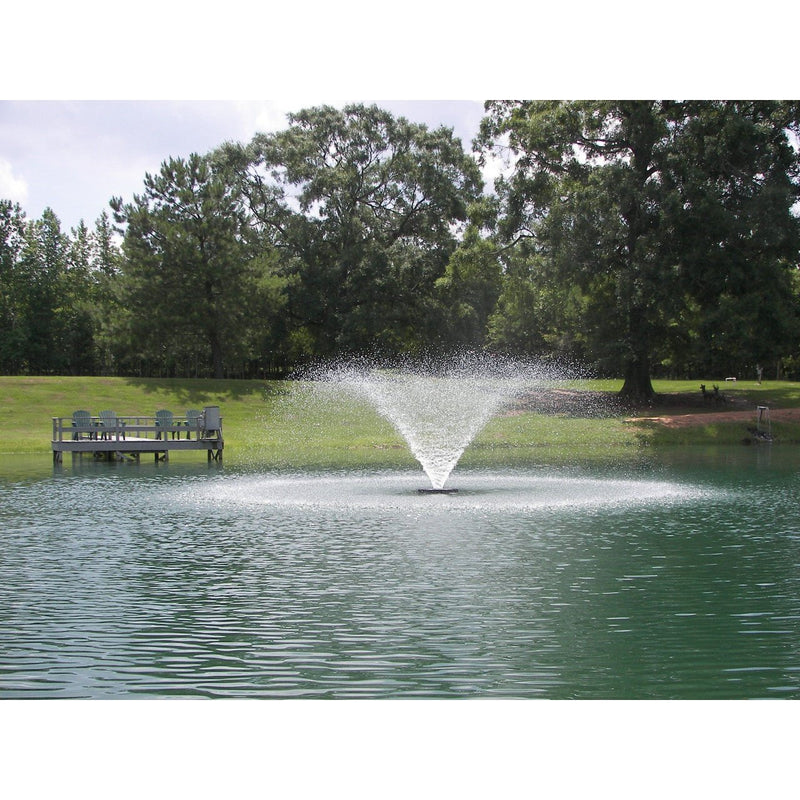
The speed of recovery is heavily influenced by the type of aeration used. While surface fountains are popular for aesthetics, they are significantly less efficient at deep-water remediation.
| Metric | Diffused Aeration (Bottom-Up) | Surface Fountains (Top-Down) |
|---|---|---|
| Oxygen Transfer Efficiency (OTE) | 1.6% per foot of depth | 1.6% – 3.2% total |
| SAE (kg O2 / hr kW) | 3.5 – 4.0 | 1.5 – 2.0 |
| Destratification Depth | Unlimited (Full water column) | Upper 2–4 feet only |
| Muck Reduction Speed | High (Oxygenates the sediment) | Low (Bottom stays anaerobic) |
For a pond to move from a fragile state to a resilient one, the system must address the "hypolimnion" (the cold, bottom layer). Diffused aeration achieves this by using the "Air Lift" effect: as bubbles rise from the bottom, they pull thousands of gallons of oxygen-depleted water to the surface for gas exchange.
Challenges: Why Some Ponds Recover Slower
Several factors can impede the recovery timeline. Understanding these limitations is vital for professional pond management.
External Nutrient Loading: If a pond is adjacent to a heavily fertilized lawn or a farm field, the constant influx of new nitrogen and phosphorus may exceed the system's ability to process it. In these cases, aeration must be paired with buffer strips or nutrient binders.
Excessive Depth: In ponds deeper than 20 feet, the pressure required to push air can reduce the compressor's lifespan and efficiency. Specialized deep-water diffusers are required to maintain the recovery timeline in these environments.
High Water Temperature: Oxygen solubility is inversely proportional to temperature. At 26°C (79°F), water can hold significantly less oxygen than at 10°C (50°F). During peak summer months, a system that was sufficient in the spring may struggle to meet the increased Biological Oxygen Demand (BOD).
Practical Tips for Optimizing Recovery
To accelerate the transition to a clear, healthy pond, focus on these mechanical and biological best practices:
- Sizing the System: Ensure the compressor can provide at least 1-2 "turns" of the entire pond volume every 24 hours. Undersized systems will fail to eliminate the dead zones where nutrients are recycled.
- Diffuser Placement: Position diffusers in the deepest areas of the pond. This maximizes the contact time between bubbles and the water column, increasing the Oxygen Transfer Efficiency (OTE).
- Maintenance Intervals: Clean or replace air filters every 3 to 6 months. A clogged filter increases the internal temperature of the compressor, leading to premature piston failure and a drop in oxygen output.
- Bioaugmentation: Supplementing the pond with aerobic bacteria "pellets" can speed up muck reduction. These bacteria thrive in the oxygen-rich environment provided by the aerator and focus specifically on breaking down cellulose and organic sludge.
Example Scenario: The 1-Acre Eutrophic Pond
Consider a 1-acre pond with an average depth of 8 feet and 24 inches of organic muck accumulation. Before aeration, the pond suffers from annual fish kills and visibility of less than 12 inches.
Months 1-2: After a 7-day gradual start-up, a 1/2 HP diffused aeration system is set to run 24/7. Odors vanish within the first 14 days. By day 60, water visibility increases to 3 feet as the phosphorus precipitates and the algae die off.
Year 1: The pond bottom, once a "black, smelling mess," begins to firm up. Fish activity increases as they can now utilize the entire 8-foot depth rather than being restricted to the top 2 feet.
Year 5: Following the data from long-term studies, the muck layer may be reduced by as much as 10-15 inches without dredging. The pond has shifted from a fragile system prone to collapse to a resilient ecosystem capable of handling seasonal changes.
Advanced Considerations: The Role of pH and Alkalinity
Aeration does more than just add oxygen; it stabilizes the pond's chemistry. Stagnant water often has high levels of dissolved carbon dioxide ($CO_{2}$), which lowers the pH and makes the environment acidic.
Through the process of gas exchange at the surface, aeration strips $CO_{2}$ from the water. This typically causes the pH to rise and stabilize between 7.5 and 8.5. This slightly alkaline environment is ideal for the nitrifying bacteria (such as Nitrosomonas and Nitrobacter) responsible for converting toxic ammonia into harmless nitrates.
Without this stabilization, the pond remains in a "fragile" state where small changes in weather or temperature can cause massive ammonia spikes, endangering the fishery.
Final Thoughts
The timeline of a pond's recovery is a biological certainty if the mechanical inputs are correctly managed. By moving from the "murky mess" of an anaerobic, nutrient-rich environment to a well-oxygenated, aerobic state, you are building a system that can defend itself against algae and muck.
Consistency is the most important factor in this transformation. Turning off an aeration system for even a few days can allow the bottom to return to an anoxic state, undoing weeks of microbial progress. Maintain your filters, monitor your pressure gauges, and allow the natural aerobic cycle the time it needs to work.
If you are just beginning this journey, remember that the most dramatic changes happen beneath the surface long before you see them at the top. The reduction in nitrogen, the sequestration of phosphorus, and the awakening of beneficial bacteria are the invisible engines of a truly resilient pond.