

The Best Pond Aeration Strategy For Deep Lakes
Deep water requires deep thinking. Surface bubbles won't save your lake. When your water is 20+ feet deep, standard aeration fails. You need a professional strategy to break the thermocline and keep the entire water body alive from the bottom up.
Water bodies exceeding 20 feet in depth present unique mechanical and thermodynamic challenges. At these depths, the weight of the water column creates significant head pressure, and the natural thermal stratification becomes a rigid barrier to oxygen transport. Relying on surface-level equipment is mathematically insufficient for maintaining dissolved oxygen levels in the hypolimnion. A strategic shift from surface agitation to subsurface diffusion is mandatory for any deep-water management plan.
This guide provides the technical framework for deploying professional deep-water diffusion systems. It focuses on the mechanical optimization of compressors, the physics of gas transfer at depth, and the chemical benefits of maintaining aerobic conditions at the sediment-water interface.
The Best Pond Aeration Strategy For Deep Lakes
The primary objective in deep lake management is the elimination of thermal stratification through bottom-up aeration. In lakes deeper than 12–15 feet, water naturally separates into three distinct layers based on density and temperature: the epilimnion (warm surface layer), the metalimnion or thermocline (the transition zone), and the hypolimnion (cold, oxygen-depleted bottom layer).
Subsurface diffused aeration is the most effective strategy for these environments. Unlike surface aerators that move water into the air, diffused systems pump compressed air through weighted lines to diffusers located at the lake’s deepest points. These diffusers release millions of fine bubbles, typically 1–3 mm in diameter.
As these bubbles rise, they engage a process known as synergistic lift. Because water is a viscous fluid, the rising bubble column pulls cold, dense, deoxygenated water from the bottom toward the surface. This mechanical movement forces the entire water column to circulate, effectively "breaking" the thermocline and equalizing the temperature and oxygen levels throughout the lake. This strategy is not merely about adding oxygen; it is about managing the entire energy profile of the water body.
How the Mechanics of Deep Diffusion Work
A professional deep-water system consists of three critical mechanical components: the compressor, the delivery tubing, and the diffuser membranes. Each must be optimized for the specific pressure requirements of the lake's depth.
The compressor is the heart of the system. For depths exceeding 15 feet, rocking piston compressors are the industrial standard. These units are designed to handle high-pressure environments, capable of operating continuously at 30 PSI or higher. Unlike linear diaphragm pumps, which lose efficiency rapidly as backpressure increases, rocking piston units maintain a consistent Cubic Feet per Minute (CFM) output even when fighting 20+ feet of water head pressure.
The air travels through self-weighted, lead-free tubing. This tubing must have a high burst pressure rating and be flexible enough to follow the contours of the lake bed without kinking. In deep applications, the weight of the tubing is essential to prevent "looping" or floating caused by the buoyancy of the air inside.
At the terminus, the air enters the diffuser station. Professional systems utilize EPDM or PTFE-coated membranes. These membranes feature thousands of microscopic slits that open under pressure to release fine bubbles. Fine bubbles are technically superior to coarse bubbles because they have a higher surface-area-to-volume ratio, which maximizes the Oxygen Transfer Efficiency (OTE). Furthermore, fine bubbles rise more slowly, providing more contact time with the water column for gas exchange.
Benefits of Deep Water Aeration
The implementation of a bottom-diffusion system provides measurable improvements in water chemistry and biological health. These benefits are driven by the restoration of aerobic conditions in the hypolimnion.
One of the most significant advantages is the reduction of internal nutrient loading. In anoxic (oxygen-depleted) conditions, the chemical bond between iron and phosphorus in the bottom sediments breaks down. This causes phosphorus to "leak" into the water column, fueling massive algal blooms. Maintaining dissolved oxygen (DO) at the sediment-water interface keeps phosphorus locked in the soil, effectively starving algae of its primary food source.
Additionally, aerobic conditions accelerate the decomposition of organic matter, often referred to as "muck." Aerobic bacteria are approximately 20 times more efficient at breaking down organic debris than anaerobic bacteria. By delivering oxygen to the bottom, the system facilitates the natural "digestion" of leaf litter and fish waste, reducing the need for expensive physical dredging.
Thermal equalization is another key benefit. By mixing the cold bottom water with the warm surface water, the system prevents the sudden "turnover" events that occur in the fall. These events can lead to catastrophic fish kills if a large volume of deoxygenated bottom water suddenly mixes with the rest of the lake.
Challenges and Common Mistakes
System failure in deep-water applications is rarely due to equipment defect; it is usually the result of improper sizing or installation. The most frequent error is underestimating the required PSI (Pounds per Square Inch).
Every 2.31 feet of water depth adds 1 PSI of backpressure. A diffuser at 23 feet depth requires nearly 10 PSI just to overcome the water’s weight, before accounting for friction loss in the tubing. If the compressor is not rated for this continuous load, it will overheat, the seals will fail, and the CFM output will drop to zero.
Another common pitfall is the "Old Water" hazard. If a deep lake has been stratified and anaerobic for years, it contains high concentrations of hydrogen sulfide and methane. Starting a powerful aeration system at full capacity can bring these toxic gases to the surface too quickly, causing an immediate oxygen sag and killing the fishery. Professionals use a "Startup Map," running the system for only 30 minutes the first day and doubling the run time daily over a week to safely vent these gases.
Maintenance neglect also leads to system degradation. Air filters must be changed every 3–6 months. A clogged filter forces the compressor to work harder, increasing internal heat and shortening the lifespan of the piston cups. Similarly, diffusers can become fouled by calcium carbonate or bio-films. Periodic "acid bumping" or mechanical cleaning is necessary to maintain the OTE.
Limitations of Deep Water Aeration
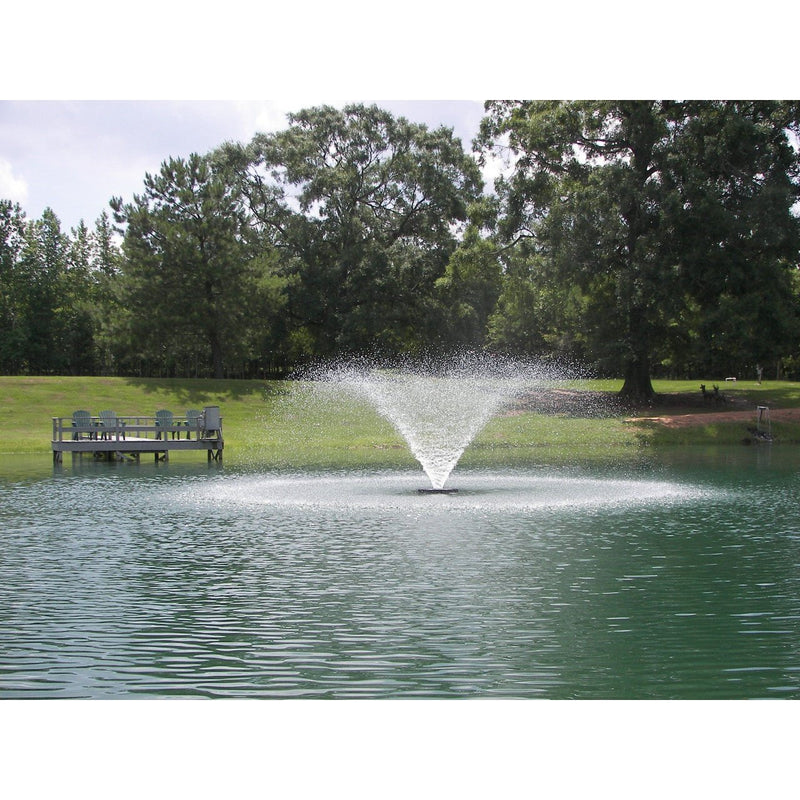
While highly effective, diffused aeration is not a universal solution. In extremely shallow areas (less than 5 feet), the bubble column does not have enough "runway" to create significant synergistic lift. In these zones, surface aerators or horizontal circulators may be more efficient.
Environmental constraints also play a role. In very large reservoirs, the energy density required to destratify the entire volume may be cost-prohibitive. In such cases, managers may opt for "area-specific aeration," focusing on protecting critical fish habitats or intake structures rather than the entire lake.
There are also physical limits to the technology. As depth increases toward 50+ feet, the air becomes more compressed, and the volume of the bubble decreases. This changes the dynamics of the lift. At extreme depths, specialized high-pressure blowers or liquid oxygen injection may be required, shifting the project from a standard management task to a high-level engineering operation.
Comparing Standard Surface Aeration vs. Professional Deep Diffusion
The following table outlines the performance differences between these two technologies in a deep-water context.
| Feature | Standard Surface Aeration | Professional Deep Diffusion |
|---|---|---|
| Primary Mechanism | Atmospheric contact via splashing | Subsurface synergistic lift |
| Effective Depth | 0–8 feet | 8–50+ feet |
| Oxygen Transfer Efficiency (SAE) | 1.5–2.0 kg O2/hr/kW | 3.5–4.0 kg O2/hr/kW |
| Energy Consumption | High (per gallon moved) | Low (highly efficient at depth) |
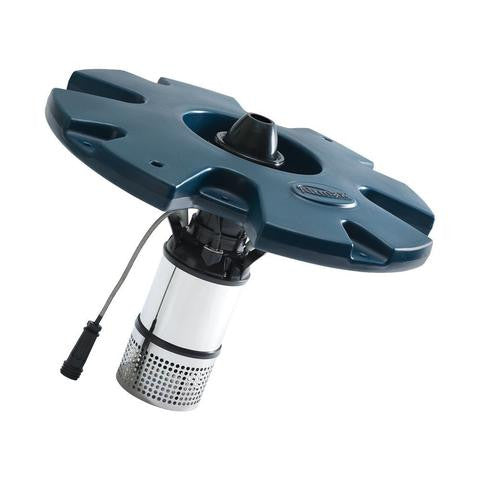
| Maintenance Location | In-water motor | On-shore compressor cabinet |
| Aesthetic Impact | High (Fountains/Splashing) | Low (Subtle bubble boils) |
Practical Tips and Best Practices
Optimization of a deep-water system requires attention to the physics of air delivery. To ensure maximum efficiency, follow these technical best practices:
- Calculate Total Dynamic Head (TDH): Factor in the depth (1 PSI per 2.31 ft) plus the friction loss for every 100 feet of tubing. Use 1/2-inch or 5/8-inch ID (Inner Diameter) tubing for long runs to reduce backpressure.
- Manifold Balancing: If running multiple diffusers of a single compressor, use a valved manifold to equalize the air flow. Air will naturally take the path of least resistance; without balancing, the shallowest diffuser will receive all the air, leaving the deep zones stagnant.
- Compressor Housing: Always house the compressor in a fan-cooled, ventilated cabinet. Heat is the primary enemy of rocking piston compressors. A 20-degree rise in operating temperature can halve the life of the piston seals.
- Placement Strategy: Place diffusers in the deepest sections of the lake, but not directly in the deepest "pit" if it is filled with 5 feet of loose muck. Elevate the diffuser 12 inches off the bottom using a stand or base to prevent it from burying itself and clogging the membranes.
Advanced Considerations for Serious Practitioners
For those managing high-value fisheries or sensitive ecosystems, oxygen transfer is only the baseline. One must also consider the Standard Oxygen Transfer Efficiency (SOTE) as a function of depth. According to Boyle's Law, the volume of a gas is inversely proportional to the pressure. As a bubble rises from 30 feet, the pressure decreases, and the bubble expands. This means the lift capacity increases as the water moves upward, creating a "venturi effect" in the water column.
Serious practitioners should also monitor the Redox Potential (ORP) of the sediment. A positive ORP indicates an oxidizing environment where phosphorus remains bound. Deep-water diffusion should aim to maintain an ORP of +200mV or higher at the sediment interface. If DO levels are high but ORP remains negative, the system may need to be moved or the CFM increased to overcome the sediment's chemical oxygen demand (COD).
Furthermore, consider the "Turning Ratio." In a deep lake, the goal is typically to turn the entire volume of the lake once every 24 to 48 hours. Using the manufacturer's "Lifting Rate" data (expressed in Gallons Per Minute), you can calculate the total volume moved per day and compare it to the lake's total volume. This ensures the system is not just aerating, but truly destratifying.
Scenario: Aerating a 5-Acre, 25-Foot Deep Lake
Consider a 5-acre circular lake with a maximum depth of 25 feet. To manage this effectively, the practitioner must calculate the requirements for a complete turnover.
First, calculate the volume. A 5-acre lake with an average depth of 12 feet contains approximately 60 acre-feet of water, or roughly 19.5 million gallons. To turn this volume once every 24 hours, the system must move 13,500 gallons per minute (GPM).
A professional 1/2 HP rocking piston compressor typically produces about 4.5 CFM. At 25 feet, a single fine-bubble diffuser station can move approximately 3,000 GPM via synergistic lift. Therefore, a 5-acre lake at this depth requires a minimum of four or five diffuser stations strategically placed in a grid pattern to ensure total coverage and meet the turnover target.
The compressor must be rated for at least 15 PSI continuous duty (10.8 PSI for depth + 2-3 PSI for friction and membrane resistance). A dual-piston unit would be the optimal mechanical choice for this scenario, providing the necessary pressure and air volume to maintain a healthy aerobic state.
Final Thoughts
Deep water management is a discipline of mechanical and chemical balance. Surface solutions are insufficient for lakes that thermally stratify, as they leave the most critical part of the water body—the bottom—in a toxic, anaerobic state. By implementing a professional bottom-diffusion strategy, you address the root cause of water quality degradation.
Successful implementation requires a high-pressure rocking piston compressor, fine-bubble membrane technology, and a mathematically sound layout. This approach not only provides oxygen but also manages nutrient cycles and organic sediment, ensuring the long-term viability of the aquatic ecosystem.
Whether you are protecting a trophy fishery or managing a community reservoir, the move to deep-water diffusion is an investment in the physical and chemical stability of your lake. Regular maintenance and technical optimization will keep the system running at peak efficiency for a decade or more.