

The Best Aeration Setup For Shallow Ponds
Shallow ponds die fast in the summer. Here is the survival guide. Shallow ponds heat up like a tea kettle, killing oxygen levels. You can't use deep-water tactics here. You need a high-flow, low-pressure strategy to keep it cool.
The Best Aeration Setup For Shallow Ponds
The most effective aeration strategy for a shallow pond—typically defined as a body of water with a maximum depth of 6 to 8 feet—centers on maximizing surface area contact and water volume displacement. In deeper systems, the primary goal of aeration is to break thermal stratification and move a massive column of water from the hypolimnion to the surface. In a shallow pond, stratification is often less pronounced due to wind mixing, but the thermal mass is so small that solar radiation can spike water temperatures past the point where dissolved oxygen (DO) can remain in solution.
For these environments, a high-flow, low-pressure system is required. This usually involves a linear diaphragm compressor or a high-volume surface aerator. Unlike deep-water systems that require high pounds per square inch (PSI) to overcome hydrostatic pressure, shallow systems benefit from high cubic feet per minute (CFM) at low pressure. The goal is to move as much water as possible across the air-water interface to facilitate gas exchange and evaporative cooling.
Shallow ponds are highly susceptible to "summer kill" events. These occur when high water temperatures combined with low wind speeds and high nutrient loads cause oxygen levels to plummet overnight. While deep ponds have a reservoir of cooler water at the bottom, a shallow pond is often uniform in temperature, meaning the entire water column reaches a lethal threshold simultaneously. A robust aeration setup provides the mechanical buffer necessary to prevent this collapse.
How High-Flow Aeration Works
Aeration operates on the principle of gas exchange at the water’s surface. Oxygen transfer occurs when the partial pressure of oxygen in the atmosphere is higher than the partial pressure of oxygen in the water. In a stagnant pond, a thin layer of saturated water forms at the surface, preventing further oxygen from entering the lower layers. High-flow aeration breaks this surface tension and replaces the saturated surface water with oxygen-depleted water from below.
The mechanical process involves two primary methods: diffused aeration and surface agitation. In a diffused system, a compressor on shore pumps air through weighted tubing to diffusers on the pond floor. These diffusers release millions of fine bubbles. As these bubbles rise, they create an upward current known as an "airlift." In shallow water, the bubbles have less time to transfer oxygen directly, so the primary benefit is the vertical circulation they create.
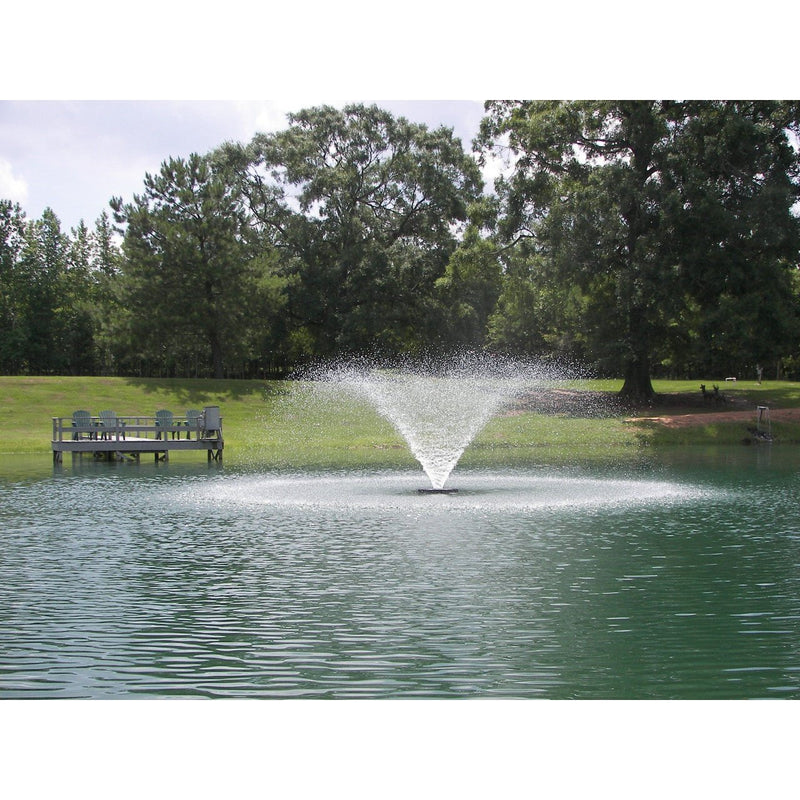
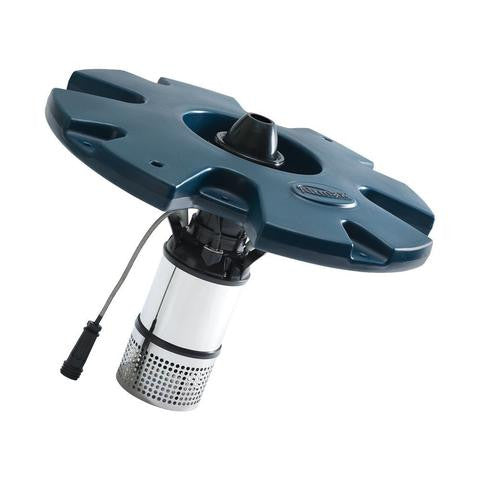
Surface aerators work by drawing water from the upper 3 to 4 feet of the pond and spraying it into the air. This process breaks the water into small droplets, exponentially increasing the surface area exposed to the atmosphere. This is particularly effective in shallow ponds because the entire volume of water is often within the "draw" range of the motor. The splashing action also strips out harmful gases like carbon dioxide and methane that accumulate during the decomposition of organic matter at the sediment layer.
The Role of Hydrostatic Pressure
The physics of aeration are dictated by depth. For every 2.31 feet of water depth, a compressor must overcome 1 PSI of backpressure. In a 5-foot deep pond, the backpressure is minimal (approximately 2.16 PSI). Using a high-pressure rocking piston compressor designed for 30 feet of depth is mechanically inefficient in this scenario. These compressors often run at higher temperatures and higher wattages when operated at low backpressure. Linear diaphragm pumps, however, are engineered to provide maximum CFM at pressures below 5 PSI, making them the most energy-efficient choice for shallow applications.
Benefits of Targeted Shallow Aeration
The primary advantage of a high-flow, low-pressure strategy is the maintenance of stable Dissolved Oxygen (DO) levels. Fish and aerobic bacteria require a minimum of 5 mg/L of DO to remain healthy. When temperatures exceed 80°F, water's ability to hold oxygen drops significantly. Active aeration ensures that even as the temperature rises, the water remains at 100% saturation.
Another critical benefit is the acceleration of the nitrogen cycle. Beneficial aerobic bacteria reside in the pond's sediment and on the surfaces of aquatic plants. These bacteria break down fish waste and decaying plant matter. Without oxygen, these processes shift to anaerobic pathways, which are slower and produce toxic byproducts like hydrogen sulfide (H2S). Proper aeration keeps the sediment-water interface oxygenated, allowing for rapid decomposition and reduced muck accumulation.
Evaporative cooling is a secondary but vital benefit. In a shallow pond, the sun can heat the water to temperatures that exceed the thermal tolerance of species like bass or koi. By constantly moving water to the surface and creating spray or ripples, the system promotes evaporation. This process removes heat from the water, often keeping an aerated pond several degrees cooler than a stagnant one.
Challenges and Common Mistakes
One of the most frequent errors in shallow pond management is the use of "decorative" fountains for aeration. While these units look aesthetically pleasing, the high-pressure nozzles required to create tall, thin spray patterns move very little water. They prioritize "show" over "flow." For survival-level aeration, a "VFX" or "display" aerator with a wide, frothy pattern is necessary. These units move thousands of gallons per minute, whereas a decorative fountain may only move a fraction of that.
Undersizing the compressor is another pitfall. In deep water, a single diffuser can move a massive amount of water because of the long vertical column. In shallow water, the "cone of influence" for each diffuser is much smaller. To achieve total pond turnover, a shallow pond usually requires more diffuser heads than a deep pond of the same surface area. Failing to account for this leads to "dead zones" where water remains stagnant and oxygen-depleted.
Installation depth is also critical. Placing a diffuser too shallow (e.g., 2 feet deep in a 6-foot pond) misses a significant portion of the water column. Conversely, placing it directly on a soft, mucky bottom can stir up sediment, increasing turbidity and releasing trapped nutrients that fuel algae blooms. The use of a diffuser base or a "sled" is necessary to keep the equipment slightly above the muck layer.
Limitations of Shallow Pond Systems
Environmental constraints play a significant role in the effectiveness of aeration. If a pond is exceptionally shallow—less than 3 feet deep across its entire area—diffused aeration becomes nearly impossible. The bubbles do not have enough vertical travel to create a meaningful "airlift" current. In these "ultra-shallow" environments, horizontal circulators or paddlewheel aerators are the only viable mechanical options.
Nutrient loading is another limiting factor. If a pond has a high volume of runoff from fertilized lawns or agricultural fields, the biological oxygen demand (BOD) may exceed the system's capacity to deliver oxygen. Aeration is a management tool, but it cannot overcome poor watershed management. In high-nutrient scenarios, even a perfectly sized aeration system may struggle to keep up with the oxygen consumed by massive algae die-offs during the night.
Finally, there are mechanical limits to energy efficiency. While linear diaphragm pumps are efficient, they have a short stroke length. If the pond depth varies or if you attempt to run long lengths of small-diameter airline, the friction loss and backpressure can cause the diaphragms to rupture prematurely. A shallow-water system must be designed with oversized airlines (typically 1/2" or 3/4" ID) to minimize friction and keep the compressor within its optimal operating curve.
Compressor Comparison: Shallow vs. Deep Tactic
The choice of compressor depends entirely on the operating environment. The following table illustrates why certain technologies are prioritized for shallow water survival.
| Feature | Linear Diaphragm (Shallow) | Rocking Piston (Deep) |
|---|---|---|
| Max Efficiency Depth | 0 - 8 Feet | 10 - 50 Feet |
| Air Flow (CFM) | High (at low PSI) | Moderate (constant at high PSI) |
| Power Draw (Amps) | 0.5 - 2.5 Amps | 3.5 - 6.0 Amps |
| Noise Level | Extremely Quiet (<45 dB) | Audible Hum (>60 dB) |
| Maintenance | Diaphragm replacement (2-3 yrs) | Piston seal rebuild (1-2 yrs) |
Practical Tips for Summer Operation
Run the system 24/7 during the peak of summer. Many pond owners attempt to save money by running aerators only during the day. This is a critical mistake. Photosynthesis from algae and aquatic plants adds oxygen to the water during the day, but at night, these same plants consume oxygen. Dissolved oxygen levels are at their lowest just before dawn. Running the system at night is the most important part of the survival guide.
Optimize diffuser placement by mapping the pond's "bottom contours." Even a "shallow" pond has deeper pockets and shallower flats. Place diffusers in the deepest areas to maximize the airlift effect. If the pond is long and narrow, space multiple smaller diffusers evenly along the centerline rather than placing one large unit in the middle. This ensures that the current created by the aeration covers the entire surface area.
Maintain the air filter on your compressor. High summer temperatures often bring dust and pollen. A clogged air filter forces the compressor to work harder, increasing internal heat and shortening the life of the diaphragms or pistons. Check the filter monthly and replace it if it shows signs of discoloration. This simple maintenance step can prevent a system failure during a heatwave when the pond is most vulnerable.
Advanced Considerations for Water Chemistry
Serious practitioners must understand the relationship between temperature and the Oxygen Saturation Curve. At 68°F (20°C), freshwater at sea level saturates at 9.1 mg/L of DO. At 86°F (30°C), that saturation point drops to 7.5 mg/L. In a shallow pond with high organic loading, the Biological Oxygen Demand (BOD) can easily consume 4-5 mg/L overnight. If the starting point is only 7.5 mg/L, the margin for error is razor-thin.
Consider the "Degassing" efficiency of your system. Aeration is not just about adding O2; it is about removing CO2. High levels of dissolved carbon dioxide can depress the pH of the water and make it more difficult for fish to transport oxygen in their blood. A high-flow system that creates significant surface turbulence is much more effective at CO2 stripping than a system that produces large, slow-rising bubbles.
For ponds with heavy sediment loads, calculate the "Oxygen Uptake Rate" (OUR) of the muck layer. In some cases, the sediment consumes more oxygen than the fish. If the pond has been stagnant for years, do not turn on a high-flow aeration system at full capacity instantly. This can cause "turnover shock," where low-oxygen water and toxic gases from the bottom are mixed into the surface too quickly, triggering a fish kill. Start the system for 1 hour the first day, 2 hours the second, and double the time daily until it runs 24/7.
Scenario: The 1-Acre Shallow Retention Pond
Imagine a 1-acre retention pond with an average depth of 4 feet and a maximum depth of 6 feet. During a typical July heatwave, water temperatures reach 85°F. Without aeration, the pond becomes stagnant, and a thick mat of filamentous algae covers 30% of the surface.
A deep-water aeration kit with a single 1/2 HP rocking piston compressor and one large diffuser would likely fail here. The single diffuser would only circulate about 25% of the pond's volume because the depth is insufficient to create a wide "boil." Instead, the correct application is a 1/4 HP linear diaphragm compressor driving four small, high-efficiency diffusers. By splitting the airflow into four points, the system creates four distinct circulation cells, ensuring that every corner of the 1-acre pond receives oxygenated water. This configuration uses less electricity (approx. 120 watts vs 450 watts) while providing superior oxygen distribution for the shallow environment.
Final Thoughts
Shallow pond survival in the summer is a function of mechanical displacement and gas exchange efficiency. When temperatures rise, the biological demand for oxygen increases exactly as the water's physical capacity to hold that oxygen decreases. This "scissors effect" is the primary cause of pond failure.
By employing a high-flow, low-pressure strategy, you bypass the inefficiencies of deep-water equipment. Linear diaphragm compressors and high-volume surface aerators are the tools of choice for maintaining the thin margin of safety required for a healthy ecosystem. Focus on total water turnover, nighttime operation, and meticulous filter maintenance to ensure your system performs when the "tea kettle" effect is at its peak.
Application of these principles allows for a stable, aerobic environment even in the most challenging summer conditions. Experiment with diffuser placement and monitor water clarity as indicators of successful circulation. A well-aerated shallow pond will not only survive the summer but will thrive with clearer water and a more robust biological foundation.