The Beginner’s Guide To Pond Oxygen Levels
Oxygen isn't just a number—it's the 'breath' of your entire backyard ecosystem. Oxygen is the engine of the pond. Without it, muck builds up, fish struggle, and the water smells. Here is the beginner's roadmap.
Dissolved oxygen represents the concentration of free, non-compound oxygen molecules in the water column. It is the primary limiting factor for biological activity in any closed aquatic system. Maintaining adequate levels is not merely a matter of fish survival; it is a requirement for the mechanical and biological efficiency of the entire pond.
Backyard ponds function as biological reactors where complex chemical transitions occur. Oxygen fuels the aerobic bacteria responsible for breaking down waste. When levels fall, these processes stall, leading to the accumulation of toxic compounds and organic sludge.
Understanding the metrics of oxygenation allows a pond owner to optimize performance. This guide focuses on the technical variables that govern gas exchange. It provides the data necessary to transition from guesswork to precise ecosystem management.
The Beginner’s Guide To Pond Oxygen Levels
Dissolved oxygen (DO) is measured in milligrams per liter (mg/L) or parts per million (ppm). These units are functionally identical in freshwater applications. The amount of oxygen water can hold is determined by physical laws, primarily temperature and atmospheric pressure.
Saturation occurs when the water holds the maximum amount of oxygen possible at a specific temperature and pressure. For example, at sea level and 20°C (68°F), 100% saturation is approximately 9.1 mg/L. As water temperature increases, its physical capacity to hold oxygen decreases.
Oxygen enters the pond through two primary pathways: atmospheric diffusion and photosynthesis. Diffusion happens at the air-water interface, where gas molecules move from areas of high concentration to low concentration. Photosynthesis by aquatic plants and algae adds oxygen during daylight hours but consumes it at night.
Real-world pond management requires balancing the Oxygen Supply with the Biological Oxygen Demand (BOD). BOD is the amount of oxygen required by fish, bacteria, and decomposing organic matter. A healthy pond maintains a surplus of DO, typically above 6.0 mg/L for most ornamental species.
Mechanical Principles of Gas Exchange
The movement of oxygen into water is governed by Henry’s Law. This law states that the amount of dissolved gas is proportional to its partial pressure in the atmosphere. To increase oxygenation, one must increase the surface area where gas and water interact.
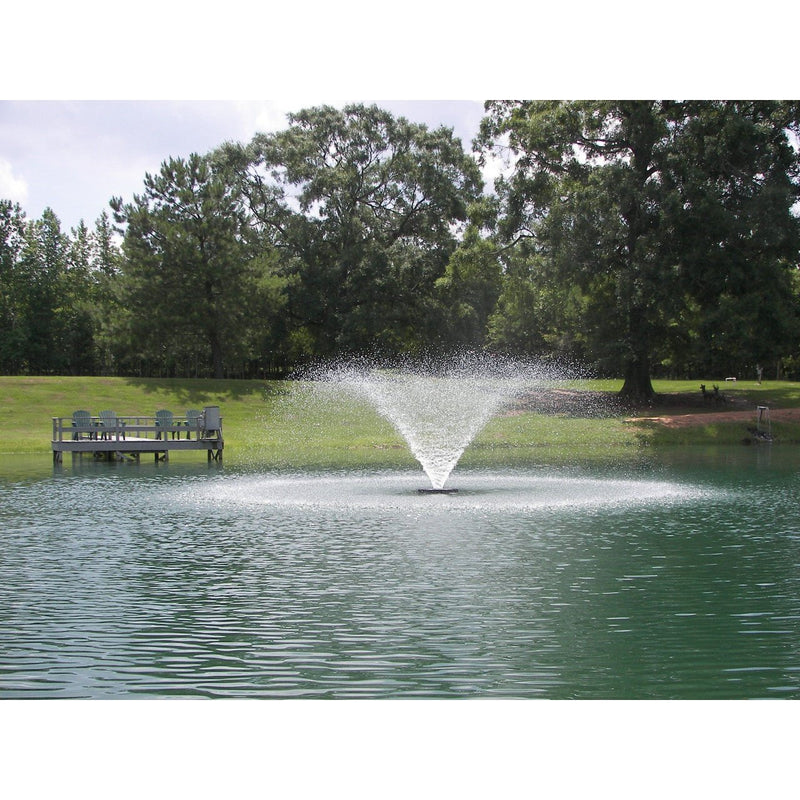
Surface agitation is the most common mechanical method for gas exchange. Breaking the surface tension removes the boundary layer of stagnant water. This allows "fresh" water with lower oxygen concentrations to reach the surface and absorb gas from the atmosphere.
Bubbles from a diffuser system work through two mechanisms. First, oxygen transfers directly from the bubble into the water as it rises. Second, the rising column of air creates a vertical current that brings deoxygenated water from the bottom to the surface for atmospheric exchange.
Bubble residence time is a critical efficiency metric. Smaller bubbles (fine-pore diffusion) have a higher surface-area-to-volume ratio and rise more slowly than large bubbles. This increased contact time results in a higher Standard Oxygen Transfer Efficiency (SOTE).
Temperature and Solubility Metrics
The relationship between temperature and dissolved oxygen is inverse and non-linear. As the kinetic energy of water molecules increases, gas molecules are more likely to escape into the atmosphere. This makes summer the most high-risk period for oxygen depletion.
| Water Temp (°C / °F) | 100% DO Saturation (mg/L) | Minimum Target for Koi (mg/L) |
|---|---|---|
| 4°C / 39°F | 13.1 | 6.0 |
| 10°C / 50°F | 11.3 | 6.0 |
| 20°C / 68°F | 9.1 | 6.0 |
| 25°C / 77°F | 8.2 | 6.0 |
| 30°C / 86°F | 7.5 | 6.0 |
Benefits of High Dissolved Oxygen
Optimized oxygen levels accelerate the nitrogen cycle. Nitrifying bacteria, such as Nitrosomonas and Nitrobacter, are obligate aerobes. They require significant amounts of oxygen to convert toxic ammonia into nitrite and eventually nitrate.
Aerobic decomposition of organic "muck" is significantly more efficient than anaerobic processes. In an oxygen-rich environment, bacteria can break down fish waste and leaf litter without producing hydrogen sulfide or methane. This prevents the "rotten egg" smell often associated with neglected ponds.
Fish health is directly tied to metabolic efficiency. Oxygen is the fuel for digestion and growth. When DO levels are consistently high, fish exhibit better food conversion ratios and stronger immune responses.
High oxygen levels also assist in the oxidation of dissolved metals and minerals. This helps clarify the water by causing fine suspended particles to clump together and settle. It essentially acts as a chemical polisher for the water column.
Challenges and Common Pitfalls
Thermal stratification is a major challenge in deeper ponds. During summer, a warm layer of water sits on top of a cold, dense, and oxygen-poor layer. Without mechanical circulation, the bottom layer becomes anoxic, trapping harmful gases at the pond floor.
Overstocking is the most frequent cause of oxygen crashes. Every inch of fish adds to the Biological Oxygen Demand. If the fish population exceeds the pond's aeration capacity, the system will eventually fail during a heatwave or power outage.
Excessive algae growth creates a dangerous diurnal oxygen cycle. While algae produce oxygen during the day through photosynthesis, they consume it at night through respiration. Large blooms can strip a pond of all oxygen in the pre-dawn hours, leading to fish kills.
Mistaking "moving water" for "aerated water" is a common error. A waterfall that merely slides down rocks may look beautiful but provides limited gas exchange. Effective aeration requires turbulent mixing and significant surface breaking to be effective.
Limitations and Environmental Constraints
Mechanical aeration cannot push oxygen levels beyond 100% saturation under normal conditions. Once water is saturated, any additional air provided by a compressor is simply wasted energy. Efficiency drops to zero once the physical limit of the water is reached.
Altitude affects oxygen availability. At higher elevations, atmospheric pressure is lower, which reduces the partial pressure of oxygen. Ponds in mountainous regions have lower saturation points and require more aggressive aeration to achieve the same mg/L results as sea-level ponds.
Salt concentration also limits dissolved oxygen. While most backyard ponds are freshwater, the addition of salt for therapeutic reasons reduces oxygen solubility. If you are treating fish with high salinity, you must increase aeration to compensate for the reduced gas capacity.
Depth provides a physical limit for surface-based aerators. A fountain or surface splasher rarely affects water more than 4 to 6 feet deep. In deeper ponds, bottom-mounted diffusers are mandatory to ensure the entire water column is oxygenated and circulated.
Comparison: Single-Use: The Bubbler vs Multi-Use: The Living Lung
Aeration systems generally fall into two categories based on their mechanical integration. Choosing between a standalone bubbler and an integrated system depends on the required filtration load and pond volume.
Single-Use: The Bubbler refers to a standard air pump connected to an air stone. Its sole function is gas exchange. This is a modular solution that is easy to install but provides no biological filtration benefits beyond the oxygen it adds to the water.
Multi-Use: The Living Lung refers to systems where aeration is integrated into the filtration hardware. An example is an aerated bottom drain or a moving bed bio-reactor (MBBR). In these setups, the air used for oxygenation also powers the movement of filter media or creates currents that sweep waste toward the drain.
| Feature | Single-Use: The Bubbler | Multi-Use: The Living Lung |
|---|---|---|
| Primary Goal | Oxygen Transfer | Oxygen + Filtration + Circulation |
| Installation Difficulty | Low (Plug and Play) | High (Plumbing Required) |
| Energy Efficiency | Moderate | High (One pump does two jobs) |
| Waste Management | None | Active (Clears the pond floor) |
Practical Tips for Pond Aeration
Size your air compressor based on the "Standard Aeration Efficiency" (SAE). This metric measures how many pounds of oxygen are transferred per horsepower-hour. For most backyard ponds, a compressor providing 1.0 to 2.0 CFM (Cubic Feet per Minute) of airflow per 1,000 gallons is a baseline for high-performance systems.
Place diffusers at the deepest point of the pond to maximize bubble residence time. The deeper the bubble starts, the longer it stays in contact with the water. This also ensures that the most stagnant water at the bottom is moved to the surface for gas exchange.
Clean your air stones or diffusers regularly. Over time, biofilm and calcium deposits clog the pores of the diffuser. This increases backpressure on the compressor, reducing airflow and potentially leading to mechanical failure. A monthly inspection is recommended.
Monitor your Dissolved Oxygen levels during the hottest weeks of the year. Digital DO meters are the most accurate, though chemical test kits are available for occasional checks. Measuring at 5:00 AM provides the most critical data point, as this is when oxygen levels are naturally at their lowest.
Advanced Considerations: Redox and ORP
For serious practitioners, Oxygen Reduction Potential (ORP) is a more detailed metric than DO alone. ORP is measured in millivolts (mV) and indicates the water's ability to cleanse itself. It essentially measures the "oxidizing power" of the water.
A high ORP (typically 300mV to 400mV) suggests an environment where organic waste is rapidly oxidized. If ORP drops below 200mV, it indicates that the system is overwhelmed by organic matter and lacks the oxidative capacity to keep up. Oxygen levels are the primary driver of ORP.
Understanding the "Oxygen Demand" of fish feed is another advanced optimization technique. Approximately 1.25 kg of oxygen is required to process every 1 kg of fish food added to a pond. Professional keepers use these ratios to adjust aeration schedules during heavy feeding seasons.
Compressor backpressure should be monitored using a pressure gauge. If the PSI (Pounds per Square Inch) exceeds the manufacturer's rating, it indicates a clog or an undersized air line. Maintaining the correct pressure profile extends the life of the compressor diaphragms and maintains consistent oxygen output.
Example Scenario: Calculating Oxygen Demand
Consider a 2,000-gallon pond with 20 medium-sized koi. In the peak of summer, the water temperature reaches 26°C (79°F). At this temperature, the 100% saturation level is approximately 8.1 mg/L.
If the pond owner feeds 200 grams of high-protein food daily, the biological system will require roughly 250 grams of oxygen just to process that feed. This does not account for the basal metabolism of the fish or the decay of algae.
Without mechanical aeration, a pond of this size might only absorb 50 grams of oxygen per day through its surface. The deficit of 200 grams must be made up by a compressor. An air pump rated for 40 liters per minute (LPM) would comfortably bridge this gap, maintaining levels near saturation even under high load.
If a power failure occurs in this scenario, the oxygen surplus would be depleted in a matter of hours. This illustrates why backup power or battery-operated aerators are critical components of a professional pond design.
Final Thoughts
Oxygen management is the foundation of successful pond keeping. It is a mechanical process governed by predictable physical laws. By focusing on variables like temperature, surface agitation, and bubble residence time, you can create a system that is both stable and efficient.
The goal is to move beyond mere survival and aim for an optimized ecosystem. High dissolved oxygen levels ensure that biological filtration operates at peak capacity, waste is processed rapidly, and fish remain in optimal health. It is the most cost-effective way to improve water quality.
Start by assessing your current aeration capacity. If you rely solely on a waterfall or a small fountain, consider adding a diffused air system or exploring the Multi-Use: The Living Lung approach. Precise control over your pond's "breath" is the roadmap to a clear, healthy, and low-maintenance backyard ecosystem.