

Preventing Summer Fish Kill With Deep Aeration
The deepest part of your pond is either a toxic tomb or a life-saving sanctuary. In the peak of summer, the bottom of your pond is a 'nuisance'—a stagnant, sulfurous dead zone. But with strategic aeration, that same space becomes your pond's greatest 'asset.' It turns into a cool, oxygenated refuge where your fish can thrive while the surface is boiling.
Understanding the mechanics of deep pond aeration requires a shift from viewing a pond as a static pool of water to seeing it as a dynamic thermal engine. In a typical unmanaged pond, summer heat creates a physical barrier known as a thermocline. This barrier separates the warm, oxygen-rich surface (epilimnion) from the cold, oxygen-depleted bottom (hypolimnion). Without intervention, the bottom layer becomes anoxic, accumulating lethal concentrations of hydrogen sulfide and ammonia.
Strategic aeration transforms this stratified environment. By injecting air at the deepest point, you utilize the physics of bubble plumes to induce vertical mixing. This process, known as destratification, does not just add oxygen; it reclaims the entire volume of the pond for biological use.
Preventing Summer Fish Kill With Deep Aeration
Summer fish kill is rarely a single event. It is the culmination of a systemic collapse in dissolved oxygen (DO) levels, often triggered by a sudden change in weather or biological demand. In a stratified pond, the oxygen demand at the bottom is extreme. This is caused by the accumulation of organic matter—leaves, fish waste, and dead algae—that requires oxygen for decomposition.
When a pond is stratified, the bottom layer has zero or near-zero oxygen. If a heavy cold rain or a strong windstorm occurs, these layers can mix rapidly. This event, known as a summer turnover, distributes the anoxic, gas-heavy water throughout the entire water column. The resulting drop in average dissolved oxygen can be so severe that fish suffocate within minutes.
Deep aeration prevents this by ensuring the pond never stratifies in the first place. By maintaining a constant state of mixing, the oxygen levels remain uniform from top to bottom. This eliminates the risk of a "shock" turnover. Furthermore, it allows aerobic bacteria to colonize the bottom sediments. These bacteria are significantly more efficient at breaking down muck than the anaerobic bacteria that thrive in toxic, oxygen-free zones.
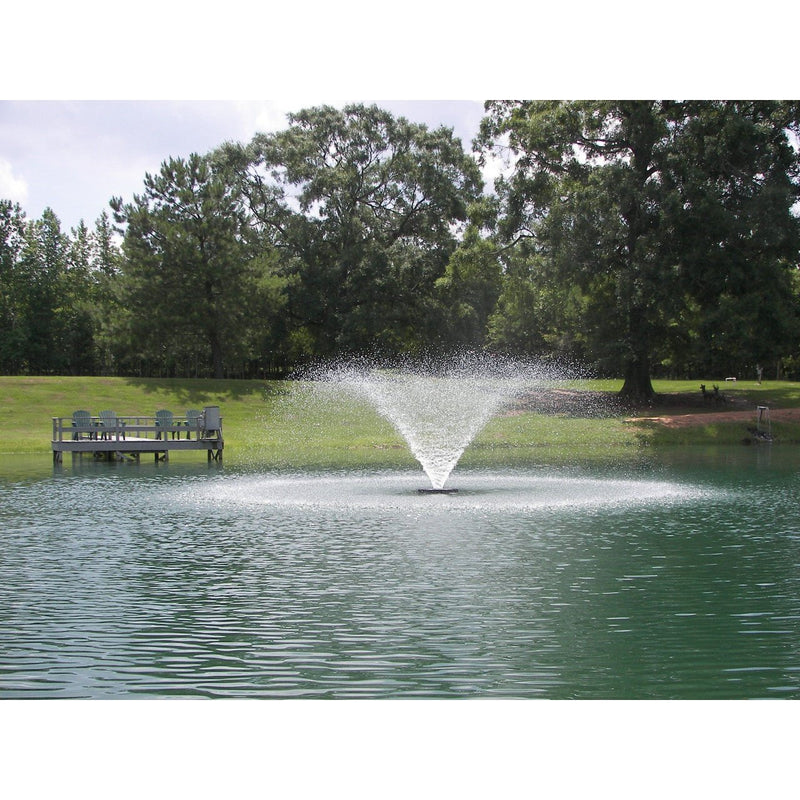
In real-world applications, deep aeration is the only viable method for ponds exceeding six to eight feet in depth. Surface fountains, while aesthetically pleasing, typically only circulate the top two to three feet of water. They leave the deadly depths untouched, creating a false sense of security while a biological "time bomb" ticks at the bottom.
How Deep Pond Aeration Systems Work
The operation of a deep aeration system is based on the principle of airlift pumping. A land-based compressor pumps air through weighted tubing to diffusers placed on the pond floor. These diffusers break the air into millions of tiny bubbles. As these bubbles rise, they create a vertical current that pulls the heavy, cold bottom water toward the surface.
Fine-bubble diffusers are the industry standard for efficiency. They maximize the surface area of the air-to-water interface, which increases the Standard Oxygen Transfer Efficiency (SOTE). However, the primary oxygenation in deep systems does not come from the bubbles themselves. Instead, it comes from the massive volume of water brought to the surface to interact with the atmosphere.
Calculating the necessary turnover rate is critical. Most pond managers aim for at least one full turnover every 24 hours. To determine this, you must calculate the total volume of the pond in acre-feet or gallons. An acre-foot is approximately 325,851 gallons. If a system cannot move this volume within a 24-hour window, it will fail to prevent stratification during extreme heatwaves.
Placement of the diffusers is equally vital. They must be located at the deepest points of the pond to ensure that no "dead zones" remain. In irregularly shaped ponds, multiple diffuser heads are often required to overcome geographical barriers like underwater ridges or peninsulas that might obstruct water flow.
The Benefits of Reclaiming the Hypolimnion
The primary benefit of deep aeration is the expansion of the habitable zone for fish. During summer, surface temperatures can exceed 85°F (29°C), which is stressful or even lethal for many species. In an un-aerated pond, the only cool water is at the bottom, but that water is toxic. This leaves fish "squeezed" in a narrow middle layer where oxygen is low and temperature is high.
Oxygenating the bottom turns the hypolimnion into a thermal asset. Fish can retreat to the cooler, deep water without fear of suffocation. This reduces metabolic stress and improves growth rates, as fish spend less energy fighting for survival and more energy on biomass production.
Chemical benefits are also measurable. Aerobic conditions at the pond floor facilitate the oxidation of phosphorus and nitrogen. In anoxic conditions, phosphorus is released from the sediment into the water column, fueling massive algae blooms. By keeping the bottom oxygenated, you "lock" nutrients into the sediment, leading to clearer water and fewer nuisance blooms.
Challenges and Common Mistakes
The most frequent mistake in deep pond aeration is "Turnover Shock." This occurs when a system is installed in a highly stratified pond in the middle of summer and turned on at full capacity. The sudden mixing of hydrogen sulfide and anoxic water can kill every fish in the pond within hours.
To avoid this, a "Start-up Map" must be followed. New systems should run for only 30 minutes on the first day, doubling the run time each subsequent day until 24-hour operation is achieved. This allows the gases to vent slowly and the oxygen demand to be met incrementally.
Another common pitfall is undersizing the compressor. A compressor that is too weak will create a small "chimney" of bubbles but will lack the power to move the entire water column. This results in partial destratification, where the very bottom remains toxic while the rest of the pond is mixed. This condition is often worse than no aeration at all, as it can keep toxic gases closer to the fish's habitable zone.
Maintenance neglect is a third challenge. Over time, diffusers can become fouled by mineral deposits or biological growth (biofouling). This increases backpressure on the compressor, reducing efficiency and eventually leading to mechanical failure. Annual cleaning or acid-dipping of diffusers is necessary to maintain design SOTE levels.
Limitations and Environmental Constraints
Deep aeration is not a universal solution. In very shallow ponds (less than 4 feet deep), the bubble plume does not have enough "runway" to develop the necessary velocity for effective airlift pumping. In these scenarios, surface aerators or horizontal circulators are often more efficient.
Environmental limitations also include ponds with extremely high Biochemical Oxygen Demand (BOD). If a pond has decades of accumulated muck, the initial oxygen demand might exceed the capacity of even a properly sized system. In these cases, aeration must be paired with mechanical dredging or aggressive biological treatments (beneficial bacteria) to reduce the organic load.
Power availability is a practical constraint. Deep aeration systems require electricity to run compressors. While solar-powered options exist, they often struggle to provide the 24-hour operation required during the hottest summer nights when oxygen levels are at their lowest. The cost of running electrical lines to remote pond sites must be factored into the initial design.
Comparing Aeration Technologies
Choosing between surface aeration and deep diffused aeration depends on the specific metrics of the water body. The following table compares these systems based on efficiency and application:
| Feature | Surface Aeration (Fountains) | Deep Diffused Aeration |
|---|---|---|
| Primary Function | Aesthetics and Surface Gas Exchange | Destratification and Deep Oxygenation |
| Effective Depth | 0 to 4 Feet | 5 to 50+ Feet |
| SAE (lb O2/hp-hr) | 1.5 – 2.5 | 2.0 – 8.0 |
| Operating Cost | Higher (moves heavy water) | Lower (compresses light air) |
| Winter Use | Not recommended (freezing risk) | Excellent (prevents ice-over) |
As indicated by the Standard Aeration Efficiency (SAE), diffused systems are generally more energy-efficient for large volumes. This is because it is mechanically easier to pump air down than it is to pump thousands of gallons of water up into the air.
Practical Tips for System Optimization
Monitoring is the key to managing a deep aeration system. Use a Secchi disk to measure water clarity regularly. A sudden decrease in clarity often indicates a spike in nutrient levels, which may require an adjustment in aeration timing or the addition of nutrient binders.
Check dissolved oxygen levels pre-dawn. This is when DO is at its lowest point because photosynthesis has been inactive all night. If your pre-dawn DO levels are below 5 ppm (parts per million), your system is likely undersized for the current biological load of the pond.
Ensure your compressor is housed in a ventilated, weather-proof cabinet. Heat is the enemy of compressor longevity. If the internal temperature of the cabinet exceeds 100°F, the lifespan of the diaphragms or pistons will be significantly shortened. Using cooling fans and keeping the intake filters clean can double the life of the unit.
Advanced Considerations for Serious Practitioners
Professional pond managers often look at the "Alpha Factor" when designing systems. The Alpha Factor is the ratio of oxygen transfer in pond water versus clean water. High levels of organic matter or surfactants in a pond can reduce the SOTE by coating the bubbles and preventing gas exchange. If your pond is "thick" with algae or waste, you may need to increase your air volume by 20-30% to compensate for this resistance.
Pressure drop (friction loss) in the airlines is another advanced metric. If the run from the compressor to the pond is long (over 500 feet), the diameter of the tubing must be increased. Using 1/2-inch tubing for a 1000-foot run will create so much backpressure that the compressor will overheat and fail. Switching to 1-inch or 2-inch feeder lines for the long-distance run preserves the mechanical integrity of the system.
Lastly, consider the "Oxygen Demand" of the sediment. In older ponds, the sediment itself consumes oxygen (Sediment Oxygen Demand or SOD). Even if the water column appears healthy, the bottom inch of water can remain anoxic if the SOD is too high. In these cases, placing diffusers slightly off the bottom (using a "muck stand") can prevent them from churning up the silt while still providing oxygen to the lower layers.
Example Scenario: A 1-Acre Farm Pond
Consider a 1-acre pond with an average depth of 8 feet and a maximum depth of 15 feet. The total volume is roughly 8 acre-feet, or 2.6 million gallons. In July, this pond develops a thermocline at the 6-foot mark.
A surface fountain in this pond would splash 150 gallons per minute. While visually impressive, it would only move 216,000 gallons in 24 hours—less than 10% of the pond's volume. The water below 6 feet would remain anoxic and trapped.
A deep diffused system with two diffuser heads placed at 15 feet and a 1/2-hp compressor would move approximately 2,000 gallons of water per minute via the airlift effect. This results in nearly 2.9 million gallons moved every 24 hours. This achieves a 1.1x turnover rate, ensuring that the entire 2.6-million-gallon volume is oxygenated and the thermocline is destroyed. The result is a pond where fish can utilize all 15 feet of depth, effectively doubling their living space.
Final Thoughts
Deep pond aeration is the bridge between a dying water body and a thriving ecosystem. By addressing the physical reality of thermal stratification, you move beyond surface-level fixes and tackle the root cause of pond instability. Transforming the "Deadly Depth" into a "Thermal Asset" is the most significant step any pond owner can take toward long-term sustainability.
Success in this endeavor requires a data-driven approach. Monitor your oxygen levels, calculate your turnover rates, and maintain your equipment with the same precision you would apply to any other mechanical system. When the bottom of your pond is healthy, the rest of the ecosystem follows.
Experimenting with diffuser placement and timing can yield significant improvements in water quality. Whether you are managing a trophy fishery or a decorative estate pond, the principles of deep aeration remain the same. Reclaim your depths, and you will reclaim your pond.