

Natural Ph Control For Fish Ponds
Stop chasing pH numbers with a bottle when you can fix the atmosphere of your pond. Are you stuck in a cycle of buying 'pH Up' or 'pH Down' every time it rains? The 'synthetic' route is a never-ending bill. Learn how 'natural' atmospheric gas exchange through aeration automatically balances your water chemistry, keeping your fish in the 'sweet spot' without a single chemical drop.
Natural Ph Control For Fish Ponds
Natural pH control in an aquatic ecosystem is the process of utilizing mechanical and biological systems to maintain a stable acid-base equilibrium. In most managed ponds, pH levels fluctuate based on the concentration of dissolved carbon dioxide (CO2). Carbon dioxide acts as a weak acid when dissolved in water, forming carbonic acid (H2CO3). Therefore, managing the "atmosphere" of the pond through gas exchange is the most efficient method for stabilizing these values.
This approach is used extensively in commercial aquaculture and high-end koi keeping where chemical additives are considered high-risk variables. Unlike synthetic buffers, natural control relies on the physics of Henry’s Law, which dictates that gases in a liquid will eventually reach equilibrium with the gases in the air above it. By increasing the surface area and turbulence of the water, a pond owner can force excess CO2 to "off-gas" into the atmosphere, effectively raising and stabilizing the pH.
In real-world situations, a pond with high biological loads or heavy algae growth experiences massive daily pH swings. During the day, photosynthesis removes CO2, causing pH to spike. At night, respiration by fish and plants adds CO2, causing pH to crash. Natural control via aeration dampens these swings by providing a constant pathway for CO2 to exit the system, ensuring the water remains at its natural "pH ceiling" determined by its carbonate hardness.
The Mechanism of Gas Exchange and Carbonic Acid
The primary driver of pH in a freshwater pond is the relationship between carbon dioxide and the carbonate buffering system. When CO2 dissolves in water, it undergoes a hydration reaction: CO2 + H2O ? H2CO3 ? H+ + HCO3- (bicarbonate). The release of hydrogen ions (H+) is what directly lowers the pH. Consequently, the more dissolved CO2 present in the water, the more acidic the environment becomes.
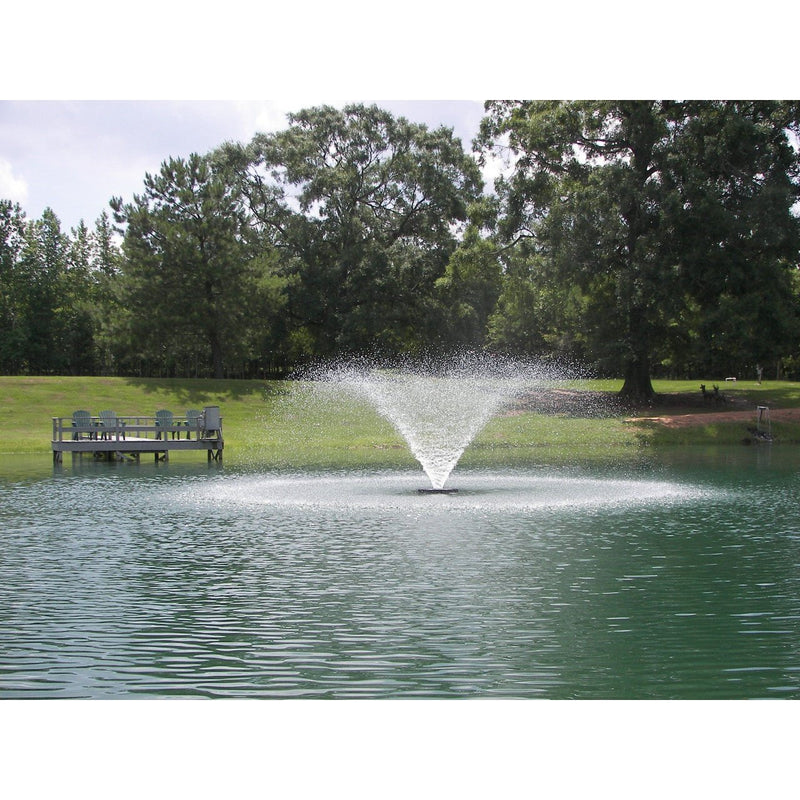
Atmospheric air contains approximately 0.04% carbon dioxide. Pond water, however, often becomes supersaturated with CO2 due to fish respiration and the decomposition of organic matter on the pond floor. This creates a partial pressure gradient where the CO2 "wants" to leave the water and enter the air. Mechanical aeration accelerates this process by breaking the surface tension and increasing the air-water interface area.
The efficiency of this gas transfer is governed by the stagnant film model. This model suggests that a thin, stationary layer of water exists at the surface which resists gas movement. Mechanical turbulence from a waterfall, fountain, or diffused air stone disrupts this film, allowing for rapid molecular diffusion. As CO2 escapes, the chemical reaction reverses, consuming hydrogen ions and causing the pH to rise toward a stable equilibrium point, typically between 8.1 and 8.5 in well-buffered systems.
Benefits of Atmospheric pH Stabilization
Implementing mechanical gas exchange offers measurable advantages over chemical dosing. The most significant benefit is the elimination of "pH shock." Rapid changes in pH, even within the tolerable range of 6.5 to 9.0, can damage the slime coat and gill tissues of fish. Natural stabilization through aeration ensures that the rate of change is gradual and tied to environmental physics rather than a sudden chemical reaction.
Another advantage is the optimization of the nitrification process. Beneficial bacteria (Nitrosomonas and Nitrobacter) that convert toxic ammonia into nitrate perform most efficiently at a slightly alkaline pH (7.5–8.5). By using aeration to keep CO2 low and pH stable in this range, the pond’s "bio-filter" operates at peak capacity. This reduces the risk of ammonia spikes which are common in stagnant, low-oxygen environments.
Furthermore, this method is self-regulating. Once the water reaches equilibrium with the atmosphere, the pH will not continue to rise indefinitely. This provides a "safety ceiling" that prevents the water from becoming too basic. In contrast, over-dosing with synthetic buffers like soda ash can easily push pH levels past 9.0, leading to increased ammonia toxicity and mineral precipitation.
Challenges and Common Pitfalls
The most frequent error in natural pH management is ignoring Carbonate Hardness (KH). KH is the measure of bicarbonate and carbonate ions in the water, acting as the "battery" that powers the pH buffering system. If KH is too low (below 50 ppm), the water lacks the "absorptive" capacity to handle the hydrogen ions produced by organic decay. In these cases, even heavy aeration may fail to prevent a "pH crash."
Another pitfall is the "algae trap." Planktonic and filamentous algae consume massive amounts of CO2 during daylight hours. If an owner relies solely on daytime aeration, they may find their pH spiking to dangerous levels (above 9.5) because the mechanical off-gassing is adding to the CO2 depletion already caused by the algae. This creates a hyper-alkaline environment that stresses fish and increases the toxicity of any present ammonia.
Inconsistent aeration timing is also a technical failure point. Some practitioners turn off pumps or air stones at night to save electricity. This is the exact moment when respiration is highest and CO2 levels are climbing. By cutting the gas exchange at night, the pond experiences a massive accumulation of carbonic acid, leading to a sharp pH drop by dawn. Consistency in mechanical operation is required for true atmospheric balance.
Limitations of Natural Gas Exchange
Natural pH control is not a universal fix for every water chemistry issue. It cannot overcome extreme source water parameters. For example, if the pond is filled with water from a limestone-heavy well that has a natural pH of 9.0 and a KH of 300 ppm, aeration will not lower that pH. Mechanical gas exchange primarily moves pH toward the atmospheric equilibrium point; it does not "pull" pH down if the base minerals are already in excess.
Environmental factors like heavy leaf litter or high stocking densities also create boundaries. If the rate of CO2 production from decomposing muck and fish respiration exceeds the "Oxygen Transfer Rate" (OTR) of the aeration system, the pH will remain suppressed and acidic. In such cases, mechanical aeration must be paired with physical debris removal to reduce the biological oxygen demand (BOD) and CO2 load.
Trade-offs also exist regarding plant growth. Aquatic plants and lilies require dissolved CO2 for photosynthesis. High-efficiency aeration systems that are optimized for pH stability and fish health may strip CO2 so effectively that plant growth becomes stunted. Practitioners must decide whether their priority is a high-biomass fish environment or a heavily aquascaped water garden.
Synthetic Fix vs Natural Balance
| Feature | Synthetic Fix (Chemicals) | Natural Balance (Aeration) |
|---|---|---|
| Speed of Change | Immediate (Minutes) | Gradual (Hours/Days) |
| Operational Cost | Recurring (Chemical Purchases) | Fixed (Electricity/Maintenance) |
| Risk Factor | High (Overdose/Shock) | Low (Self-Regulating) |
| Complexity | Requires Precise Measuring | Set and Forget |
| Secondary Benefits | None | Higher DO, Reduced Ammonia |
Practical Tips for Atmospheric pH Optimization
To maximize the efficiency of natural pH control, focus on the "Total Surface Renewal" rate. This is achieved not just by moving water, but by creating a high-velocity interface between air and water. For deep ponds, diffused aeration (bottom air stones) is superior because it utilizes the entire water column to move CO2 upward. In shallow ponds, a high-volume splash aerator or a wide waterfall provides better gas stripping.
Monitor KH levels at least once a month. Aim for a Carbonate Hardness of 100 to 200 ppm (approximately 6–11 degrees of hardness). If your KH drops below this range, your aeration efforts will be fighting an uphill battle against acidification. You can naturally increase KH by adding crushed limestone or oyster shells to your filter, providing a slow-release mineral buffer that supports the mechanical aeration.
Position your aeration outlets to avoid "dead zones." Stagnant pockets of water in the corners of a pond will accumulate CO2 and organic acids, creating localized low-pH zones. Use the flow from your returns or aerators to create a circular or "sweeping" current. This ensures that every gallon of water eventually reaches the air-water interface for processing.
Advanced Considerations for Serious Practitioners
Experienced pond managers should look at the Standard Aeration Efficiency (SAE) of their equipment. SAE is a metric that measures how many kilograms of oxygen are transferred per kilowatt-hour of electricity. While typically used for oxygen, it serves as a proxy for gas exchange capacity. High-efficiency paddlewheels or fine-pore diffusers provide the most gas stripping per dollar spent on power.
Consider the impact of temperature on gas solubility. According to the laws of thermodynamics, cold water holds more gas than warm water. This means that in the winter, CO2 levels can climb higher before off-gassing occurs naturally. Adjusting aeration intensity seasonally is a strategy used to maintain consistent pH year-round. In summer, you aerate to combat respiration; in winter, you aerate to prevent CO2 buildup under ice or in stagnant, dense water.
Another advanced technique is the use of "night-only" or "supplemental" aeration cycles. If a pond has a heavy algae load that drives pH too high during the day, reducing aeration during peak sunlight can allow a small amount of CO2 to remain in the water, acting as a natural brake on the pH spike. This requires precise monitoring and is only recommended for those using automated pH and Dissolved Oxygen (DO) sensors.
Scenario: Resolving the "Morning Crash"
Imagine a 2,000-gallon koi pond with heavy lily coverage and a high fish load. The owner notices the fish are lethargic and "piping" at the surface every morning at 7:00 AM. Testing shows a pH of 6.8 at dawn and 8.4 at dusk. This indicates a massive CO2 accumulation overnight. The "synthetic" solution would be to add buffer salts every evening, which is expensive and labor-intensive.
The "natural" solution is the installation of a bottom-diffused aeration system. By running a 40-liter-per-minute air pump through a 9-inch disc diffuser at the pond's deepest point, the owner increases the gas transfer rate by 400%. Within 48 hours, the morning pH stabilizes at 7.8, and the evening pH remains at 8.2. The reduced delta (swing) of 0.4 units significantly lowers the metabolic stress on the koi.
In this scenario, the aeration system effectively "vented" the respiratory CO2 before it could react with the water to form carbonic acid. The fish stopped gasping because the dissolved oxygen levels remained high, and the pH remained stable because the carbonic acid concentration was kept in check by the constant atmospheric exchange.
Final Thoughts
Natural pH control is an exercise in mechanical optimization and environmental physics. By focusing on the removal of dissolved carbon dioxide through aeration, you address the root cause of pH instability rather than just treating the symptoms with chemical additives. This creates a more resilient ecosystem where water chemistry is governed by the predictable laws of gas exchange and mineral buffering.
Maintaining a stable pH through atmospheric balance requires a shift in mindset from "adding" to "exchanging." While it requires an initial investment in quality aeration equipment and a commitment to monitoring KH, the long-term results are measurable in both fish health and operational savings. A pond that breathes well is a pond that stays balanced naturally.
Experiment with your pond’s flow patterns and aeration timing to find the specific "equilibrium point" for your system. Once you understand the relationship between your stocking levels, your KH, and your gas exchange rate, you will find that the bottle of 'pH Down' stays on the shelf, and your fish thrive in the consistency of a naturally balanced environment.