

Pond Aeration vs Pond Fountains: What Actually Adds More Oxygen?
One looks pretty, the other works wonders. Can you spot the difference? Fountains are for looks; aeration is for life. If you want a healthy pond, you need to understand why surface splashing isn't enough to save your water.
A pond is a biological reactor. Every cubic meter of water is home to complex chemical cycles, microbial colonies, and dissolved gases that must remain in a specific state of equilibrium to prevent ecosystem collapse. When this equilibrium fails, the results are measurable: dissolved oxygen (DO) levels drop, thermal stratification occurs, and anaerobic decomposition begins to release toxic gases like hydrogen sulfide and methane.
Choosing between a decorative fountain and a subsurface aeration system is a decision between visual architecture and mechanical life support. While a fountain provides a localized point of gas exchange at the surface, a diffused aeration system addresses the total volume of the water body. This distinction is critical for any practitioner managing aquaculture, large-scale ornamental ponds, or stormwater retention basins.
Pond Aeration vs Pond Fountains: What Actually Adds More Oxygen?
Oxygen enters pond water through two primary pathways: atmospheric diffusion and photosynthetic byproduct. In a stagnant water body, the rate of natural atmospheric diffusion is insufficient to meet the biological oxygen demand (BOD) of the system. This is where mechanical intervention becomes necessary.
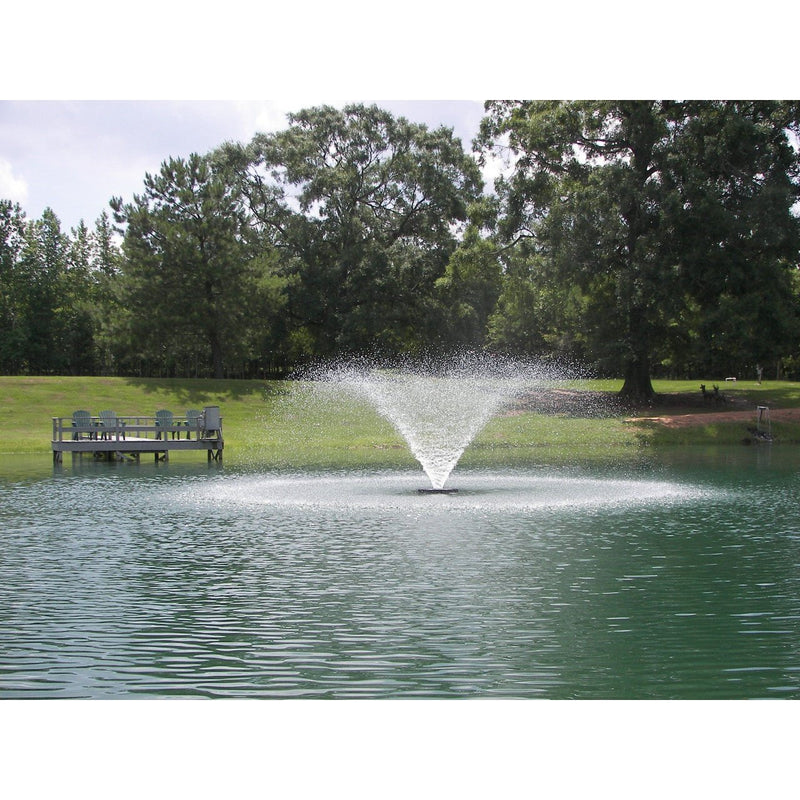
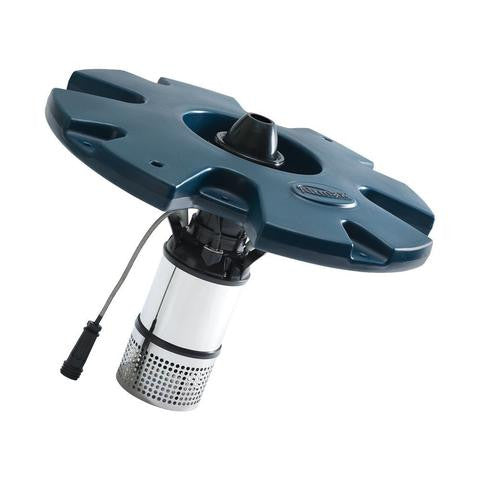
Pond fountains function by drawing water from the upper 1–3 feet of the water column and propelling it into the atmosphere. As the water droplets travel through the air, they increase their surface area, allowing for gas exchange. When these droplets impact the surface, they trap a small amount of air. However, this process is localized. Data suggests that standard decorative fountains only effectively oxygenate the top 4–6 feet of water.
Subsurface aeration, also known as diffused aeration, operates on the principle of bottom-up circulation. An on-shore compressor pushes air through weighted tubing to diffusers located at the pond's deepest point. These diffusers release millions of micro-bubbles (typically 1–3mm in diameter). These bubbles do not just add oxygen directly; they create an "airlift" effect. As the bubbles rise, they displace dense, cold, oxygen-depleted water from the bottom and carry it to the surface. This mechanical turnover ensures that the entire water column, regardless of depth, participates in atmospheric gas exchange.
In terms of raw efficiency, diffused aeration is significantly superior. The Standard Aeration Efficiency (SAE) for a high-quality fine bubble diffuser ranges from 2.0 to 4.5 lbs of oxygen per kilowatt-hour (lb O2/kWh). In contrast, many decorative fountains struggle to exceed 1.5 lb O2/kWh. For deep-water environments (over 8 feet), fountains provide negligible oxygenation to the benthos, where the highest concentration of organic waste resides.
How Subsurface Aeration Systems Work
The operation of a diffused aeration system is governed by fluid dynamics and the physics of gas solubility. To optimize these systems, one must understand the three primary components: the compressor, the transport line, and the diffuser.
The compressor is the heart of the system. For ponds under 8 feet deep, linear diaphragm pumps are often used due to their high efficiency and low noise profile. For deeper applications, rocking piston compressors are mandatory. These units are designed to overcome the "head pressure" or backpressure caused by the weight of the water. The required pressure is calculated using the formula: PSI = (0.433 × Depth in feet) + Friction Loss.
Weighted tubing acts as the transport mechanism. It must be made of high-density materials to ensure it remains on the pond floor without the need for external weights, which can snag and degrade over time. The internal diameter of the tubing must be sized to the airflow (measured in Cubic Feet per Minute or CFM) to minimize friction loss, which otherwise forces the compressor to run hotter and reduces its lifespan.
The diffuser is the final stage of delivery. Professional systems utilize fine bubble membrane diffusers. These membranes have thousands of microscopic slits that open under pressure. Smaller bubbles provide a higher surface-area-to-volume ratio, which slows their ascent and increases the contact time between the air and the water. This maximize the Oxygen Transfer Efficiency (OTE).
Benefits of Mechanical Aeration
The primary benefit of a well-engineered aeration system is the prevention of thermal stratification. During summer months, the sun warms the surface water (epilimnion), making it less dense than the cold water at the bottom (hypolimnion). This creates a physical barrier called a thermocline. Without mixing, the bottom layer becomes anoxic (void of oxygen).
Diffused aeration breaks this thermocline through constant vertical mixing. This turnover provides several measurable advantages:
- Accelerated Decomposition: Aerobic bacteria are approximately 20 times more efficient at breaking down organic "muck" (leaves, fish waste) than anaerobic bacteria. Keeping the pond floor oxygenated prevents sludge buildup.
- Pathogen Reduction: High DO levels and constant movement create an inhospitable environment for certain harmful algae and mosquito larvae.
- Fish Kill Prevention: Most fish kills occur at night when plants stop producing oxygen and start consuming it (respiration). Aeration ensures a "buffer" of oxygen is always available during these critical hours.
- Phosphorus Sequestration: In an oxygenated environment, phosphorus binds to iron and settles into the sediment. In anoxic conditions, this phosphorus is released back into the water, fueling massive algae blooms.
Challenges and Common Implementation Mistakes
One of the most frequent errors in pond management is undersizing the aeration system. Many operators choose a compressor based on the pond's surface acreage without considering the total volume or the depth. An undersized system may create a small "chimney" of oxygenated water but fail to move the entire volume, leaving large "dead zones" where toxic gases continue to accumulate.
Another challenge is the "initial turnover" risk. If an aeration system is installed in a pond that has been stagnant for years, the sudden mixing of toxic, anoxic bottom water with the surface can cause an immediate crash in total dissolved oxygen, leading to a massive fish kill. Professional protocols require a "staged startup," where the system is run for only 15–30 minutes on the first day, gradually increasing the duration over two weeks.
Mechanical maintenance is also frequently overlooked. Compressors require air filter changes every 3–6 months to prevent overheating. Diffuser membranes can become "blinded" by calcium carbonate scaling or biofouling. If the backpressure (PSI) on the system starts to rise, it is a clear indicator that the diffusers require cleaning or replacement.
Limitations: When Fountains or Aeration May Not Be Ideal
Diffused aeration is not a universal solution. In extremely shallow ponds (under 4 feet), the bubbles do not have enough "rise time" to create a significant airlift effect. In these environments, the bubbles reach the surface too quickly, and the OTE is very low. For shallow water, a high-volume surface aerator (different from a decorative fountain) or a horizontal circulator is often more effective.
Environmental limitations also include ponds with heavy chemical contamination. Aeration can strip volatile organic compounds (VOCs) from the water, but it can also increase the temperature of the bottom water. In trout ponds, where cold water is essential for survival, the "warming" effect of mixing the epilimnion with the hypolimnion must be carefully monitored. If the entire pond reaches 70°F, the trout will perish regardless of the oxygen levels.
Technical Comparison: Fountains vs. Diffusers
| Feature | Decorative Fountain | Subsurface Diffuser |
|---|---|---|
| Primary Goal | Aesthetics/Visuals | Biological Life Support |
| Max Effective Depth | ~6 feet | Up to 50+ feet |
| Efficiency (SAE) | 0.8 – 1.5 lb O2/kWh | 2.0 – 4.5 lb O2/kWh |
| Power Consumption | High (Pumping Water) | Low (Pumping Air) |
| Maintenance Loc. | In-water motor | On-shore compressor |
Practical Tips for System Optimization
To maximize the efficiency of an aeration system, the placement of diffusers is paramount. They should be located at the deepest point of the pond, but not directly in the muck. Placing a diffuser 6–12 inches above the sediment layer prevents it from sucking in silt, which can clog the membrane and increase turbidity.
Monitoring dissolved oxygen (DO) levels is the only way to verify performance. A healthy pond should maintain a DO level above 5 mg/L at all depths. If levels drop below 3 mg/L, aquatic life enters a state of stress. Professional managers use DO meters to check the water at the bottom (benthic zone) specifically, as this is the first area to fail.
Linear airflow is also a critical factor. Ensure that the distance from the compressor to the diffusers is minimized, or use larger diameter tubing for long runs to prevent "line drop." For every 100 feet of 3/8" tubing, you may lose 1–2 PSI due to friction, which forces the compressor to work harder and consumes more energy.
Advanced Considerations: The Physics of Gas Exchange
The rate of oxygen transfer is governed by Henry’s Law, which states that the amount of dissolved gas in a liquid is proportional to its partial pressure above the liquid. As a bubble travels deeper into the water, the hydrostatic pressure increases, which actually increases the solubility of the oxygen within that bubble. This is why diffused aeration becomes exponentially more efficient as the depth increases.
At 20 feet of depth, the pressure is roughly double that of the surface. This means the driving force for oxygen to move from the bubble into the water is twice as strong. Fountains, operating only at the surface where pressure is 1 atmosphere, cannot take advantage of this physical law.
Furthermore, consider the "residence time." A droplet from a fountain is in the air for perhaps 1–2 seconds. A bubble released at a depth of 15 feet may take 15–20 seconds to reach the surface, providing a much longer window for gas transfer. When combined with the massive volume of water moved by the bubble plume (often thousands of gallons per minute), the mechanical advantage of the diffuser is undeniable.
Real-World Example: The Retention Pond Scenario
Consider a 2-acre stormwater retention pond with an average depth of 12 feet. A facility manager installs a 2 HP decorative fountain to improve the appearance for residents. While the fountain looks impressive, the pond continues to suffer from foul odors and "blue-green" algae blooms.
Upon technical inspection, it is discovered that the water below 5 feet is completely anoxic (0 mg/L DO). The fountain is simply recirculating the top layer of water. The bottom 7 feet of the pond is a "dead zone" where organic matter is rotting anaerobically, producing hydrogen sulfide (the "rotten egg" smell).
The solution is to replace the 2 HP fountain with a 3/4 HP rocking piston compressor and four fine-bubble diffusers. This system uses 60% less electricity but turns over the entire volume of the pond twice every 24 hours. Within three weeks, the thermocline is destroyed, the DO levels at the bottom rise to 6 mg/L, and the odors vanish as aerobic bacteria begin to consume the accumulated muck.
Final Thoughts
The choice between a fountain and an aeration system should be based on the biological requirements of the water body rather than aesthetic preferences alone. Fountains serve a clear purpose in shallow, decorative settings where visual impact is the primary goal. However, they are insufficient for the long-term health of deep or high-nutrient ponds.
Diffused aeration is the standard for mechanical water management. By addressing the pond from the bottom up, these systems provide total volume circulation, efficient oxygen transfer, and a sustainable environment for beneficial microbes and fish. It is a more complex installation involving compressors, weighted lines, and diffusers, but the result is a self-cleaning ecosystem that requires fewer chemical interventions over time.
For those managing critical aquatic environments, prioritizing the oxygen cycle is the most effective way to ensure water clarity and biological stability. Implementing the correct mechanical system today prevents the catastrophic costs of dredging or fish kills tomorrow. Experiment with your setup, monitor your dissolved oxygen levels, and choose the tool that fits the physics of your pond.