

Pond Aeration Sizing Guide: How Much Air Does Your Pond Actually Need?
Stop paying for air you don't need. Learn the math of proper pond sizing. Most pond owners guess on their pump size and end up burning cash on electricity. Our sizing guide shows you exactly how much CFM you need to keep your ecosystem healthy without the waste.
Precision in pond aeration is a matter of fluid dynamics and biological oxygen demand. When a system is oversized, energy is dissipated as heat and unnecessary mechanical wear. When undersized, the lack of dissolved oxygen (DO) leads to anaerobic conditions, fish kills, and the accumulation of organic muck.
Achieving the balance between Oversized Energy Waste and Precision-Sized Savings requires an understanding of how air volume, measured in Cubic Feet per Minute (CFM), interacts with water pressure and depth. This guide provides the technical framework necessary to calculate the exact requirements for any aquatic environment.
Pond Aeration Sizing Guide: How Much Air Does Your Pond Actually Need?
Pond aeration sizing is the process of matching a compressor's output to the physical and biological requirements of a specific water body. The primary metric used is CFM, which represents the volume of air delivered at a specific pressure. Because water exerts weight, the deeper the diffuser is placed, the more pressure the compressor must overcome to deliver that air.
In real-world applications, a 1-acre pond that is 5 feet deep requires a fundamentally different system than a 1-acre pond that is 15 feet deep. In the shallow pond, air must be spread across more diffusers to achieve coverage. In the deep pond, a single diffuser can move more water due to the longer rise time of the bubbles, but the compressor must be rated for higher Pounds per Square Inch (PSI).
Think of it as a delivery truck. If the truck is too small, it cannot carry the load. If the truck is too large, you are paying for fuel to move an empty trailer. Precision sizing ensures the "load" of oxygen needed by your fish and bacteria is met with the most efficient "fuel" consumption possible.
The Variables of Aeration Math
To determine the required CFM, four primary variables must be calculated: surface acreage, maximum and average depth, biological load, and the friction loss of the delivery lines. Neglecting any of these factors usually results in a system that fails during the peak heat of summer when oxygen solubility is at its lowest.
How to Calculate Your Required CFM
Calculating the required CFM involves determining the oxygen transfer rate (OTR) needed to meet the Biological Oxygen Demand (BOD) of the pond. While "1.5 CFM per acre" is a common rule of thumb, serious practitioners use a more granular approach based on turnover rates and depth-specific pressure.
Step 1: Determine Total Water Volume and Surface Area
Surface area is calculated by multiplying the length by the width and dividing by 43,560 (for acres). Volume is then estimated by multiplying the surface area by the average depth. A common mistake is using the maximum depth for the entire calculation, which leads to overestimating the volume and over-sizing the pump.
Step 2: Calculate Backpressure (PSI)
Water pressure increases at a rate of 0.433 PSI per foot of depth. This is a physical constant. If a diffuser is placed at 10 feet, the compressor must overcome 4.33 PSI just to push the first bubble out. You must also account for the "cracking pressure" of the diffuser itself—usually between 0.5 and 1.5 PSI depending on the membrane type.
| Depth (Feet) | Static Water Pressure (PSI) | Recommended Compressor Type |
|---|---|---|
| 4 | 1.73 | Linear Diaphragm |
| 8 | 3.46 | Linear Diaphragm or Rocking Piston |
| 12 | 5.20 | Rocking Piston |
| 20 | 8.66 | Rocking Piston or Rotary Vane |
Step 3: Account for Friction Loss
Air moving through a pipe experiences resistance. This is known as friction loss or "line loss." If you are running 200 feet of 3/8-inch tubing to a diffuser, the friction will add significant backpressure to the system. Using 1/2-inch or 3/4-inch tubing for long runs reduces this resistance and allows the compressor to operate at a higher CFM output.
Benefits of Precision Sizing
The primary advantage of precision sizing is mechanical efficiency. When a compressor is matched perfectly to the depth and diffuser count, it operates within its "sweet spot" on the performance curve. This results in several measurable benefits:
- Reduced Electrical Consumption: You avoid paying for high-wattage motors that are fighting excessive backpressure.
- Extended Component Life: Over-pressurized compressors run hotter, causing diaphragms and pistons to wear out prematurely. Proper sizing keeps operating temperatures low.
- Optimal Oxygen Transfer: Small, uniform bubbles have a higher surface-area-to-volume ratio than large, erratic bubbles. Precision sizing ensures the diffuser receives the exact CFM required to produce the finest bubbles.
- Consistent Thermal Destratification: A correctly sized system moves the entire water column, preventing the "dead zone" (thermocline) from forming without creating so much turbulence that it stresses the fish.
Common Mistakes in Sizing Aeration Systems
The most frequent error is ignoring the performance curve of the compressor. A pump might be advertised as "5.0 CFM," but that is usually "open flow" (0 PSI). At a depth of 10 feet, that same pump might only produce 1.8 CFM. If your pond requires 3.0 CFM for health, the 5.0 CFM pump is actually undersized for your specific application.
Another mistake is using the wrong diameter tubing for long distances. Small-diameter tubing (like 3/8") is easier to handle but has high friction loss. For runs exceeding 100 feet, the backpressure added by the tubing can effectively "choke" the compressor, reducing its output and increasing its heat signature. Transitioning to 1/2" or even 1" manifold lines for the main run is a technical necessity for efficiency.
Finally, many owners fail to account for "Biological Oxygen Demand" (BOD). A pond with three feet of organic muck on the bottom has a much higher BOD than a clean, newly dug pond. The bacteria breaking down that muck consume massive amounts of oxygen. If you size for a "clean" pond but have a "dirty" one, the oxygen levels will never reach saturation.
Limitations of Bottom Aeration
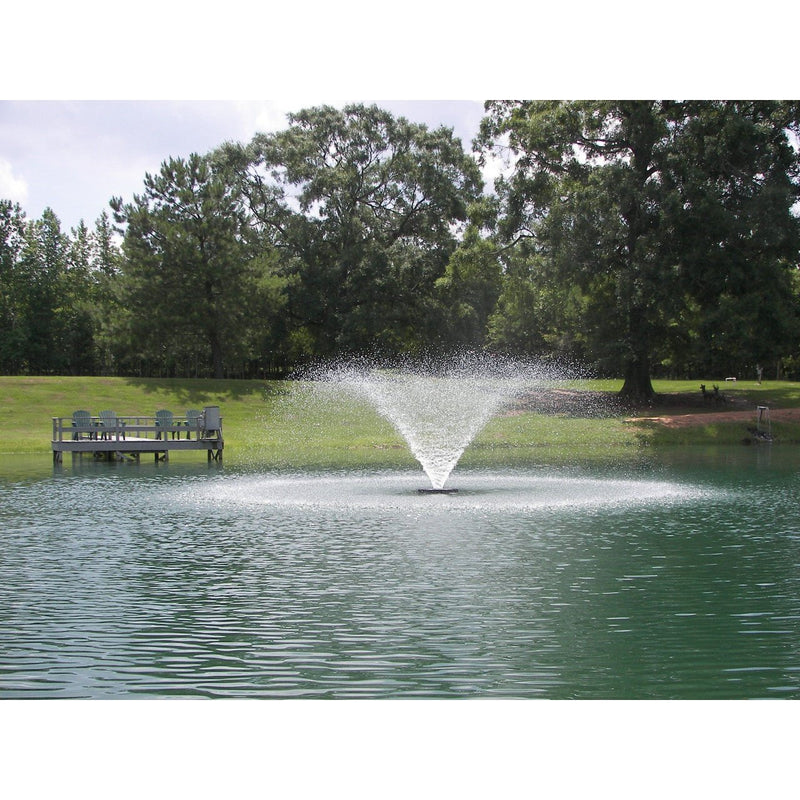
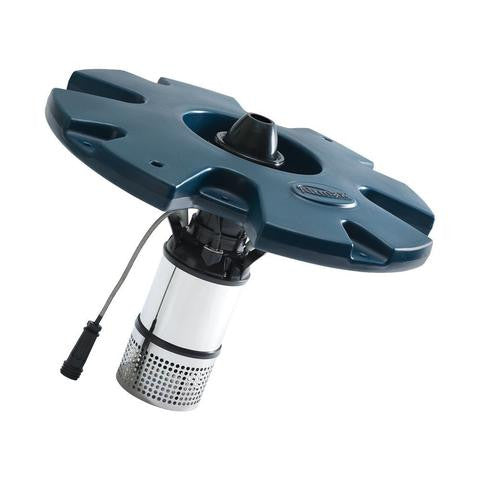
While bottom-diffused aeration is the most efficient way to move water, it is not ideal for every scenario. In very shallow ponds (less than 4 feet deep), the "cone" of water moved by the rising bubbles is narrow. In these cases, you would need an impractical number of diffusers to achieve full circulation. Surface aerators or fountains are often more effective for shallow, high-surface-area environments.
Environmental factors like altitude also play a role. At higher elevations, the air is less dense, meaning each cubic foot of air contains less oxygen. A system sized for sea level will provide significantly less oxygen at 5,000 feet of elevation. Technical adjustments must be made to the CFM requirements to compensate for this atmospheric thinning.
Compressor Comparison: Linear vs. Rocking Piston
Choosing between compressor technologies is a choice of efficiency versus pressure capability. Linear diaphragm pumps are incredibly efficient at shallow depths but lose nearly all their CFM output as they approach 8-10 feet of depth. Rocking piston compressors are less efficient in terms of CFM-per-watt but can maintain their output at much higher pressures.
| Feature | Linear Diaphragm | Rocking Piston |
|---|---|---|
| Max Depth | 8-10 Feet | 30-50 Feet |
| Noise Level | Very Low (<45 dB) | Moderate (60-70 dB) |
| Efficiency | Highest at low PSI | Highest at high PSI |
| Maintenance | Diaphragm replacement | Piston seal replacement |
Practical Tips for System Optimization
Once you have calculated your CFM and chosen a compressor, focus on the installation geometry to maximize performance. Placement of diffusers is as important as the air volume they receive. Place diffusers in the deepest parts of the pond to maximize the "lift" of the water column, but avoid placing them directly in the muck, which can clog the membranes.
- Check Your Gauges: Always install a pressure gauge at the compressor. If the gauge reads higher than your calculated depth pressure + 1 PSI, you have a restriction in the line or a clogged diffuser.
- Level the Diffusers: If you have multiple diffusers on one pump, they must be at the same depth. Air follows the path of least resistance. If one diffuser is 2 feet shallower than the other, it will take 90% of the air.
- Use Valved Manifolds: Use a manifold with ball valves to manually balance the airflow to each diffuser. This allows you to compensate for minor depth differences.
- Protect the Compressor: Heat is the enemy of CFM. Ensure your compressor cabinet is well-ventilated. A 10-degree drop in operating temperature can add years to the life of the motor.
Advanced Considerations: The Oxygen Transfer Formula
For serious practitioners, calculating the Standard Oxygen Transfer Rate (SOTR) provides the highest level of precision. SOTR is defined as the amount of oxygen transferred to water per hour under standard conditions (20°C, 1 atm, and 0 mg/L DO). However, since pond conditions are never "standard," we must calculate the Actual Oxygen Transfer Rate (AOTR).
The AOTR accounts for the salinity of the water, the current DO levels, and the water temperature. As water temperature increases, its ability to hold oxygen decreases, while the metabolic rate of the fish increases. This "double-whammy" is why summer is the most dangerous time for ponds. A system that provides 5 lbs of oxygen per day in the spring might only provide 3 lbs in July. Sizing must always be based on the "worst-case scenario" of the hottest summer month.
Example Scenario: Sizing a 1-Acre Pond
Consider a 1-acre pond with a maximum depth of 12 feet and an average depth of 6 feet. The goal is to achieve one complete turnover of the water volume every 24 hours.
1. Volume Calculation: 1 acre (43,560 sq ft) x 6 ft (avg depth) = 261,360 cubic feet of water. This is approximately 1.95 million gallons.
2. Pressure Calculation: 12 ft (max depth) x 0.433 = 5.2 PSI. Adding 0.8 PSI for diffuser and line loss gives us a total system pressure of 6.0 PSI.
3. CFM Requirement: To turn over 2 million gallons in 24 hours using typical fine-bubble diffusers, research suggests we need approximately 2.5 to 3.0 CFM of air delivered at the bottom. A single 1/2 HP rocking piston compressor typically delivers 3.5 CFM at 10 PSI, making it the ideal choice for this application.
Final Thoughts
Proper pond aeration sizing is an engineering task that pays dividends in both ecosystem health and financial savings. By moving away from "rule of thumb" guesses and toward calculated CFM requirements, you ensure that every watt of electricity is converted into life-sustaining dissolved oxygen. Precision sizing prevents the mechanical strain of backpressure and the biological disaster of oxygen depletion.
Start by measuring your depths and understanding your pond's organic load. Use the data provided here to match your compressor technology to your specific pressure requirements. When you treat your pond like the complex fluid system it is, you stop paying for air you don't need and start investing in a clear, healthy environment that lasts for decades.