

How to Design a Pond Aeration System for Maximum Oxygen Transfer
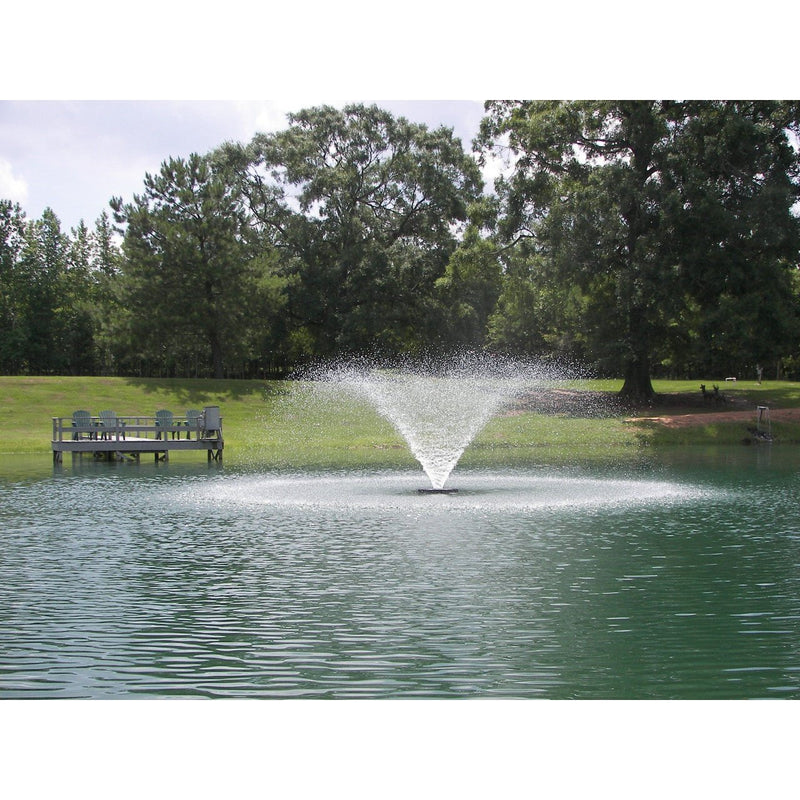
Why modern science beats tradition when it comes to keeping your fish alive. Old-school surface fountains look pretty, but they're incredibly inefficient at moving oxygen into the water. If you want maximum oxygen transfer, you need to go deep. Here is how we design systems for modern efficiency.
How to Design a Pond Aeration System for Maximum Oxygen Transfer
Pond aeration design is the mechanical process of increasing dissolved oxygen (DO) levels within a water body through controlled gas exchange. In technical terms, it involves maximizing the Standard Oxygen Transfer Rate (SOTR), which is the amount of oxygen a system can move into a liquid mass under standard conditions—typically 20°C at zero initial dissolved oxygen at sea level. Designing for maximum efficiency requires moving beyond visual aesthetics to focus on Standard Oxygen Transfer Efficiency (SOTE).
Traditional systems rely on surface agitation, which only influences the top 12 to 24 inches of the water column. In contrast, modern subsurface systems utilize fine bubble diffusion to leverage the entire depth of the pond. This design is used in aquaculture, municipal wastewater treatment, and private lake management where fish health and organic decomposition are the primary performance metrics. The fundamental goal is to overcome the oxygen saturation deficit efficiently, using the least amount of energy (measured in SAE, or Standard Aeration Efficiency) to achieve the highest possible DO levels at the benthic (bottom) zone.
Visualizing the system requires seeing the pond as a three-dimensional reactor. Every foot of depth provides a physical opportunity for oxygen to migrate from a bubble into the surrounding water. If the design fails to account for hydrostatic pressure, bubble rise time, or friction loss, the system will operate at a deficit, leading to anaerobic conditions at the bottom despite a "pretty" fountain at the surface.
How Sub-Surface Diffusion Works: The Physics of Gas Transfer
Oxygen transfer is governed by the Two-Film Theory, which suggests that gas must pass through a gas-film and a liquid-film interface. The rate of this transfer is dictated by Fick’s Law of Diffusion. To maximize this, design must focus on three physical variables: surface area, contact time, and pressure.
Bubble Surface Area: Fine bubble diffusers produce bubbles typically 1 to 3 mm in diameter. A single large 20 mm bubble from a coarse aerator has significantly less surface area than the thousands of 1 mm bubbles required to equal its volume. Because oxygen transfer occurs only at the interface where the bubble meets the water, increasing the total surface area per cubic foot of air directly increases the Oxygen Transfer Efficiency (OTE).
Hydrostatic Pressure and Saturation: As water depth increases, so does hydrostatic pressure. For every 2.31 feet of depth, pressure increases by 1 PSI. According to Henry’s Law, the solubility of a gas in a liquid is directly proportional to the partial pressure of that gas above the liquid. In deeper water, the increased pressure "pushes" more oxygen into the water. A diffuser at 15 feet is physically capable of transferring more oxygen than a diffuser at 5 feet, simply because the saturation point of the water is higher at the bottom.
Rise Time and Contact Duration: Sub-surface diffusion relies on the time it takes for a bubble to travel from the diffuser to the surface. Smaller bubbles rise more slowly than larger ones due to their lower buoyancy-to-drag ratio. This extended residence time allows for a longer duration of gas exchange. While a coarse bubble might reach the surface in seconds, a fine bubble "plume" creates a slow-moving column of air that interacts with the water for several times longer.
Benefits of Deep-Water Diffusion Systems
Choosing a deep-water diffusion system over surface aeration provides measurable improvements in water chemistry and mechanical efficiency. The most significant benefit is thermal destratification. Most ponds suffer from a thermocline—a sharp temperature gradient separating the warm, oxygen-rich surface from the cold, oxygen-depleted bottom. A subsurface aerator acts as an air-lift pump, pulling the dense, hypoxic water from the bottom and bringing it to the surface where it can vent CO2 and absorb atmospheric oxygen.
Aerobic Decomposition: By delivering oxygen to the benthic zone, you provide the necessary environment for aerobic bacteria to consume organic "muck" or sludge. Anaerobic decomposition at the bottom is slow and produces toxic byproducts like hydrogen sulfide and methane. Aerobic decomposition is significantly faster and cleaner, reducing nutrient loading that otherwise fuels algae blooms.
Energy Efficiency (SAE): Modern subsurface systems are rated by their Standard Aeration Efficiency (SAE), measured in pounds of oxygen transferred per horsepower-hour (lb O2/hp-hr). Fine bubble diffusers often reach SAE values of 2.5 to 4.0, whereas surface fountains frequently drop below 1.5. This means you can achieve higher oxygen levels with lower monthly electricity costs.
Challenges and Common Design Mistakes
The most frequent error in system design is failing to account for Total System Backpressure. Backpressure is the sum of three components: hydrostatic pressure (depth), diffuser resistance, and friction loss within the delivery tubing. If the compressor is not matched to the total backpressure, the motor will overheat, and air volume (CFM) will drop significantly.
Friction Loss in Tubing: Designers often use undersized 3/8-inch ID (inner diameter) tubing for long runs. As air travels through a pipe, friction against the walls creates resistance. For runs exceeding 100 feet, switching to 1/2-inch or even 3/4-inch tubing is mandatory to prevent the compressor from working against its own delivery lines. High friction leads to increased heat at the compressor head, which can melt internal valves and shorten the lifespan of the diaphragms.
Improper Compressor Selection: There is a critical difference between a linear diaphragm pump and a rocking piston compressor. Diaphragm pumps are quiet and efficient but generally cannot handle pressures above 4-5 PSI (roughly 9-11 feet of depth). Rocking piston compressors are designed for higher pressures, making them suitable for ponds 15 to 40 feet deep. Using the wrong pump type results in either premature mechanical failure or zero airflow at the diffuser.
Limitations and Environmental Constraints
Sub-surface aeration is not a universal solution. In extremely shallow ponds—those less than 4 to 5 feet deep—the bubble rise time is too short to allow for efficient gas transfer. In these scenarios, the physical "splash" of a surface aerator may actually move more oxygen because the diffusion plume lacks the vertical space to develop. Additionally, in very shallow water, the "lifting" capacity of the air bubbles is reduced, meaning the system may fail to fully circulate the water from the edges of the pond.
The Alpha Factor: In technical design, we must consider the Alpha Factor (α), which is the ratio of oxygen transfer in pond water versus clean tap water. Dissolved solids, salts, and surfactants (from organic decay or fertilizers) can lower the α factor, making it harder for oxygen to cross the bubble interface. In highly productive (eutrophic) ponds, a system that looks "sufficient" on paper may underperform because the water chemistry itself is resisting oxygen uptake.
Comparing Traditional Fountains vs. Modern Diffusion
To understand the efficiency gap, we can compare the performance metrics of a standard 1-HP floating fountain versus a 1/2-HP subsurface diffusion system in a 10-foot deep pond.
| Feature | 1-HP Surface Fountain | 1/2-HP Sub-Surface Diffusion |
|---|---|---|
| Oxygen Transfer Rate (SOTR) | 1.5 - 2.0 lb O2/hr | 2.0 - 3.5 lb O2/hr |
| Effective Aeration Depth | Top 2 feet | Full Water Column |
| Circulation Pattern | Localized Surface Spray | Total Bottom-to-Top Lift |
| Power Consumption | ~800 - 1000 Watts | ~300 - 450 Watts |
| Bottom Muck Reduction | Minimal | Significant (Aerobic) |
The table demonstrates that the subsurface system provides superior oxygenation while consuming less than half the electricity. This is why commercial aquaculture and large-scale lake management have moved away from decorative surface units for primary life support.
Practical Tips for System Optimization
- Placement Strategy: Always place diffusers in the deepest part of the pond to maximize rise time. If the pond has multiple "bowls" or deep pockets, each pocket requires its own diffuser to prevent localized dead zones.
- Verify Compressor CFM at Depth: Do not buy a compressor based on its "open flow" rating. Look at the flow chart for its CFM at 5 PSI or 10 PSI. A pump that moves 4.0 CFM at the surface might only move 1.5 CFM at 12 feet of depth.
- Manifold Balancing: If running multiple diffusers from one compressor at different depths, you must use a manifold with individual valves. Air follows the path of least resistance; without valves, all the air will go to the shallowest diffuser, leaving the deep one inactive.
Advanced Considerations: Sizing for BOD and COD
Serious practitioners must size systems based on the Biological Oxygen Demand (BOD) and Chemical Oxygen Demand (COD) of the pond. BOD is the amount of oxygen required by bacteria to break down organic matter, while COD represents the oxygen consumed by chemical reactions (like the oxidation of iron or ammonia).
In a pond with a high "muck" layer, the BOD can be massive. Simply "adding some air" is often insufficient. To calculate the required SOTR, you must estimate the daily influx of organic matter (leaves, fish waste, fertilizer runoff) and the existing volume of sludge. A standard rule of thumb for maintenance is 1 to 2 CFM per acre, but for active remediation of a polluted pond, requirements can jump to 5+ CFM per acre. Failing to meet the BOD/COD threshold means the pond will remain in a state of chronic hypoxia regardless of whether the aerator is running.
Scenario: Remediation of a 1-Acre Eutrophic Pond
Consider a 1-acre pond with an average depth of 8 feet and a maximum depth of 12 feet. The pond has a 6-inch layer of organic sludge and frequent summer fish kills. A decorative 1.5-HP fountain is currently installed but the water remains murky and smells of sulfur.
Technical Solution: Remove the fountain as a primary oxygenator. Install a 1/2-HP rocking piston compressor housed in a ventilated cabinet. Run 1/2-inch weighted tubing to two dual-disc fine bubble diffusers. Place the first diffuser at 12 feet (the deepest point) to maximize the "chimney effect" for circulation. Place the second at 8 feet in a secondary deep area.
Result: Total system backpressure is calculated at approximately 6.5 PSI (5.2 PSI from depth + 0.5 PSI from the diffuser + 0.8 PSI from friction loss). The compressor provides 3.2 CFM at this pressure. This setup delivers roughly 1.8 lbs of oxygen per hour directly to the bottom. Within 30 days, the sulfur smell vanishes as the benthic zone becomes aerobic, and the increased Standard Aeration Efficiency reduces the monthly electric bill by 60% compared to the old fountain.
Final Thoughts
Efficiency in pond management is a matter of physics, not aesthetics. While surface fountains provide a visual benefit, they are functionally limited by their inability to interact with the deeper, more critical layers of the water column. Designing for modern efficiency requires a commitment to subsurface diffusion, fine bubble technology, and rigorous backpressure calculation.
By focusing on the Standard Oxygen Transfer Rate and the Standard Aeration Efficiency, you ensure that every watt of electricity consumed translates into the maximum possible dissolved oxygen for your aquatic ecosystem. This technical approach not only protects your investment in fish and water quality but also provides a sustainable, long-term solution for pond health.
As you implement these systems, remember that the most effective design is one that works from the bottom up. Experimenting with diffuser placement and monitoring DO levels at various depths will allow you to fine-tune the system for the specific oxygen demands of your environment. For those looking to go further, exploring the relationship between nutrient loading and oxygen consumption will provide the final piece of the puzzle in total water management.