

How Dock Deicers Prevent Ice Jacking
Is your dock standing still while the ice is moving in for the kill? Static ice is a slow-motion wrecking ball for your dock. When water stops moving, it expands with enough force to rip pilings right out of the lakebed. See how dynamic water movement uses the lake's own energy to create a protective 'liquid moat' that no freeze can cross.
The maintenance of marine infrastructure in cold climates requires a precise understanding of fluid dynamics and thermal stratification. Standard dock pilings are not designed to withstand the vertical and lateral loads generated by a solidifying ice sheet. Without active thermal management, the structural integrity of a waterfront asset is compromised the moment the surface temperature reaches the triple point of water.
This article examines the mechanical systems and physical principles utilized to mitigate ice-related structural failure. It focuses on the transition from static, freezing conditions to a state of controlled circulation, a process often referred to as maintaining flowing heat.
How Dock Deicers Prevent Ice Jacking
Ice jacking is a mechanical process where a fluctuating ice sheet adheres to a vertical structure and exerts vertical lift as the water level rises. The adhesion between the ice and the piling, known as adfreeze, creates a bond with high shear strength. When tides, seiches, or thermal expansion cause the ice sheet to elevate, the piling is pulled upward, often exceeding the soil's friction-based holding capacity.
Dock deicers prevent this by utilizing thermal destratification. In most deep freshwater bodies, water is at its maximum density at approximately 3.98°C (39°F). This warmer, denser water settles at the benthic zone (the bottom). A deicer acts as a mechanical pump, drawing this 3.98°C water upward to the surface.
This continuous stream of warmer water prevents the surface from reaching the freezing point. The thermal energy transferred from the bottom of the lake creates a "liquid moat" around the structure. This gap ensures that the ice sheet cannot form an adfreeze bond with the piling, effectively neutralizing the vertical jacking force.
Mechanics of Thermal Destratification
The operation of a deicer relies on the exploitation of the density-temperature relationship of water. During winter, lakes undergo reverse stratification. The coldest water (0°C) is at the surface because it is less dense than the water slightly below it.
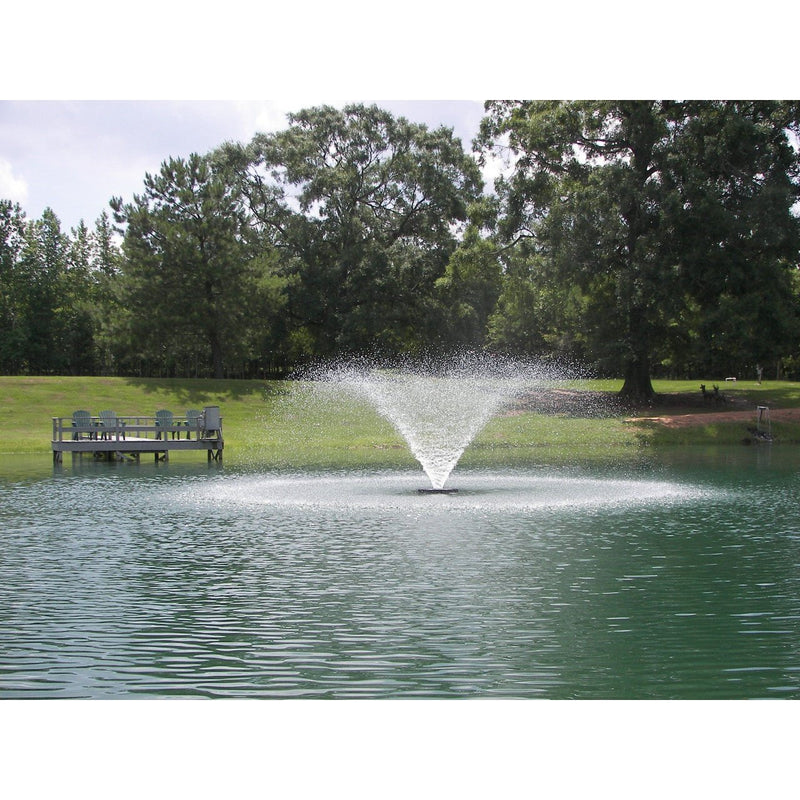
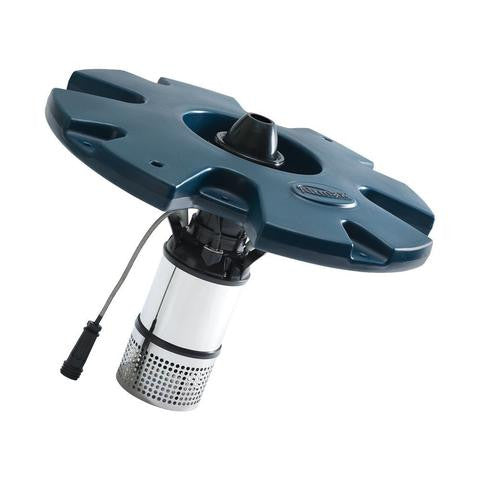
Mechanical circulators, or submersible deicers, utilize a high-thrust propeller to create a focused column of water movement. This water column carries thermal units (BTUs) from the deeper, warmer layers to the surface. The efficiency of this process is determined by the volume of water moved, measured in Gallons Per Minute (GPM), and the temperature differential between the bottom and the surface.
Diffused air systems, commonly known as bubblers, operate on a different principle. A shore-mounted compressor forces air through submerged weighted tubing. As bubbles rise, they create a vertical current through a process called "gas-lift." This current drags the warmer bottom water to the surface. While bubblers move less volume than propellers, they are often more efficient in shallow applications where a propeller might disturb the lakebed.
Benefits of Active Ice Management
Implementing a deicing system provides measurable protection for marine structures. The primary advantage is the total elimination of adfreeze forces, which can exceed 150 psi on steel pilings and even higher on rough timber surfaces.
Active circulation also prevents lateral ice crushing. An expanding ice sheet can exert massive horizontal pressure on a dock. By maintaining an open water buffer, the ice sheet expands into the open water rather than against the dock’s frame. This reduces the risk of structural buckling and weld failure.
Mechanical deicing systems offer significant cost savings compared to the annual removal and re-installation of dock sections. For permanent piers, deicers are the only viable method to prevent long-term degradation caused by "ice shove," where moving ice sheets act as a battering ram against the structure.
Challenges and Common Mistakes
Incorrect placement is a frequent cause of system failure. If a deicer is placed too deep, the column of water may lose its velocity and thermal energy before reaching the surface. Conversely, placing it too shallow can cause the unit to suck in surface air or "vortex," which drastically reduces thrust and can damage the motor.
Oversizing or undersizing the unit relative to the depth and area also presents risks. An undersized unit will fail to keep an adequate opening during extreme cold snaps, allowing the ice to close in and grip the pilings. An oversized unit may create an unnecessarily large opening, which can be an environmental concern or a safety hazard for winter lake users.
Electrical neglect is another significant pitfall. Deicers operate in a high-conductivity environment. Failing to use a dedicated Ground Fault Circuit Interrupter (GFCI) or neglecting to inspect power cords for muskrat damage can lead to catastrophic electrical failure or lethal stray current in the water.
Limitations of Deicing Technology
Deicers are not a universal solution for all environments. In very shallow water (less than 2–3 feet), there is often insufficient thermal energy at the bottom to melt surface ice. In these scenarios, the deicer relies solely on the kinetic energy of water movement, which is less effective when ambient temperatures drop below -10°C (14°F).
Extreme water depth also poses a challenge. If the deicer is suspended in a deep-water harbor without reaching the warmer bottom layers, it may simply circulate cold water, leading to a "supercooled" state where the unit itself becomes encased in ice.
Environmental regulations in certain jurisdictions may limit the use of deicers due to their impact on fish habitat or public safety on the ice. Some regions require specific permits or "Thin Ice" signage to mitigate the risk of snowmobiles or pedestrians falling through the open water created by the system.
Comparison: Submersible Propellers vs. Bubbler Systems
Choosing between a submersible propeller and a bubbler system depends on the specific geometry of the dock and the depth of the water.
| Feature | Submersible Propeller | Bubbler System (Diffused Air) |
|---|---|---|
| Water Depth Requirement | Minimum 4–6 feet for best results. | Effective in 2 feet or more. |
| Energy Consumption | Higher (typically 5–11 Amps). | Lower (typically 1–3 Amps). |
| Open Water Pattern | Circular or elongated oval. | Narrow "string" along the hose line. |
| Maintenance | Requires periodic removal for cleaning. | Compressor maintenance is on-shore. |
| Noise Level | Silent (underwater). | Audible compressor hum on shore. |
Submersible units are generally preferred for large marinas and heavy-duty pilings where massive water movement is required. Bubbler systems are ideal for long, narrow docks or shallow shorelines where a circular opening is not desired.
Practical Tips and Best Practices
The use of a thermostat, such as the C-20 controller, is highly recommended for optimizing energy efficiency. These devices turn the deicer on only when the air temperature drops below a set threshold (usually 32°F). This prevents the unit from running during warm spells, extending the motor's lifespan and reducing utility costs.
Zinc anodes must be attached to the motor housing to prevent galvanic corrosion. In brackish or salt water, electrolysis will rapidly degrade the stainless steel and aluminum components of the deicer. Sacrificial anodes ensure that the corrosion attacks the zinc rather than the structural components of the motor.
Positioning the deicer at a 45-degree angle is often more effective than vertical suspension. An angled flow creates an elongated "glade" of open water, which is useful for protecting a long section of dock or a boat hull. Ensure the flow is directed from deep water toward the structure to maximize the transport of warm thermal units.
Advanced Considerations in Ice Management
Serious practitioners should monitor the "ice collar" formation on pilings. Even with a deicer, a small ring of ice may form during extreme cold. The goal is not necessarily 100% open water, but rather ensuring the ice remains "rotten" or disconnected from the main ice sheet.
Computational fluid dynamics (CFD) models suggest that the interaction between multiple deicers can create a synergistic effect. In large marina configurations, placing units so their flow patterns overlap can create a continuous thermal barrier that is more resilient than the sum of its parts.
Variable Frequency Drives (VFDs) are an emerging technology in the deicing sector. These allow for the adjustment of motor speed based on real-time temperature data. Reducing the RPM during milder winter days saves energy, while increasing the thrust during a polar vortex ensures the structural integrity of the dock is maintained.
Example: Calculating BTU Transfer
Consider a 3/4 HP deicer moving 400 GPM of water. If the bottom water is 39°F and the surface is 32.5°F, the system is transferring a significant amount of heat.
Since one gallon of water weighs approximately 8.34 lbs, the system moves 3,336 lbs of water per minute. The temperature difference (Delta T) is 6.5°F. Using the formula (lbs of water x Delta T), the unit is delivering approximately 21,684 BTUs per minute to the surface. This thermal energy is what prevents the formation of ice, even when ambient air temperatures are well below zero.
Understanding these numbers allows a dock owner to quantify the efficiency of their setup. If the open water area begins to shrink, it indicates that the heat loss to the atmosphere is exceeding the BTU delivery from the deicer, necessitating a change in depth or a higher-powered unit.
Final Thoughts
The prevention of ice jacking is a mechanical necessity for any permanent waterfront structure in freezing climates. By transforming static water into a dynamic thermal exchange system, deicers neutralize the physical forces that lead to piling failure and structural deformation.
Success in ice management requires a balance of proper equipment selection, precise installation, and ongoing monitoring. Whether utilizing a high-thrust submersible or a low-energy bubbler, the objective remains the same: the maintenance of a liquid buffer between the ice sheet and the dock.
Implementing these systems effectively ensures that a dock remains a long-term asset rather than a liability. Careful attention to depth, angle, and thermal stratification will allow for a reliable "liquid moat" that protects investments throughout the harshest winter cycles.