

Harnessing Lake Thermal Layers For Deicing
There is enough energy at the bottom of your lake to save your dock—if you know how to harvest it. Most people think they need to 'create' heat to melt ice. The truth? Your lake is already a massive thermal battery. A dock deicer doesn't just spin; it's a fuel pump for the heat nature already provided at the bottom. Stop wasting that energy and start using it as your dock's best defense.
Harnessing Lake Thermal Layers For Deicing
Thermal stratification is the primary mechanism that allows a dock deicer to function without an internal heating element. In temperate freshwater lakes, water exhibits a unique physical property known as the density anomaly. Unlike most substances that become denser as they cool toward their freezing point, water reaches its maximum density at approximately 3.98°C (39.2°F).
As autumn transitions into winter, the surface water cools and sinks because it is denser than the warmer water below. This process continue until the entire water column reaches 4°C. Once the surface water cools below 4°C, it becomes less dense and remains at the surface. This creates a state of reverse stratification where the coldest water (0°C or 32°F) and ice float on top of a stable, "warm" layer of 4°C water at the bottom.
This bottom layer, often called the hypolimnion in deep lakes, serves as a significant thermal reservoir. Even in the peak of winter, this water contains a vast amount of latent heat energy. A mechanical deicer or circulator serves as a heat exchanger, physically transporting this 4°C water to the surface. When this warmer water reaches the interface where ice would otherwise form, it transfers its thermal energy to the surface layer, preventing the phase change from liquid to solid.
How It Works: Mechanical Heat Transfer
Mechanical deicing systems operate on the principle of forced convection. Instead of generating heat through electrical resistance, these systems move large volumes of water to disrupt the thermal equilibrium at the surface. This process relies on two primary mechanical archetypes: circulators (agitators) and diffused aeration (bubblers).
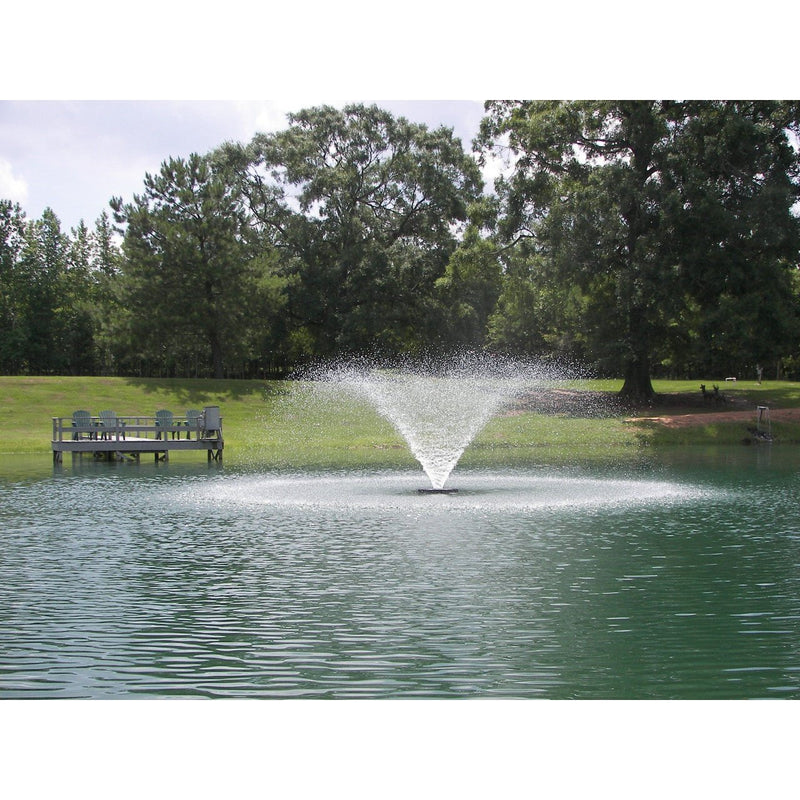
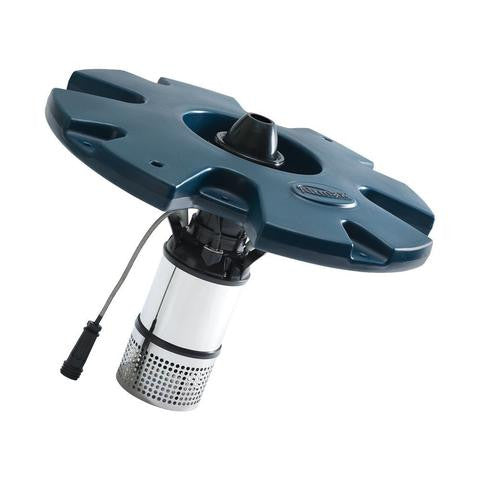
High-velocity circulators use a motor-driven propeller to draw water directly from the deeper, warmer layers. A typical 1/2 horsepower (HP) motor can move between 300 and 500 gallons of water per minute (GPM). This water is directed toward the surface or the structure being protected. The kinetic energy of the moving water prevents ice crystals from bonding, while the thermal energy of the 4°C water raises the local surface temperature above the freezing point.
Diffused aeration systems, commonly called bubblers, use an onshore compressor to pump air through weighted tubing to a diffuser at the lake bed. As the air bubbles rise, they create a "chimney effect" or an airlift. This upward movement entrains the surrounding warm water and carries it to the surface. While bubblers move less water volume than circulators, they are highly efficient at maintaining narrow, linear openings along a dock's perimeter without causing excessive surface turbulence.
Benefits of Thermal Layer Management
The primary advantage of using lake thermal layers is the massive mechanical advantage in energy efficiency. Generating heat through electrical resistance is a 1:1 energy conversion where one watt of electricity produces 3.41 BTUs of heat. In contrast, moving existing heat is orders of magnitude more efficient.
A 1,500-watt electric heater produces approximately 5,118 BTUs per hour. A 1/2 HP deicer drawing approximately 500-600 watts of power can move 400 gallons of 4°C water to the surface every minute. Since water at 4°C (39.2°F) contains approximately 60 BTUs of available heat per gallon relative to the freezing point (32°F), the deicer effectively delivers 24,000 BTUs per minute, or 1,440,000 BTUs per hour. This represents a thermal transfer capacity hundreds of times greater than an equivalent electric heater.
Structural protection is the most immediate practical benefit. Ice damage to docks occurs through two main forces: "ice jacking," where fluctuating water levels pull pilings out of the lake bed, and "ice crushing," where the lateral expansion of an ice sheet exerts thousands of pounds of pressure against a fixed structure. By maintaining a liquid barrier around the dock, these forces are neutralized.
Challenges and Common Mistakes
The most frequent error in dock deicing is the concept of "wasted thermals." This occurs when a deicer is run continuously or placed at an incorrect depth, leading to the exhaustion of the local warm water reservoir. If a deicer draws water faster than the lake can replenish the thermal layer, the water temperature in the immediate area will eventually drop toward 0°C, and the system will fail to prevent ice formation despite the motor running.
Sediment disturbance is another technical challenge. High-power circulators placed too close to the lake bed can stir up silt and organic matter. This not only clouds the water but can also release sequestered nutrients like phosphorus into the water column. Excess nutrients often lead to localized algal blooms in the spring. Furthermore, constant sediment abrasion can accelerate the wear on the deicer’s mechanical seals and propeller.
Improper angling of circulators can lead to "ice floe acceleration." If a deicer creates an excessively large opening, it allows wind-driven ice sheets from the center of the lake to gain momentum before striking the dock. The goal is to maintain a narrow, 12-to-24-inch "thermal barrier" around the pilings, rather than clearing the entire bay.
Limitations of Thermal Deicing
Depth is the most significant limiting factor for thermal deicing. In very shallow water—typically less than four feet—there is often no distinct thermal stratification. The entire water column may cool uniformly to near-freezing temperatures. Without a reservoir of 4°C water, a deicer can only rely on kinetic energy (moving the water) to prevent ice, which is significantly less effective than thermal transfer.
Extreme ambient air temperatures also present a limit. If the air temperature drops low enough (e.g., -20°F or lower) and the wind speeds are high, the rate of heat loss at the water’s surface may exceed the rate of heat delivery from the bottom. In these conditions, even a high-output system may struggle to maintain an opening, leading to the formation of "slush ice" or "grease ice" that can eventually stall the propeller.
Environmental regulations vary by jurisdiction and can impose practical limits on deicer use. Some regions require specific signage or lighting to warn of thin ice, while others may restrict the size of the open water area to protect local wildlife or recreational access. Users must ensure their system’s thermal footprint complies with local laws.
Comparison: Circulators vs. Bubblers
Choosing between a circulator and a bubbler depends on water depth, dock configuration, and local climate severity. The following table highlights the technical differences between these two primary systems.
| Factor | Propeller Circulator | Diffused Aeration (Bubbler) |
|---|---|---|
| Power Consumption | High (400W - 1200W) | Low (60W - 300W) |
| Depth Requirement | Minimum 4-5 feet | Effective in 3-15+ feet |
| Heat Transfer Rate | Very High (High GPM) | Moderate (Airlift effect) |
| Sediment Risk | High (Propeller wash) | Low (Rising air bubbles) |
| Maintenance | Submerged motor service | Onshore compressor service |
Practical Tips and Best Practices
Optimization of a deicing system starts with proper placement. A circulator should generally be placed 2-3 feet below the expected ice level but at least 2 feet above the lake bed. Angling the unit at 45 degrees toward the surface is often more effective than a vertical orientation, as it creates an elongated "glade" of open water that can protect a larger section of the dock.
Thermostatic control is essential for energy efficiency and system longevity. Running a deicer when the air temperature is 40°F is a waste of both electricity and the lake's thermal reserve. A high-quality thermostat will only activate the motor when the air temperature drops below a set threshold, typically 30°F or 32°F. Adding a timer to the circuit can further refine the operation, allowing the system to run in "pulses" during the coldest parts of the night.
Regular inspection of the power cable is a critical safety step. Submerged cables are subject to abrasion from moving ice and potential damage from aquatic life. Using a sacrificial zinc anode on the motor housing is also recommended for systems installed in brackish water or lakes with high mineral content to prevent galvanic corrosion of the motor housing.
Advanced Considerations: Fluid Dynamics and Thermal Flux
Serious practitioners should consider the "Thermal Flux" required for their specific site. The amount of heat required to keep a hole open is equal to the heat lost to the atmosphere through evaporation, radiation, and conduction. This is heavily influenced by the "Fetch" of the lake—the distance the wind travels over the water before reaching the dock.
The Nusselt number, a dimensionless ratio of convective to conductive heat transfer, can describe the efficiency of the deicer's flow. Increasing the velocity of the water (via a higher HP motor or more aggressive prop pitch) increases the convective heat transfer coefficient. However, there is a point of diminishing returns where the electricity cost exceeds the marginal gain in ice prevention.
Scaling considerations are also vital for large marinas. Multiple deicers can be synchronized to create a "curtain" of warm water. In these setups, the spacing between units must be calculated based on the "exit velocity" of the water from each propeller to ensure there are no "dead zones" where ice can take hold and begin to bridge the gap between pilings.
Example Scenario: 1/2 HP Circulator in 8 Feet of Water
Consider a standard 1/2 HP deicer installed at a depth of 5 feet in an 8-foot-deep lake. The ambient air temperature is 10°F, and the bottom water temperature is a stable 39.2°F. The unit is angled at 30 degrees from vertical.
The motor draws 5 amps at 115V (575 Watts). It moves approximately 400 GPM. As the 39.2°F water hits the 32°F surface, it releases approximately 60 BTUs per gallon. Over one hour, the system moves 24,000 gallons of water, delivering 1.44 million BTUs of thermal energy to the surface.
This thermal delivery is sufficient to keep an area approximately 15 feet wide and 30 feet long completely free of ice, even with a 10 MPH wind. If the same system were run without a thermostat, it might over-cool the local area within 48 hours, reducing the bottom temperature to 35°F and shrinking the open water diameter by 40% as the "thermal fuel" is depleted.
Final Thoughts
Efficient dock deicing is an exercise in resource management, not brute force. By understanding the density-driven stratification of your lake, you can transition from trying to "fight" the ice to simply moving the energy that is already available. The 4°C water sitting at the bottom of the lake is your most valuable asset during the winter months.
Properly calibrated systems—using thermostats, correct depth placement, and appropriate hardware—will protect structural integrity while minimizing electrical costs and environmental impact. Focus on the mechanics of heat transfer and the preservation of your lake's thermal battery.
As you implement these techniques, remember that every lake has its own unique thermal profile. Experiment with depth and timing to find the "sweet spot" for your specific location. Mastering these principles ensures that your waterfront remains protected and your energy usage remains optimized throughout the harshest winters.