

Dock Heaters Vs Water Circulators
Why pay to create artificial heat when the lake is already holding a massive thermal battery? Isolated heating elements are a battle against physics you will always lose. Strategic circulators integrate with the lake's natural environment, moving existing warmth to where it's needed most. It’s the difference between a space heater in a blizzard and a central heating system for your entire waterfront.
Understanding how to keep your dock safe during the winter requires a shift in perspective. Most people look at a frozen lake and see a solid block of ice that needs to be melted. In reality, you are standing on top of a massive reservoir of stored energy. This article breaks down the mechanical and thermodynamic differences between trying to create heat (dock heaters) and leveraging the heat that is already there (water circulators).
Dock Heaters Vs Water Circulators
Comparing these two systems is essentially a debate between raw energy consumption and mechanical efficiency. A traditional dock heater—often utilizing "isolated coils" or resistive heating elements—attempts to raise the water temperature through direct energy transfer. This method is incredibly energy-intensive because water has a high specific heat capacity. You are effectively trying to boil a small portion of the ocean while the environment is constantly stripping that heat away.
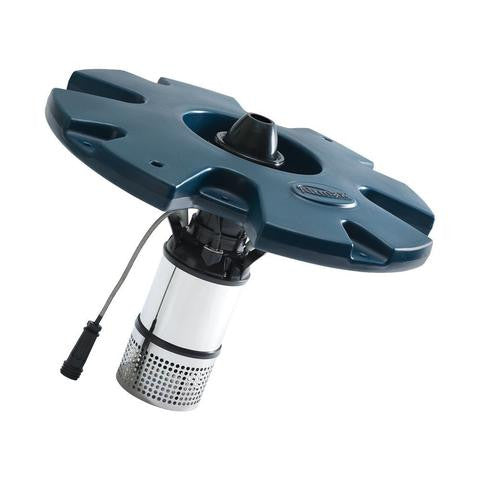
Water circulators, also known as de-icers or "ice eaters," take a completely different approach. These units use a high-efficiency motor and a specially pitched propeller to move water. Their goal is not to "heat" the water in the way a kettle does. Instead, they move the warmer, denser water found at the bottom of the lake up to the surface. This creates a "thermal flow" that prevents ice from forming by constantly replacing the surface water before it can reach the freezing point.
In real-world applications, you will rarely see a pure "heater" used for a residential dock. They are simply too expensive to operate. Most professional-grade systems labeled as "dock heaters" in consumer catalogs are actually water circulators. These devices are the industry standard because they work with the lake's natural thermal stratification rather than against it. Whether you are protecting a single boat lift or a commercial marina, the mechanical movement of water is the only fiscally responsible way to prevent ice damage.
How the Thermal Battery Works
Lakes and ponds exhibit a unique physical property known as thermal stratification. Most substances become denser as they get colder until they turn into a solid. Water follows this rule until it hits 39.2°F (4°C). At this precise temperature, water reaches its maximum density and sinks to the bottom. As the water cools further toward 32°F (0°C), it actually becomes less dense and floats back to the top.
This phenomenon creates an "inverse stratification" in the winter. While the air temperature might be -20°F, the water at the bottom of a deep enough lake remains a constant 39°F. This 7-degree difference between the surface (32°F) and the bottom (39°F) is your thermal battery. Water circulators tap into this battery by drawing the 39°F water upward.
The mechanism of action is straightforward but powerful. A circulator mounted 4 to 5 feet below the surface creates a continuous jet of "warm" water directed at the dock pilings or boat hull. Because this water is above the freezing point, it prevents the latent heat of fusion from allowing ice crystals to bond. Even in extremely shallow water where the bottom temperature might only be 34°F, the constant velocity of the water prevents ice from gaining a foothold.
Performance Metrics: Thrust and Amperage
When selecting a system, you must look at the data. The most critical metrics are thrust (measured in pounds) and amperage draw. Thrust determines how much water the unit can move, while amperage determines how much it will cost you on your monthly utility bill.
High-end models from manufacturers like Kasco or Power House (Bearon Aquatics) are engineered to maximize thrust per watt. For example, a standard 1/2 HP de-icer typically draws between 5.0 and 5.4 amps on a 120V circuit. This 1/2 HP unit can produce roughly 26 to 31 pounds of thrust. In a standard winter environment, a single 1/2 HP unit can maintain an ice-free circle approximately 50 feet in diameter.
| Horsepower (HP) | Typical Amps (120V) | Thrust (lbs) | Effective Diameter |
|---|---|---|---|
| 1/2 HP | 5.0 - 5.4 | 26 - 31 | Up to 50' |
| 3/4 HP | 6.6 - 6.7 | 34 - 37 | Up to 75' |
| 1 HP | 7.0 - 11.3 | 36 - 52 | Up to 90' |
Using "isolated coils" to achieve the same 50-foot clearing would require thousands of watts of power. Because resistive heating is 100% efficient at turning electricity into heat but 0% efficient at moving that heat through a medium like a lake, the energy cost is astronomical. Water circulators are the clear winner in any efficiency metric because they leverage the "work" of moving existing heat rather than the "work" of creating it.
Benefits of Water Circulators
Mechanical de-icing offers several measurable advantages over any other method. The primary benefit is the prevention of "ice jacking." This occurs when ice freezes around a dock piling and the lake level fluctuates. As the water level rises and falls, the ice sheet acts as a hydraulic jack, literally pulling the pilings out of the lake bed. Circulators prevent this by keeping a buffer of liquid water around the structure, ensuring the ice sheet never makes a solid connection to your dock.
Another advantage is the support of aquatic health. Keeping an area of the water open allows for gas exchange. In many frozen lakes, oxygen levels can deplete, leading to winter fish kills. A circulator provides a localized area where oxygen can enter the water and harmful gases like methane can escape. This is a subtle but important benefit for property owners who care about the long-term ecology of their waterfront.
Durability is also a significant factor. Modern circulators are built with marine-grade stainless steel and are designed to be submerged 24/7 in harsh conditions. They often feature oil-cooled motors with internal seals that prevent water intrusion. This industrial-grade construction means a well-maintained unit can last for a decade or more, providing a high return on investment compared to the frequent failure rates of cheaper, consumer-grade heating elements.
Challenges and Common Mistakes
Placement is where most people fail. A common mistake is placing the circulator too shallow. If the unit is only a foot below the surface, it will only move the coldest water. For optimal performance, the unit should be submerged 3 to 5 feet deep. This ensures it reaches the denser, warmer water at the bottom. If the water is too shallow to allow for this depth, you should mount the unit at an angle to pull water from a deeper area nearby.
Ignoring the "ice floe" risk is another frequent error. When you create a large open area in the middle of a frozen lake, you are essentially creating a runway for floating ice. If a large sheet of ice breaks loose in a storm, it can gain momentum across the open water and slam into your dock with devastating force. To avoid this, you should only open the area absolutely necessary to protect your structures. Using a timer or a thermostat (like a C-10 or C-20 controller) helps limit the open area to a safe size.
Sediment disruption is a technical challenge that can lead to environmental issues. If a circulator is pointed directly at the bottom in shallow water, it will kick up muck and silt. This clouds the water and can lead to nutrient release, which may cause algae blooms in the spring. Always tilt the unit slightly upward or ensure it has enough clearance (at least 1 foot) from the lake bed to avoid "mining" the bottom.
Limitations and Environmental Constraints
Water circulators are not magic. They have physical limits based on the environment. In extremely shallow lakes—those less than 4 feet deep—there simply isn't enough warm water to draw from. In these scenarios, the circulator is mostly relying on the kinetic energy of moving water to prevent freezing. While this still works, it is much less effective than in deep lakes. If the ambient air temperature stays below -20°F for weeks at a time, even the best circulator may struggle to keep up.
Saltwater environments pose their own set of constraints. Saltwater has a lower freezing point (around 28.4°F) and behaves differently regarding density. While circulators still work in the ocean, they require specialized "zinc anodes" to prevent galvanic corrosion. Without these sacrificial anodes, the electrical current in the water will eat away at the motor housing, leading to catastrophic failure within a single season.
Local regulations are also a factor. Some states and municipalities have strict laws regarding de-icers. Because they create open water that can be a hazard for snowmobilers or ice fishermen, you are often legally required to post "Danger: Thin Ice" signs. Some jurisdictions even limit the hours a de-icer can run or the total area of open water you are allowed to maintain. Always check local ordinances before installing a high-powered circulator system.
Practical Tips for Best Results
Optimizing your setup can save you hundreds of dollars in electricity. The first tip is to use a thermostat. Most de-icers don't need to run when the air temperature is 35°F. A thermostat will automatically kick the unit on when the air temperature drops below freezing and turn it off when it's no longer needed. This simple addition can reduce your operating costs by 50% or more.
Angle your thrust strategically. If you have a long, straight dock, mounting the circulator at the end and pointing it toward the shore will create an oval-shaped opening that protects the entire length of the structure. If you have a boat lift, you may need a vertical mount to create a circular opening directly under the lift. Experimenting with different angles during the first few days of a freeze will show you exactly how the "thermal flow" is interacting with your dock's unique geometry.
Maintenance is non-negotiable. At the end of the season, pull the unit out of the water. Inspect the propeller for nicks or cracks, as even a small imbalance can wear out the motor bearings. Clean any calcium or scale buildup off the motor housing with a stiff brush and mild vinegar solution. Most importantly, check the sacrificial anode. If it is more than 50% dissolved, replace it immediately to ensure the motor remains protected for the next season.
Advanced Considerations: Latent Heat and Delta-T
For those looking to dive deeper into the physics, consider the "latent heat of fusion." It takes a massive amount of energy to turn 32°F water into 32°F ice—roughly 80 calories per gram. This is why water doesn't flash-freeze the moment the air hits 31 degrees. A water circulator's primary job is to disturb the boundary layer where this energy exchange happens.
The "Delta-T" (the difference in temperature) between the bottom and surface water dictates your efficiency. In a lake with a high Delta-T, your circulator will clear a much larger area. If you find your unit isn't performing as expected, use a probe thermometer to check the temperature at different depths. If the temperature is uniform from top to bottom (a state called "isothermal"), you may need to increase the horsepower or change the location of the unit to find a deeper thermal pocket.
Advanced users also consider the "power factor" of their motors. Industrial-grade de-icers are often capacitor-start/capacitor-run, which improves their electrical efficiency. When comparing units, look for the "Total Unit Efficiency" metric. This tells you how many pounds of thrust you get per watt of electricity. High-efficiency units may cost more upfront but will pay for themselves through lower utility bills in just a few seasons.
Scenario: Protecting a 40-Foot Fixed Piling Dock
Imagine a standard fixed dock in a Northern climate with 6-foot water depth. The owner has two choices: let the ice freeze and risk ice jacking, or install a de-icing system.
Using a 1/2 HP Kasco de-icer mounted 4 feet deep at the end of the dock, tilted at a 30-degree angle toward the shore, the owner creates a 60-foot by 25-foot oval of open water. This opening completely surrounds the dock pilings. At an average cost of $0.12 per kWh, running this 5-amp unit 24/7 would cost roughly $43 per month. However, by adding a C-20 timer/thermostat set to run only when the temperature is below 30°F, the owner reduces the run time by 40%, bringing the cost down to about $26 per month.
In contrast, if the owner attempted to use a submerged heating element (an "isolated coil" system) to keep the same area clear, they would likely need a 5,000-watt industrial heater. Running that heater for the same period would cost over $400 per month and would likely fail to keep the area clear during a high-wind event because it lacks the kinetic energy to move the heated water across the entire 60-foot span. The choice for the circulator is not just a preference; it is a mathematical necessity.
Final Thoughts
Relying on the lake's natural thermal stratification is the smartest way to protect your waterfront investment. By moving 39-degree water to the surface, water circulators perform a task that would be physically impossible for traditional heating elements. They transform the lake itself from an adversary into a protective tool.
Effective de-icing is a blend of mechanical power and strategic placement. Choosing a unit based on thrust-to-amp efficiency, using a thermostat to control operating costs, and respecting the legal and environmental impacts of open water will ensure your dock survives the winter without a scratch.
As you prepare for the coming freeze, remember that you aren't just buying a motor; you're managing a thermodynamic system. Take the time to measure your water depth, understand your local lake's thermal profile, and choose a circulator that matches the scale of your dock. With the right setup, you can stop fighting the cold and start letting the water do the work for you.