

Protecting Dock Pilings From Ice Expansion
Your deepest water isn't a problem; it’s the secret weapon that keeps your dock from being ripped out of the ground. Ice 'jacking' is the silent killer of waterfront property. It happens when ice grips a post and the rising tide or expansion pulls it up. What most see as a 'nuisance'—the deep, cold water—is actually the asset you need to create a friction-free zone of safety. Invest in a deicer now, or pay for a new dock in April.
Effective ice management requires a fundamental understanding of thermal stratification and fluid dynamics. Surface ice does not merely sit on top of the water; it forms a mechanical bond with every vertical structure it touches. This bond, known as adfreeze, possesses significant shear strength. When water levels fluctuate or the ice sheet expands due to thermal changes, this bond transfers thousands of pounds of upward or lateral force directly into your dock pilings.
Operating a deicer is not about heating the lake; it is about mechanical energy and leveraging the Earth's natural thermal properties. In freshwater environments, water reaches its maximum density at approximately 39 degrees Fahrenheit (4 degrees Celsius). This denser, warmer water sinks to the bottom. A deicer functions by drawing this thermal reserve to the surface to prevent the phase transition from liquid to solid.
Protecting Dock Pilings From Ice Expansion
Protecting dock pilings from ice expansion is the process of maintaining a liquid barrier between structural supports and the surrounding ice sheet. When an ice sheet forms, it expands in volume by approximately 9 percent. In a confined space like a marina or a narrow bay, this expansion generates a crushing force. More importantly, in tidal or fluctuating freshwater systems, the ice sheet moves vertically. If the ice is bonded to a piling, the upward force of the rising water—aided by the buoyancy of the entire ice sheet—will pull the piling out of the substrate.
This phenomenon, commonly called ice jacking, occurs most frequently in silt or clay bottoms where the piling's friction against the soil is lower than the adfreeze strength of the ice. Once a piling is lifted even a few inches, sediment fills the void beneath it. When the water level drops, the piling cannot return to its original depth. Over several cycles, the dock becomes unlevel and eventually suffers structural failure.
Deicing systems act as a protective moat. By keeping the water in a state of constant motion and circulating warmer bottom water, these systems ensure that the ice never establishes a mechanical grip on the piling. This remains the most cost-effective method of preserving maritime infrastructure in cold climates. Without it, the structural integrity of a dock depends entirely on the tensile strength of the pilings and the grip of the underlying soil, both of which are often insufficient to resist the power of an expanding ice shelf.
Mechanics of Thermal De-Icing Systems
Mechanical deicers generally fall into two categories: high-volume circulators and low-volume bubblers. Each system utilizes different physical principles to achieve the same goal of preventing ice formation. Choosing the correct system requires an analysis of water depth, dock configuration, and local climate severity.
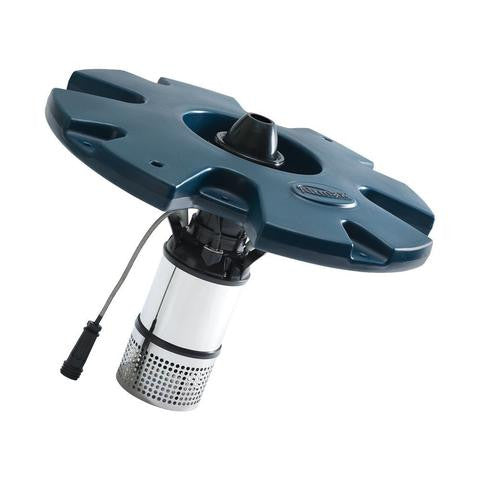
High-volume circulators, often referred to as power blockers or agitators, utilize an underwater motor and propeller. These units are submerged and angled to push a concentrated stream of water toward the surface or along a specific path. The mechanical movement prevents ice crystals from bonding, while the flow brings the 39-degree bottom water into contact with the surface. This creates a predictable, circular or oval opening in the ice.
Bubbler systems, or diffused air systems, rely on an onshore compressor that pumps air through weighted tubing to diffusers placed on the bottom. As the air bubbles rise, they create a "chimney effect," dragging the warmer bottom water to the surface. Bubblers are highly efficient in deep water and are preferred in areas where high-speed propellers might pose a risk to wildlife or where the water is too shallow for a submersible motor.
Selection Metrics: Bubblers vs. Power Circulators
Selecting the hardware for a deicing strategy depends on specific environmental variables. Power circulators are measured by horsepower (HP) and thrust, while bubblers are measured by cubic feet per minute (CFM) and the linear feet of tubing deployed.
Power circulators are ideal for large, open areas or where directional flow is required to protect a long string of pilings. A 1/2 HP motor can typically maintain an open-water radius of 15 to 25 feet, depending on the ambient temperature. These units are robust and provide immediate results, but they consume more electricity than diffused air systems. They also require sacrificial anodes to prevent galvanic corrosion in saltwater environments.
Diffused air bubblers excel in complex dock layouts with many small slips or in shallow water where a propeller would kick up silt. Because the air lines can be snaked around corners and under platforms, they provide more surgical protection. Bubbler systems are also generally more energy-efficient for long-term seasonal use. However, they are less effective in areas with high current or rapid water movement, as the bubbles can be swept away before they reach the surface.
| Feature | Power Circulator | Diffused Air Bubbler |
|---|---|---|
| Primary Mechanism | High-velocity propeller flow | Rising air bubbles (Chimney effect) |
| Ideal Depth | 4 feet to 10 feet | 8 feet or deeper (for max efficiency) |
| Energy Consumption | Higher (5.0 - 10.0 Amps) | Lower (1.5 - 4.0 Amps) |
| Maintenance | Motor seals and zinc anodes | Compressor filters and diaphragms |
| Ice Opening Shape | Circular or directional oval | Linear or distributed clusters |
Benefits of Proactive Ice Management
Implementing a dedicated deicing system provides measurable economic advantages over reactive repairs. The most immediate benefit is the prevention of structural displacement. When a dock piling is jacked or shifted, the cost of mobilization for a pile-driving barge often exceeds several thousand dollars before any actual work begins. Proactive deicing eliminates this capital risk.
Furthermore, deicers extend the lifespan of the dock materials themselves. Constant pressure from expanding ice can cause wood to splinter, bolts to shear, and concrete to crack. By maintaining a liquid environment, the hardware remains in a neutral state, reducing the rate of mechanical fatigue. For marinas and commercial waterfronts, this translates to lower insurance premiums and higher operational uptime.
Another advantage is the preservation of submerged utilities. Many modern docks house electrical conduits and water lines. If the dock structure shifts due to ice pressure, these lines can be severed, leading to dangerous electrical shorts or plumbing leaks. A stable dock structure ensures that utility connections remain secure throughout the winter months.
Challenges and Common Installation Mistakes
One of the most frequent errors in deicer deployment is improper depth placement. If a power circulator is placed too close to the surface, it will merely churn the cold top layer and may eventually freeze into the ice itself. Conversely, if it is placed too deep in a very shallow lake, it can stir up bottom sediment, which increases the wear on the motor seals and reduces the efficiency of the thermal transfer.
Inadequate electrical protection is another common pitfall. Deicers must always be connected to a Class A Ground Fault Circuit Interrupter (GFCI). Because these units operate in a highly conductive environment, any insulation failure in the power cord can create a lethal electrical field in the water. Furthermore, using undersized extension cords leads to voltage drops, which causes the motor to run hot and eventually burn out its internal capacitors.
Failure to account for "ice bridging" is a technical challenge often overlooked by beginners. If a deicer creates a hole in the ice but the surrounding ice sheet is still moving due to wind or current, the sheet can slide over the open water area and collide with the pilings. In high-wind areas, deicers must be positioned to create a wide enough buffer that the moving ice sheet cannot bridge the gap and exert lateral pressure on the structure.
Limitations and Environmental Constraints
Deicers are not a universal solution for every environment. Their effectiveness is strictly limited by the available thermal mass of the water. In very shallow bodies of water—less than 4 feet—the water column may freeze nearly to the bottom, leaving no warm water to circulate. In these scenarios, a deicer will only provide mechanical agitation, which is significantly less effective than thermal circulation.
Environmental regulations also vary by jurisdiction. Many local municipalities require specific signage to warn snowmobilers or ice fishermen of thin ice or open water. Because deicers create a "halo" of weakened ice around the open water, they can create a hazard for anyone traversing the frozen surface. Always check local ordinances regarding the marking of open water areas on public lakes.
There is also the consideration of oxygenation and nutrient loading. While deicing generally helps aquatic life by allowing for gas exchange, stirring up bottom sediment in a shallow, nutrient-rich pond can lead to algae blooms in the spring. Practitioners must balance the need for structural protection with the ecological health of the water body.
Practical Tips for Peak Efficiency
To maximize the efficiency of your deicing system, utilize a thermostat controller, such as the C-10 or similar industrial models. Running a deicer 24/7 when the temperature is 35 degrees Fahrenheit is a waste of electricity. A thermostat ensures the unit only activates when the air temperature drops below freezing, significantly reducing operational costs and motor wear.
Orientation is the next critical factor. For long docks, angle the circulator to push water down the length of the pilings rather than pointing it straight up. This creates a "flow lane" that protects multiple structures with a single unit. If you are using a bubbler, ensure the weighted tubing is level; air will always follow the path of least resistance, and if one end of the tube is higher than the other, the lower diffusers will produce fewer bubbles.
Keep a maintenance log for every unit. This should include the amperage draw during start-up and the condition of the sacrificial zinc anode. If the amperage draw begins to climb over several weeks, it often indicates that line or debris is wrapped around the propeller shaft, creating friction. Catching this early prevents total motor failure.
Advanced Considerations for Large-Scale Protection
For professional marina operators or large residential complexes, scaling a deicing system requires a load calculation. You must determine the total square footage of open water required to offset the maximum expected lateral expansion of the ice sheet. This often involves deploying multiple units in a synchronized grid to ensure no "dead zones" where ice can take hold.
Consider the impact of salinity in brackish or saltwater environments. Saltwater has a lower freezing point than freshwater, but it is also more corrosive. In these environments, the use of high-grade stainless steel components and frequent replacement of zinc anodes is mandatory. The higher density of saltwater also changes the thrust characteristics of propellers, meaning a motor may draw more current in the ocean than it would in a freshwater lake.
Advanced users may also implement variable frequency drives (VFDs) for their compressors or circulators. A VFD allows you to slow down the motor speed when the weather is only moderately cold, then ramp up to full power during a deep freeze. This level of control optimizes energy consumption and extends the mechanical life of the equipment by avoiding frequent hard starts in sub-zero temperatures.
Scenario: Protecting a Four-Piling Slip
Consider a standard boat slip supported by four timber pilings in 8 feet of water. The local climate regularly sees temperatures drop to 0 degrees Fahrenheit for extended periods. A single 1/2 HP power circulator, mounted 4 feet below the surface and angled at 45 degrees, is generally sufficient for this setup.
The unit should be positioned at the "upstream" end of the slip relative to any natural current. By aiming the flow so it hits the first two pilings, the current will naturally wrap around the piles and carry the warmer water toward the back two pilings. This creates a continuous loop of movement. If the water were shallower—around 3 feet—the owner should instead opt for a diffused air bubbler with a ring of tubing around the perimeter of the pilings to ensure the sediment isn't disturbed while still maintaining the adfreeze-free zone.
Final Thoughts
Understanding the physics of ice jacking and the thermal properties of water transforms winter dock maintenance from a guessing game into a precise engineering task. By leveraging the 39-degree water at the bottom of your basin, you turn the lake's own energy against the encroaching ice. Whether you choose a high-velocity circulator or a diffused air bubbler, the goal remains the same: eliminate the mechanical bond between the ice and your pilings.
The cost of electricity and equipment is a minor fraction of the expense required to replace a structurally compromised dock. Proactive ice management is not just a seasonal chore; it is an essential component of waterfront asset preservation. By selecting the right hardware, optimizing its placement, and monitoring its performance, you ensure that your property remains intact when the spring thaw finally arrives.
Take the time to assess your water depth and dock configuration now. The secret weapon for protecting your dock is already sitting at the bottom of the water column; you simply need the right tools to bring it to the surface. Implement these technical strategies and transition from a reactive property owner to a proactive maritime practitioner.