

Decorative Fountain or Aerating Fountain? Understanding the Difference
One is a decoration. The other is life support.
Do you want a pretty spray or a healthy pond? Most owners don't realize there is a massive difference in water movement.
Selecting between a decorative fountain and an aerating fountain requires a technical evaluation of your water body’s biological oxygen demand and hydraulic requirements. While both systems move water into the atmosphere, the mechanical principles governing their operation dictate vastly different outcomes for pond health and water clarity.
This guide provides a rigorous analysis of the mechanical, chemical, and environmental factors that separate aesthetic displays from functional aeration systems.
Decorative Fountain or Aerating Fountain? Understanding the Difference
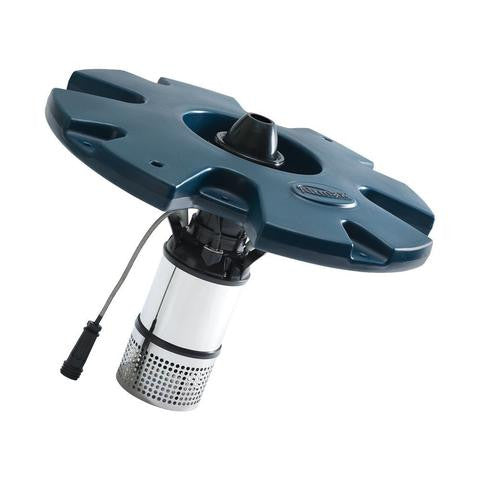
A decorative fountain is engineered for visual impact, prioritizing spray height, intricate patterns, and lighting effects. Mechanically, these units utilize centrifugal impellers to force water through restrictive nozzles at high pressure. This design creates a lower volume of water movement in exchange for a more dramatic vertical display.
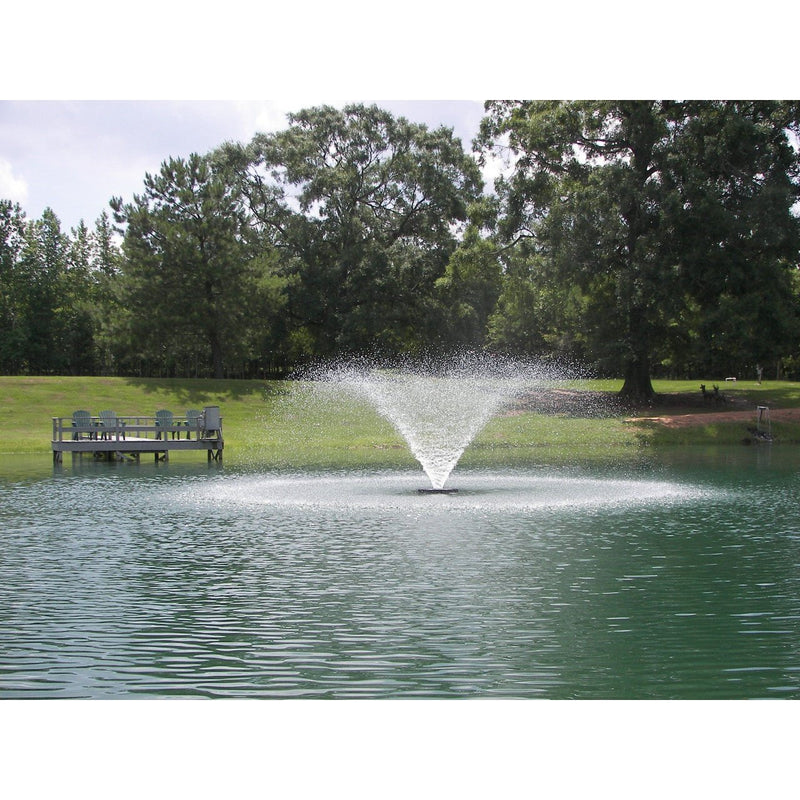
Conversely, an aerating fountain—often referred to as a "display aerator"—is a life-support system designed for high-volume water turnover. These units typically utilize high-pitched propellers rather than impellers. The lack of a restrictive nozzle allows the system to move a significantly larger mass of water at low pressure, usually in a classic "V" shaped pattern.
In real-world applications, the distinction is measurable in Gallons Per Minute (GPM). A standard 1-HP decorative fountain might move approximately 130 to 150 GPM (roughly 8,000 Gallons Per Hour). In contrast, a 1-HP aerating fountain can move 500 to 800 GPM (up to 30,000 to 48,000 Gallons Per Hour). This massive difference in volume directly correlates to the system's ability to facilitate gas exchange and prevent stagnation.
How the Mechanical Systems Work
The divergence in performance begins at the motor shaft. Decorative fountains rely on "head pressure" to achieve height. The impeller creates radial or centrifugal force, pulling water into the center and flinging it outward through a small orifice. This process consumes a significant portion of the motor’s energy just to overcome the friction and resistance of the nozzle.
Aerating fountains operate on the principle of axial flow. The propeller acts like a screw, pushing a wide column of water straight up. Because there is no nozzle to provide backpressure, nearly 100% of the motor's work is converted into water volume rather than vertical height.
Gas exchange occurs through two primary mechanisms:
- Atmospheric Interface: As water droplets are propelled into the air, they absorb oxygen and release harmful gases like carbon dioxide and methane.
- Surface Agitation: When the water falls back into the pond, the impact creates waves and turbulence, which further facilitates oxygen transfer at the surface.
High-volume aerating fountains maximize both mechanisms by ensuring that a larger percentage of the pond’s total volume reaches the surface every hour.
Benefits of High-Volume Aeration
The primary benefit of an aerating fountain is the maintenance of stable Dissolved Oxygen (DO) levels. Scientific data indicates that most fish species require DO levels above 5 parts per million (ppm) for optimal health. When levels drop below 3 ppm, aquatic life experiences significant physiological stress, and levels below 2 ppm frequently result in immediate fish kills.
Beyond supporting fish, high DO levels fuel aerobic bacteria. These "beneficial" bacteria are responsible for the oxidative decomposition of organic muck and excess nutrients like phosphorus and nitrogen. By maintaining a high Standard Oxygen Transfer Rate (SOTR), aerating fountains help prevent the nutrient loading that leads to rapid algal blooms and foul odors.
Additionally, the high volume of water movement helps eliminate thermal stratification in shallow ponds. Stratification occurs when a warm, oxygen-rich upper layer (epilimnion) sits atop a cold, oxygen-depleted bottom layer (hypolimnion). High-volume propellers help mix these layers, ensuring that the entire water column remains biologically active.
Challenges and Common Pitfalls
The most frequent error in pond management is the assumption that any fountain provides adequate aeration. Owners often select a decorative unit with an intricate three-tier spray pattern for a pond with a high biological load. While the spray is aesthetically pleasing, the restrictive nozzle may reduce the flow rate to a point where the oxygen transfer cannot keep up with the rate of oxygen consumption.
This leads to a phenomenon known as the "midnight oxygen crash." During the day, photosynthesis from algae and plants adds oxygen to the water. At night, photosynthesis stops, and every living organism in the pond—including the plants themselves—begins consuming oxygen. If the mechanical aeration system is undersized or prioritized for beauty over volume, the DO levels can plummet to lethal levels by 4:00 AM.
Another mechanical challenge is the vulnerability of decorative nozzles. Because they use small orifices to create patterns, they are highly susceptible to clogging from aquatic weeds, filamentous algae, or small debris. A partially clogged nozzle increases backpressure on the motor, leading to overheating and premature seal failure.
Limitations and Environmental Constraints
Surface-based aeration systems, whether decorative or aerating, have a definitive "depth ceiling." Research suggests that surface units lose efficiency rapidly in ponds deeper than 6 to 8 feet. The "intake zone" of a floating fountain typically only extends a few feet below the surface. In deep ponds, the water at the bottom remains stagnant and anaerobic regardless of how much water is splashed at the top.
Environmental factors such as high water temperatures also impose physical limits on oxygen solubility. Cold water naturally holds more oxygen than warm water; at 50°F, water can hold roughly 11 mg/L of DO, whereas at 85°F, the saturation point drops to approximately 7.5 mg/L. Because biological activity and oxygen demand increase as water warms, the "safety margin" for a pond disappears exactly when the water is at its hottest.
For water bodies exceeding 8 feet in depth, a surface fountain is technically insufficient as a standalone life-support system. In these scenarios, a bottom-diffused aeration system is required to address the hypolimnion.
Technical Comparison: Decorative vs. Aerating Units
The following table outlines the measurable performance differences between standard 1-HP units in each category.
| Feature | Decorative Fountain | Aerating Fountain |
|---|---|---|
| Primary Mechanism | Centrifugal Impeller | Axial Propeller |
| Typical Flow Rate (GPM) | 120 - 150 GPM | 500 - 800 GPM |
| Oxygen Transfer (SOTR) | Low (0.5 - 1.5 lbs O2/hr) | High (2.0 - 3.5 lbs O2/hr) |
| Spray Pattern | Multiple (Tiers, Jets, Crowns) | Single (V-Shape / Cone) |
| Energy Efficiency (SAE) | Lower (Power used for pressure) | Higher (Power used for volume) |
| Maintenance Profile | High (Nozzle cleaning required) | Low (Open flow design) |
Practical Tips for System Sizing
To ensure the health of your aquatic ecosystem, follow these technical best practices:
- Sizing for Aeration: If biological health is the goal, the industry standard is 1.5 to 2.0 Horsepower per surface acre. For decorative units, this requirement may double to achieve the same oxygenation.
- Runtime Optimization: Aeration systems should run 24 hours a day during the growing season. Turning the system off at night—when oxygen demand is highest—negates the biological benefits of the unit.
- Placement Strategy: In irregular or "L-shaped" ponds, place the unit in the center of the largest open area to maximize the reach of the surface waves.
- Screen Maintenance: Regardless of the unit type, ensure the intake screen is cleared of debris monthly. Reduced flow is the leading cause of motor burnout in submersible systems.
Advanced Considerations: SOTR and BOD
Professional pond managers use the Standard Oxygen Transfer Rate (SOTR) to determine if a system meets the pond's Biological Oxygen Demand (BOD). BOD is a measure of the amount of oxygen required by aerobic microorganisms to break down the organic matter present in a given water sample at a certain temperature.
If the BOD of a pond—fueled by heavy fish stocking or high leaf litter—exceeds the SOTR of the fountain, the pond will slowly drift into an anaerobic state. Serious practitioners should also consider the Standard Aeration Efficiency (SAE), which measures the pounds of oxygen transferred per horsepower-hour. Aerating fountains typically achieve much higher SAE values than decorative units because they do not waste energy pushing water through restricted apertures.
In high-load environments, combining a decorative fountain for the "focal point" with a sub-surface diffused aeration system for the "heavy lifting" is often the most technically sound approach. This ensures the visual goals are met without compromising the oxidative capacity of the ecosystem.
Scenario: The 1-Acre Retention Pond
Consider a 1-acre retention pond with an average depth of 5 feet. The owner wants to prevent algae and keep the water clear.
If the owner installs a 1-HP decorative fountain with a triple-tier nozzle, the system will move approximately 135 GPM. Over a 24-hour period, this unit will turn over about 194,400 gallons. Given that a 1-acre pond at 5 feet deep contains roughly 1.6 million gallons of water, it would take this decorative fountain over 8 days to circulate the entire pond once.
If the owner installs a 1-HP aerating fountain moving 600 GPM, the unit turns over 864,000 gallons per day. This system circulates the entire pond volume every 1.8 days. The higher turnover rate significantly increases the exposure of the water to the atmosphere, dramatically improving the rate of nutrient processing and reducing the likelihood of algal blooms.
Final Thoughts
The choice between a decorative fountain and an aerating fountain is a choice between aesthetics and ecology. A decorative fountain is an ornamental feature designed to enhance the landscape, but its mechanical constraints limit its effectiveness as a biological management tool.
An aerating fountain is a high-performance mechanical system that prioritizes water volume and gas exchange. For ponds with fish populations, high nutrient levels, or recurring algae problems, the technical advantages of a propeller-driven, high-volume unit are undeniable.
Before making a selection, evaluate your pond’s depth, surface acreage, and biological load. If you require a healthy, clear ecosystem, prioritize the GPM and SOTR metrics of an aerating fountain. If the visual display is the only requirement, a decorative fountain will suffice, provided you are prepared for the increased maintenance and the potential for lower water quality.