

Wind, Weather, and Oxygen: How Environmental Factors Affect Your Pond
Nature used to handle the breathing—now we have to help. Before modern development and smaller pond footprints, wind and surface area kept water oxygenated. Today’s managed ecosystems need a mechanical boost to survive the dog days of summer.
Dissolved oxygen (DO) is the most critical limiting factor in aquatic health. Maintaining adequate levels requires an understanding of the relationship between atmospheric pressure, temperature, and biological demand. While a pond may appear stable, the underlying chemistry often reveals a system on the edge of hypoxia, especially during peak summer temperatures.
Mechanical aeration serves as the primary intervention for preventing anaerobic conditions. This guide examines the technical mechanics of gas transfer, the physical laws governing oxygen solubility, and the efficiency metrics required to design an effective aeration strategy.
Wind, Weather, and Oxygen: How Environmental Factors Affect Your Pond
Environmental variables dictate the baseline oxygen capacity of any water body. Oxygen enters the water primarily through diffusion at the surface and as a byproduct of photosynthesis. Conversely, oxygen is removed through the respiration of fish, plants, and the microbial decomposition of organic matter.
Temperature is the primary driver of oxygen solubility. According to Henry’s Law, the amount of dissolved gas in a liquid is proportional to its partial pressure above the liquid. As water temperature increases, the kinetic energy of water molecules rises, allowing dissolved oxygen molecules to escape more easily. Cold water at 0°C (32°F) can hold approximately 14.6 mg/L of oxygen at saturation, while water at 30°C (86°F) holds only 7.5 mg/L.
Wind provides natural aeration by increasing the air-water interface area and creating turbulence. The effectiveness of wind depends on the fetch, which is the distance over which wind blows across the water without obstruction. Longer fetch allows for larger waves, which facilitate greater gas exchange. However, in small or sheltered ponds, wind-driven aeration is often insufficient to overcome the biological oxygen demand (BOD).
Atmospheric pressure also plays a significant role. At higher altitudes, lower barometric pressure reduces the partial pressure of oxygen, leading to lower saturation levels. A pond at 5,000 feet elevation will have a saturation point roughly 15-20% lower than a pond at sea level under the same temperature conditions.
The Role of Photosynthesis and Respiration
Algae and aquatic plants produce oxygen during daylight hours through photosynthesis. This often leads to supersaturation, where DO levels exceed 100% of the theoretical capacity. However, at night, the process reverses. Both plants and animals consume oxygen through respiration. In ponds with high nutrient loads and heavy algal blooms, this diurnal cycle can cause DO levels to crash to lethal levels just before dawn.
The Mechanics of Gas Transfer and Aeration
Mechanical aeration systems function by increasing the contact area between air and water. This is achieved either by splashing water into the air (surface aeration) or by pumping air into the water (diffused aeration). The efficiency of this transfer is measured by the Oxygen Transfer Rate (OTR), which defines how many pounds of oxygen are added per hour.
Standard Oxygen Transfer Rate (SOTR) is the metric used for comparing equipment performance. It is measured in clean water at 20°C and 1 atmosphere of pressure. Standard Aeration Efficiency (SAE) further refines this by measuring oxygen transfer per unit of energy consumed, typically expressed as pounds of oxygen per horsepower-hour (lb O2/hp-hr).
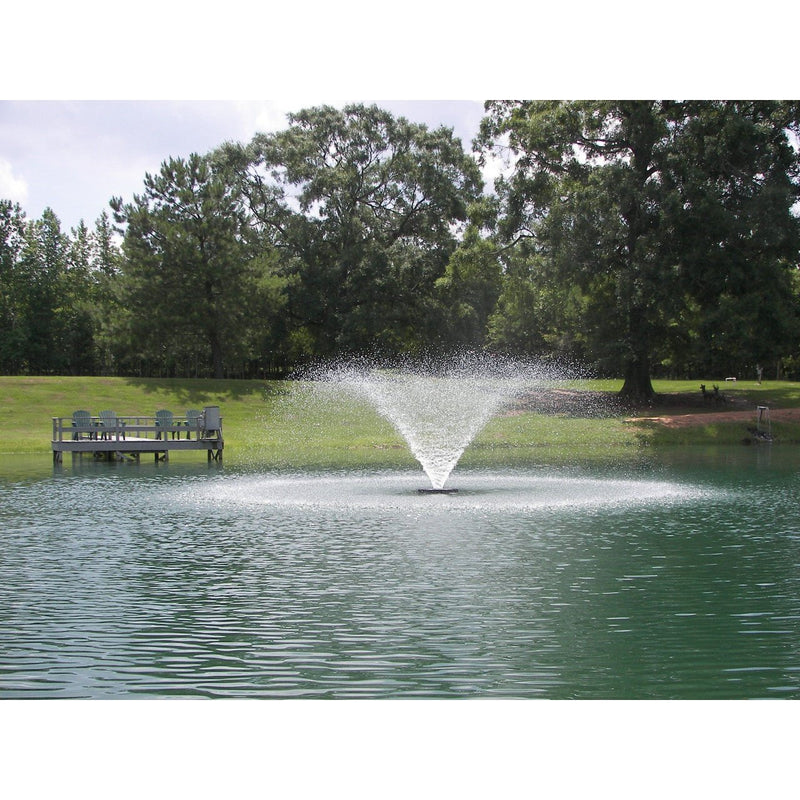
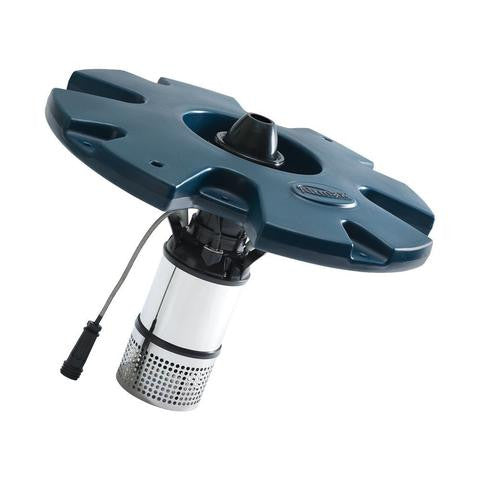
Surface aerators, such as fountains and paddlewheels, are effective in shallow environments. These systems move large volumes of water into the air, creating a high-velocity exchange. Fountains generally offer an SAE of 1.5 to 2.5, whereas specialized high-oxygen surface agitators can reach 2.6 to 3.2 lb O2/hp-hr.
Diffused aeration systems utilize a compressor to push air through a submerged membrane or stone. This creates a column of bubbles that rises to the surface. The efficiency of diffused aeration is heavily dependent on bubble size and water depth. Fine-bubble diffusers produce bubbles less than 2mm in diameter, maximizing the surface area-to-volume ratio. This increases the Standard Oxygen Transfer Efficiency (SOTE) significantly compared to coarse-bubble systems.
Fluid Dynamics of Bubbles
Bubble rise velocity is a critical factor in oxygen absorption. Smaller bubbles rise more slowly than larger ones due to increased drag relative to their buoyancy. This extended "hang time" in the water column allows for more oxygen to diffuse across the bubble’s membrane before it reaches the surface. Additionally, as bubbles descend into deeper water, the increased hydrostatic pressure increases the partial pressure of oxygen within the bubble, further accelerating the transfer rate into the water.
Benefits of Mechanical Aeration
Proper aeration provides benefits that extend beyond simply keeping fish alive. The primary technical advantage is the maintenance of an aerobic state at the pond bottom, known as the benthic zone. When oxygen is present at the sediment interface, aerobic bacteria can efficiently decompose organic muck (detritus). This prevents the buildup of toxic gases like hydrogen sulfide (H2S) and methane (CH4).
Aerobic decomposition is significantly faster and more complete than anaerobic digestion. By supporting these microbial populations, aeration helps reduce the "internal loading" of nutrients. In anaerobic conditions, phosphorus—a key driver of algae growth—is released from the sediments back into the water column. Maintaining oxygen at the bottom binds phosphorus to iron and other minerals, sequestering it in the soil.
Thermal destratification is another mechanical benefit. In the summer, ponds often separate into a warm upper layer (epilimnion) and a cold, oxygen-depleted lower layer (hypolimnion), separated by a thermocline. Diffused aeration creates a "laminar flow" that pulls cold bottom water to the surface, breaking the thermocline and creating a uniform temperature and oxygen profile throughout the entire volume.
Challenges and Common Pitfalls
The most dangerous challenge in pond management is the "turnover" event. Turnover occurs when the stratified layers of a pond mix suddenly, usually due to a cold rainstorm or high winds. If the bottom layer is completely anoxic (lacking oxygen), the sudden mixing can dilute the oxygen in the upper layer to lethal levels, causing a mass fish kill in minutes.
Starting an aeration system in the middle of a hot summer in a previously unmanaged pond carries similar risks. If the diffuser is turned on at full capacity immediately, it can force too much anoxic water to the surface at once. Professionals use a "startup schedule," running the system for only 30-60 minutes the first day and gradually increasing the duration over a week to slowly integrate the layers.
Mechanical failure during peak demand periods is a frequent error. In high-density aquaculture or heavily stocked ornamental ponds, the biological oxygen demand is so high that the system relies entirely on the mechanical boost. A power outage or a torn diffuser membrane during a heatwave can result in a total loss of livestock within hours. Redundancy and battery backups are essential for high-value ecosystems.
Limitations and Constraints
Aeration is not a universal solution for all water quality issues. In very shallow ponds (less than 4-5 feet), diffused aeration loses significant efficiency because the bubbles reach the surface too quickly to transfer much oxygen. Surface aerators or horizontal mixers are more appropriate in these scenarios.
Extreme nutrient loading (hyper-eutrophication) can also exceed the capacity of even the best aeration systems. If the BOD from decaying algae and fish waste is greater than the SOTR of the equipment, oxygen levels will continue to decline. In these cases, aeration must be paired with nutrient mitigation strategies, such as ultrasonic algae control, chemical binders, or manual harvesting of organic matter.
Maintenance requirements for diffused systems are often underestimated. Compressors require regular air filter changes and vane or piston replacements. EPDM diffuser membranes can become "blinded" or fouled by biofilm and calcium deposits, increasing the backpressure on the system and reducing oxygen output. This requires periodic pulling of the diffusers for cleaning or replacement.
Comparison of Aeration Technologies
Choosing the correct system requires balancing depth, pond shape, and energy cost. The following table compares the three primary mechanical aeration methods based on technical performance metrics.
| Technology | Depth Suitability | SAE (lb O2/hp-hr) | Primary Function | Maintenance Level |
|---|---|---|---|---|
| Diffused Aeration | Deep (> 8 ft) | 3.0 - 5.0 | Destratification / Bottom DO | Moderate (Compressor) |
| Surface Aerators | Shallow (< 8 ft) | 2.5 - 3.2 | Rapid Oxygenation | High (Motor in water) |
| Decorative Fountains | Shallow (< 6 ft) | 1.0 - 2.0 | Aesthetics / Surface Flow | High (Clogging) |
Diffused aeration is the most energy-efficient choice for deep ponds because it leverages the entire water column for gas transfer. Surface aerators are superior for emergency aeration because they transfer oxygen directly into the top layer where fish reside during a crisis.
Practical Tips and Best Practices
Sizing the compressor is the first step in a technical setup. A general rule of thumb for diffused aeration is to provide approximately 1 to 2 cubic feet per minute (CFM) of air per acre of pond surface. However, this must be adjusted based on the depth and the oxygen demand of the species present.
Diffuser placement should target the deepest areas of the pond to maximize the rise time of the bubbles. In irregularly shaped ponds (L-shaped or long and narrow), multiple diffuser heads are required to ensure there are no "dead zones" where water remains stagnant. Avoid placing diffusers directly on the bottom soil; use a weighted base or a stand to keep the membrane 6-12 inches above the sediment to prevent pulling silt into the water column.
Monitoring is the only way to verify performance. Using a handheld DO meter or a permanently installed sensor allows for data-driven decisions. Target a minimum of 5.0 mg/L for most game fish. If levels drop below 3.0 mg/L, the system is under-designed or failing to keep up with the current BOD. Monitoring should take place in the early morning, as this is when oxygen levels are at their natural minimum.
Advanced Considerations for Serious Practitioners
Experienced managers often look at Oxygen Transfer Efficiency (OTE) rather than just SOTR. OTE measures the percentage of oxygen in the air bubbles that actually dissolves into the water. In a 20-foot deep reservoir, OTE can be as high as 20% with fine-bubble diffusers, whereas in 5 feet of water, it might drop to 4%.
Automated control systems are becoming the standard for high-efficiency management. These systems use a DO probe connected to a Variable Frequency Drive (VFD) on the compressor. When oxygen levels are high (during sunny afternoons), the system scales back power to save energy. When levels drop at night or during cloudy weather, the system ramps up to maintain the set point. This can reduce energy costs by 30-50% while providing a higher safety margin for the ecosystem.
Chemical interactions must also be considered. High aeration rates increase the stripping of carbon dioxide (CO2) from the water. While this is generally beneficial, it can cause a shift in pH. In poorly buffered water, removing CO2 can cause pH to spike, which may increase the toxicity of any ammonia present in the system. Monitoring alkalinity is therefore a prerequisite for aggressive aeration strategies.
Scenario: Designing Aeration for a 1-Acre Pond
Consider a 1-acre pond with an average depth of 8 feet and a maximum depth of 12 feet. The goal is to prevent summer stratification and maintain 5.0 mg/L DO for a population of largemouth bass.
Total water volume is approximately 3.2 million gallons. A 1/2 HP rocking piston compressor capable of producing 4.5 CFM at 10 PSI would be selected. This air would be split between two fine-bubble diffuser stations placed in the 12-foot deep sections. By placing the diffusers at 12 feet, each bubble has a 12-foot vertical path, maximizing oxygen transfer. This setup would provide roughly 3.5 lb of oxygen per hour under standard conditions, which is sufficient to overcome the respiration of the fish and the aerobic bacteria in the muck layer.
Operating costs for this system, assuming a $0.12/kWh electricity rate, would be approximately $35 to $45 per month. This investment significantly reduces the risk of a multi-thousand-dollar fish loss and prevents the long-term accumulation of organic sludge.
Final Thoughts
Mechanical aeration is a technical requirement for modern managed ponds. Understanding the relationship between temperature, pressure, and gas transfer allows for the design of systems that are both efficient and effective. Relying on natural wind and photosynthesis is a high-risk strategy that often fails during the peak thermal loads of summer.
Designing an aeration strategy requires more than just buying a pump. It involves calculating the required oxygen transfer rates, selecting the appropriate technology for the pond's specific geometry, and implementing a maintenance schedule that ensures long-term reliability. When implemented correctly, aeration transforms a stagnant pond into a highly productive, aerobic ecosystem.
Continuous monitoring and incremental adjustments are the hallmarks of successful management. As the pond ages and nutrient levels change, the aeration requirements will likely evolve. Practitioners should remain focused on the data provided by dissolved oxygen readings to ensure the mechanical boost remains ahead of the biological demand.