

How to Aerate a Large Pond or Lake (5+ Acres): System Design Guide
One bubbler isn't enough for a lake. You need an integrated system.
Large lakes (5+ acres) function differently than backyard ponds. To keep them healthy, you need an integrated network of diffusers that work in sync. Here is our design blueprint.
Managing a large body of water requires a shift from localized bubbling to systemic fluid dynamics. In a 5-acre or 10-acre lake, a single aeration point creates a "chimney effect" that only services a small fraction of the total volume. Without a distributed network, the majority of the lake remains stratified, leading to anoxic dead zones and nutrient accumulation. An integrated system solves this by engineering overlapping zones of influence that move the entire water column.
How to Aerate a Large Pond or Lake (5+ Acres): System Design Guide
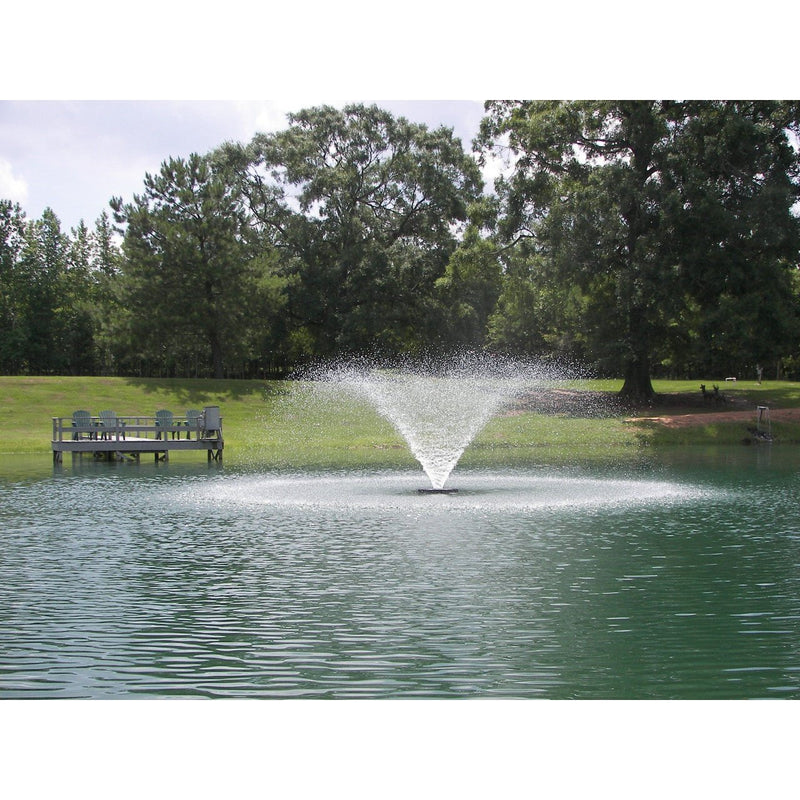
Aerating a large lake involves the mechanical introduction of oxygen through a subsurface diffused aeration system. Unlike surface fountains that provide aesthetic value but limited deep-water gas exchange, subsurface systems utilize shore-based compressors to push air through weighted tubing to diffusers located on the lake floor.
These systems are designed to address thermal stratification. In lakes 5 acres and larger, water typically separates into layers: the warm, oxygen-rich epilimnion at the surface and the cold, oxygen-depleted hypolimnion at the bottom. This separation is maintained by a density gradient called the thermocline. An integrated aeration network breaks this barrier by using rising bubble plumes to entrain cold bottom water and carry it to the surface for atmospheric gas exchange.
Real-world applications for these systems include municipal reservoirs, large private estates, and golf course water hazards. In these environments, the goal is often the reduction of biochemical oxygen demand (BOD) and the sequestration of phosphorus in the sediments. Without active circulation, the bottom of a 5-acre lake becomes a factory for hydrogen sulfide and methane, which can lead to catastrophic fish kills during seasonal turnover events.
Engineering the Integrated Network: How the System Functions
The physics of a large-scale aeration system rely on the principle of laminar flow and bubble-induced entrainment. As compressed air is forced through micro-porous membranes, it creates millions of fine bubbles. These bubbles do not simply provide oxygen directly through the bubble-to-water interface; instead, their primary function is to act as a buoyant lift.
The Lifting Rate Mechanism
As a bubble plume rises, it creates a friction-based vacuum that pulls surrounding water upward. Technical data from manufacturers like Vertex Aquatic Solutions indicates that a single diffuser station can move thousands of gallons of water per minute depending on the depth. For instance, at a depth of 15 feet, a single 1.0 CFM (cubic feet per minute) diffuser can lift approximately 2,500 to 3,000 gallons of water per minute to the surface.
Calculating Total System Volume (V/Q)
Design specifications for 5+ acre lakes require a calculated turnover rate. Most limnologists recommend a minimum of one full turnover of the lake volume every 24 to 48 hours. The formula for determining the required air volume is:
(Total Lake Gallons / Turnover Time in Minutes) / Lifting Efficiency = Required CFM.
In a 5-acre lake with an average depth of 8 feet, the total volume is approximately 13 million gallons. To achieve a 24-hour turnover, the system must move 9,000 gallons per minute.
Compressor Selection and Manifolding
Large systems typically utilize rocking piston compressors or rotary vane blowers. Rocking piston compressors are preferred for depths exceeding 15 feet due to their ability to maintain high CFM at higher pressures (PSI). For shallower lakes (under 12 feet), rotary vane systems offer higher air volumes at lower operating costs. A central manifold distributes the air from the compressor to various "AirStations" or diffuser points across the lake bed.
Benefits of Integrated Lake Aeration
Implementing a high-efficiency integrated network provides measurable improvements to the aquatic ecosystem and the structural integrity of the lake.
Mitigation of Thermal Stratification
Breaking the thermocline ensures that dissolved oxygen (DO) levels remain consistent from the surface to the floor. This eliminates the "dead zone" in the hypolimnion, allowing aerobic bacteria to colonize the lake bottom. These bacteria are significantly more efficient at breaking down organic muck than their anaerobic counterparts.
Nutrient Sequestration
In anoxic conditions, phosphorus remains soluble and is readily released from the sediment into the water column, fueling algae blooms. High DO levels at the sediment-water interface facilitate the binding of phosphorus to iron and calcium, effectively "locking" the nutrients in the mud and starving algae populations.
Reduction of Organic Silt (Muck)
Continuous aeration promotes "bio-dredging." As aerobic microbes proliferate in the presence of oxygen, they digest the layer of dead leaves, fish waste, and organic debris that accumulates on the lake floor. Data suggests that a well-oxygenated lake can reduce muck levels by several inches per year without mechanical dredging.
Challenges and Technical Pitfalls
Designing for 5+ acres introduces variables that are often neglected in smaller pond setups. Failure to account for these can lead to system failure or mechanical damage.
System Backpressure and Friction Loss
Moving air over several hundred feet of tubing creates resistance. For every 100 feet of 1/2-inch weighted tubing, a system might experience 0.14 to 0.50 PSI of friction loss depending on the CFM. If the lake is 20 feet deep (adding 8.6 PSI of water pressure), the total system pressure can quickly exceed the compressor’s maximum rating. Selecting the wrong diameter of tubing—such as using 3/8-inch instead of 5/8-inch for a 500-foot run—can cause the compressor to overheat and fail prematurely.
The Initial Turnover Shock
When a system is first installed in a stagnant 5-acre lake, the bottom water is often toxic. Turning the system on at full capacity immediately can bring high levels of hydrogen sulfide and low-oxygen water to the surface too quickly, resulting in a fish kill. Designers must implement a "startup schedule," beginning with 15 to 30 minutes of operation on day one and doubling the time each day until the lake is safely cycled.
Limitations of Subsurface Aeration
While subsurface diffused aeration is the industry standard for large lakes, certain environmental factors can limit its effectiveness.
Maximum Depth Constraints
Diffused aeration becomes exponentially more efficient with depth because the bubble plumes have more "travel time" to entrain water. Conversely, in very shallow lakes (under 5 feet), the plumes do not have enough vertical distance to create significant water movement. In these scenarios, a 5-acre lake might require dozens of small diffusers or a hybrid system involving horizontal aspirators.
Power Availability
Compressors for 5-acre systems often require 230V power to minimize amperage draw over long distances. If the power source is located far from the shoreline, the cost of trenching electrical lines can exceed the cost of the aeration equipment itself. In these cases, remote manifold boxes are used, where the compressor sits at the power source and air is piped through low-pressure PVC lines to the water's edge.
Isolated Point-Failure vs. Integrated Network
A common mistake in large lake management is the "Isolated Point-Failure" approach—installing one massive aerator in the center of a 5-acre lake.
| Factor | Isolated Point System | Integrated Network |
|---|---|---|
| Circulation Efficiency | Low; creates dead zones in corners. | High; overlapping plumes move entire volume. |
| Mechanical Redundancy | Zero; single compressor failure stops aeration. | Partial; multiple compressors can maintain levels. |
| Installation Complexity | Simple; one run of tubing. | High; requires manifolding and mapping. |
| Maintenance Frequency | High; single unit works at max capacity. | Moderate; load is distributed across units. |
Practical Tips for Large Lake Aeration Setup
Efficient design requires more than just high-quality hardware. It necessitates strategic placement and operational discipline.
- Map the Depths: Use a depth finder or sonar to create a bathymetric map. Place diffusers in the deepest areas of each "basin" or "pocket" of the lake to maximize the entrainment of the coldest water.
- Optimize Tubing Diameter: Use larger diameter weighted tubing (3/4-inch) for runs exceeding 300 feet to reduce backpressure on the compressor.
- Install Pressure Gauges: Every manifold should have a liquid-filled pressure gauge. A sudden rise in PSI indicates a clogged diffuser, while a drop indicates a leak in the airline.
- Use Weighted Tubing: Never use standard irrigation poly-pipe in the water. It will float and become a hazard for boat propellers and swimmers. High-density weighted tubing sinks and remains in place without additional weights.
Advanced Considerations: Oxygen Transfer Efficiency (OTE)
For professional practitioners, calculating the Standard Oxygen Transfer Efficiency (SOTE) is critical for system optimization. SOTE is the percentage of oxygen from the air that actually dissolves into the water.
Fine-bubble diffusers typically achieve an SOTE of 2% to 3% per foot of depth. This means that in 20 feet of water, a system can achieve up to 40% to 60% oxygen transfer efficiency. However, this efficiency is influenced by the "alpha factor," which accounts for the presence of surfactants and pollutants in the lake water that can interfere with the bubble surface. Serious practitioners should also account for the "Standard Oxygen Transfer Rate" (SOTR) to ensure the system can outpace the lake's biological oxygen demand during peak summer months when water temperatures are highest.
Example Scenario: 10-Acre Reservoir Aeration
Consider a 10-acre reservoir with an average depth of 12 feet and a maximum depth of 18 feet. The total volume is roughly 39 million gallons.
To achieve a 24-hour turnover, the system needs to move approximately 27,000 gallons per minute. Based on a lifting rate of 3,000 gallons per minute per AirStation at 15 feet of depth, the design requires a minimum of 9 diffuser stations.
The equipment list would include a dual 1-HP rocking piston compressor cabinet situated on the shore. Nine separate 5/8-inch weighted airline runs would lead to 9 multi-disk diffusers placed in a grid pattern. This layout ensures that no single area of the lake is more than 150 feet from a rising plume, effectively eliminating stagnant zones.
Final Thoughts
Designing a system for a lake of 5 or more acres is a task of mechanical engineering rather than simple pond maintenance. One bubbler isn't enough for a lake; the goal is to create a synchronized network that transforms the entire body of water into an active, aerobic environment.
Successful lake management relies on understanding the relationship between air volume, depth-induced pressure, and volumetric turnover rates. By prioritizing an integrated network over isolated components, lake owners can ensure long-term water clarity, healthy fish populations, and the prevention of organic silt buildup. Experimenting with diffuser placement and monitoring dissolved oxygen levels will allow for the fine-tuning of the system for maximum efficiency. Consider researching advanced monitoring systems that can automate compressor speeds based on real-time DO data to further optimize energy consumption.