Why Does My Pond Smell Like Rotten Eggs?
That rotten egg smell is Hydrogen Sulfide. It's not just gross; it's a sign of a dying ecosystem. Stagnant water only serves one purpose: rot. A multi-use circulation system prevents toxic gas pockets from forming. Don't just mask the smell—solve the stagnation.
Understanding the mechanics of water column health requires a shift from viewing a pond as a static pool to seeing it as a pressurized chemical reactor. When vertical and horizontal movement ceases, biological processes shift from aerobic efficiency to anaerobic decay. This transition is not merely an aesthetic issue; it represents a fundamental failure in the pond's gas exchange capabilities.
Effective pond management relies on maintaining a high oxidation-reduction potential (ORP) throughout the entire water column. Stagnation leads to thermal stratification, where density differences create a physical barrier between oxygenated surface water and the benthic zone. Resolving this requires a multi-depth circulation strategy that addresses both the epilimnion and the hypolimnion simultaneously.
Why Does My Pond Smell Like Rotten Eggs?
The characteristic "rotten egg" odor is the result of Hydrogen Sulfide (H2S) gas production. This occurs primarily in the benthic zone—the very bottom of the pond—where organic matter such as leaf litter, fish waste, and dead algae accumulates. In a healthy, well-circulated pond, aerobic bacteria break down this material using dissolved oxygen (DO). However, in stagnant systems, oxygen is depleted faster than it can be replenished.
When dissolved oxygen levels drop below 1.0 mg/L, the environment becomes anoxic. This shift triggers the activity of sulfate-reducing bacteria (SRB), such as those in the genus Desulfovibrio. These microorganisms do not use oxygen for respiration; instead, they utilize sulfate ions as terminal electron acceptors. The metabolic byproduct of this process is Hydrogen Sulfide.
H2S is highly soluble in water but becomes volatile when the water is disturbed or when concentrations reach a saturation point. In stratified ponds, the gas remains trapped in the cold, dense bottom layer (the hypolimnion). Because the thermocline acts as a "thermal curtain," there is no natural mixing to bring this gas to the surface for atmospheric venting. Consequently, the concentration of H2S can reach toxic levels, often exceeding 10 ppm in the interstitial water of the sediment.
How Multi-Depth Circulation Works
A multi-depth circulation system functions by mechanically breaking the thermocline and forcing a continuous exchange between the bottom and surface layers. This is typically achieved through diffused aeration, which utilizes a shore-mounted compressor to push air through weighted tubing to diffusers located at the pond's deepest points.
The process relies on the physics of the bubble plume. As air is forced through the fine pores of a diffuser, thousands of micro-bubbles are released. These bubbles do not just add oxygen directly; their primary function is to act as an "air-lift pump." As the bubbles rise, they create an upward current, pulling cold, oxygen-depleted, H2S-rich water from the bottom toward the surface.
Once this water reaches the surface, it spreads out horizontally, allowing Hydrogen Sulfide to vent into the atmosphere and oxygen to be absorbed through surface tension. The now-oxygenated water, which is cooler and denser than the surrounding surface water, eventually sinks back down, completing a full vertical "turnover." This continuous cycle ensures that the entire volume of the pond is exposed to the atmosphere, preventing the formation of stagnant "dead zones."
The Role of Horizontal Movement
While vertical circulation addresses stratification, horizontal circulation ensures that every corner of the pond is integrated into the system. In irregularly shaped ponds or those with significant "coves," vertical diffusers alone may leave pockets of stagnant water. Integrating horizontal circulators or directional jets creates a "racetrack" effect, moving water toward the intake zones of the vertical diffusers.
Benefits of Multi-Depth Circulation
Implementing a system that addresses multiple depths provides measurable improvements in water chemistry and biological stability. By maintaining high dissolved oxygen levels at the pond floor, you fundamentally change the microbial landscape.
Aerobic bacteria are significantly more efficient at decomposing organic muck than their anaerobic counterparts. With sufficient oxygen, these bacteria can reduce the "muck layer" by several inches per year through a process called bio-oxidation. This reduces the internal nutrient loading of the pond, which in turn limits the fuel available for harmful algal blooms.
Furthermore, oxygenating the hypolimnion prevents the chemical reduction of phosphorus. In anoxic conditions, phosphorus bound to bottom sediments is released back into the water column. By maintaining an aerobic interface at the sediment-water boundary, phosphorus remains "locked" in the soil, effectively starving algae of a primary nutrient source.
Comparative Efficiency: Diffused Aeration vs. Surface Aerators
| Metric | Diffused Aeration (Bottom-Up) | Surface Aerators / Fountains |
|---|---|---|
| Operating Depth | Optimized for >6 feet. | Limited to top 2–4 feet. |
| Oxygen Transfer Efficiency (OTE) | Approx. 1.6% per foot of depth. | Constant 1.6%–3.2%. |
| Destratification Power | High; breaks thermocline via bubble plume. | Low; only mixes the surface layer. |
| Energy Efficiency | High; low HP required for high volume lift. | Moderate to Low; requires high HP to move water. |
| H2S Mitigation | Excellent; vents gas from the bottom. | Poor; does not reach bottom gas pockets. |
Challenges and Common Mistakes
The most dangerous mistake in pond management is the "Sudden Summer Startup." If a pond has been stagnant for months, the bottom layer is likely loaded with H2S and devoid of oxygen. If you turn on a high-powered circulation system at full capacity in the middle of a hot July afternoon, you will cause a rapid turnover.
This rapid mixing forces the entire volume of anoxic water to the surface instantly, stripping the remaining oxygen from the top layer and exposing fish to a lethal slug of Hydrogen Sulfide. This often results in a total fish kill within hours. To avoid this, new systems must be started on a "staged schedule"—running for 30 minutes the first day, 1 hour the second, and doubling the time daily until the pond is stabilized.
Another common pitfall is undersizing the system. Circulation is a function of volume and turnover rate. If the compressor cannot move the entire volume of the pond at least once every 24 to 48 hours, the system will fail to keep up with the rate of oxygen depletion in the sediment.
Limitations of Circulation Systems
While circulation is a primary tool, it is not a universal cure. In very shallow ponds (less than 4–5 feet), diffused aeration loses its efficiency because the bubbles do not have enough "hang time" in the water column to create a strong upward current. In these environments, horizontal circulators or surface agitators are often more effective.
Environmental factors such as high sulfate levels in the source water (common in well-drawn water or certain geographic regions) will continuously provide the raw materials for H2S production. In these cases, circulation must be run 24/7 to ensure the gas is oxidized as quickly as it is produced. If the mechanical system fails, the pond will revert to a toxic state much faster than a pond with low sulfate input.
Practical Tips for System Optimization
To maximize the efficiency of a circulation system, focus on the placement and mechanical specifications of the diffusers.
- Position diffusers at the deepest point: This ensures the maximum volume of water is moved per cubic foot of air. Placing a diffuser in a shallow area leaves the deep "kettle" of the pond stagnant.
- Monitor the "Boil": A healthy circulation system should create a gentle, visible "boil" at the surface directly above the diffuser. If the surface is turbulent, you are wasting energy; if there is no movement, your compressor is likely undersized or the line is leaking.
- Calculate Turnover Rate: For H2S mitigation, aim for a minimum of 1.0 to 1.5 turnovers per day. Use the formula: (Total Volume / Gallons Moved per Hour) = Hours for one turnover.
- Use Weighted Tubing: Non-weighted tubing will float, creating a tripping hazard and making the diffusers susceptible to shifting due to wind or currents.
Advanced Considerations: The Chemistry of Oxidation
Serious practitioners should understand the stoichiometric requirements for H2S removal. The chemical reaction for the oxidation of Hydrogen Sulfide by dissolved oxygen is:
2H2S + O2 ? 2H2O + 2S
Technically, it takes approximately 1.0 mg/L of oxygen to oxidize 1.0 mg/L of dissolved sulfide. However, because aeration systems are not 100% efficient, a "buffer" is required. Engineers typically aim for a residual oxygen level of 5.0 mg/L in the bottom water to ensure that any surge in H2S production is immediately neutralized.
Oxygen Transfer Efficiency (OTE) increases as the depth of the diffuser increases. For every additional foot of depth, the air bubbles remain in the water longer, allowing more oxygen to dissolve. This is why deep-water diffused aeration is the gold standard for large-scale H2S remediation.
Example Scenario: Remediation of a 1-Acre Pond
Consider a 1-acre pond with an average depth of 8 feet, totaling approximately 2.6 million gallons of water. The pond currently exhibits a strong H2S odor and has a 12-inch muck layer.
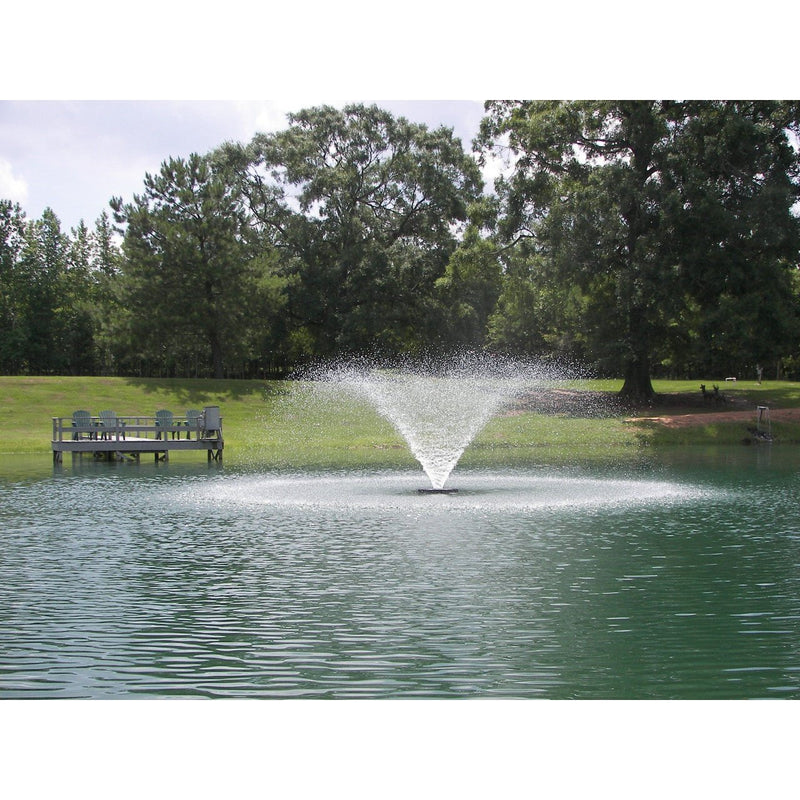
A standard surface fountain might move 500 gallons per minute (GPM), but only from the top 3 feet of water. This would circulate 720,000 gallons per day, failing to touch the remaining 1.8 million gallons at the bottom. The H2S would remain trapped.
In contrast, a 1/2 HP diffused aeration system with three diffusers placed at the 8-foot depth can move upwards of 2,500 GPM through induced current. This results in 3.6 million gallons of water moved per day—achieving a turnover rate of 1.38 times every 24 hours. Within two weeks of a staged startup, the H2S gas will be vented, the odor will dissipate, and the aerobic bacteria will begin digesting the muck layer.
Final Thoughts
Hydrogen Sulfide is a symptom of a systemic failure in water column management. Stagnation creates the perfect conditions for anaerobic bacteria to dominate the ecosystem, leading to gas accumulation, fish toxicity, and nutrient loading.
By implementing a multi-depth circulation system, you address the root cause of the problem. Moving water from the bottom to the top facilitates essential gas exchange, breaks thermal barriers, and promotes the growth of beneficial aerobic bacteria.
Don't settle for surface-level fixes. To maintain a truly healthy pond, you must ensure that every gallon of water—from the sunlit surface to the dark benthic floor—is part of a continuous, oxygenated cycle. Experiment with diffuser placement and monitor your dissolved oxygen levels to find the optimal balance for your specific environment.