Why Are Fish Gasping At The Surface Of My Pond?
Your fish aren't greeting you; they're suffocating. Heat is the silent killer of pond oxygen. When water temperatures rise, oxygen levels tank. If your fish are gasping at the surface, they are literally 'drowning' in thin air. Here is how to fix the exposure problem before it's too late.
Maintaining a functional aquatic ecosystem requires a precise understanding of dissolved oxygen (DO) dynamics. Many pond owners mistake surface activity for playfulness, when in reality, the fish are exhibiting a survival behavior known as "piping." This occurs when the water column lacks the necessary milligrams per liter (mg/L) of oxygen to sustain metabolic function.
Aquatic environments are closed systems governed by the laws of thermodynamics and gas solubility. Unlike the atmosphere, which contains approximately 21% oxygen (210,000 parts per million), water at saturation rarely contains more than 10 to 12 parts per million (ppm). This thin margin for error means that even minor environmental shifts can lead to a total system collapse.
Why Are Fish Gasping At The Surface Of My Pond?
Fish gasp at the surface because they are seeking the oxygen-rich micro-layer located at the air-water interface. In a pond experiencing hypoxia, this topmost fraction of an inch is often the only area where gas exchange is sufficient to prevent immediate respiratory failure.
Thermal stress is the primary driver of this phenomenon. Water temperature and oxygen solubility share an inverse relationship. As the temperature of the water increases, its physical capacity to hold dissolved oxygen decreases. For example, freshwater at 50°F (10°C) can hold roughly 11.3 mg/L of oxygen at saturation. When that same water reaches 86°F (30°C), the saturation point drops to approximately 7.5 mg/L.
Simultaneously, fish are poikilotherms, meaning their internal body temperature is dictated by their environment. Their metabolic rate increases as the water warms, a principle defined by the Q10 temperature coefficient. For most pond fish, the metabolic rate roughly doubles with every 18°F (10°C) increase in temperature. This creates a lethal biological pincer: the water provides less oxygen exactly when the fish require significantly more to stay alive.
Biological Oxygen Demand (BOD) also spikes during heatwaves. Beneficial aerobic bacteria and algae consume oxygen. While algae produce oxygen via photosynthesis during daylight hours, they consume it through respiration at night. This often leads to "morning crashes," where DO levels are at their lowest just before dawn, causing mass mortality in the early hours of the day.
Mechanics of Oxygenation and Gas Exchange
Oxygen enters pond water through two primary pathways: atmospheric diffusion and photosynthetic byproduct. Mechanical aeration systems optimize the atmospheric pathway by increasing the surface area of the water and creating turbulence.
Atmospheric Diffusion and Surface Tension
Gas exchange occurs at the interface where water meets air. In a stagnant pond, a thin film of saturated water forms at the surface, which effectively blocks further oxygen from entering the deeper layers. Breaking this surface tension is mandatory for continuous oxygenation.
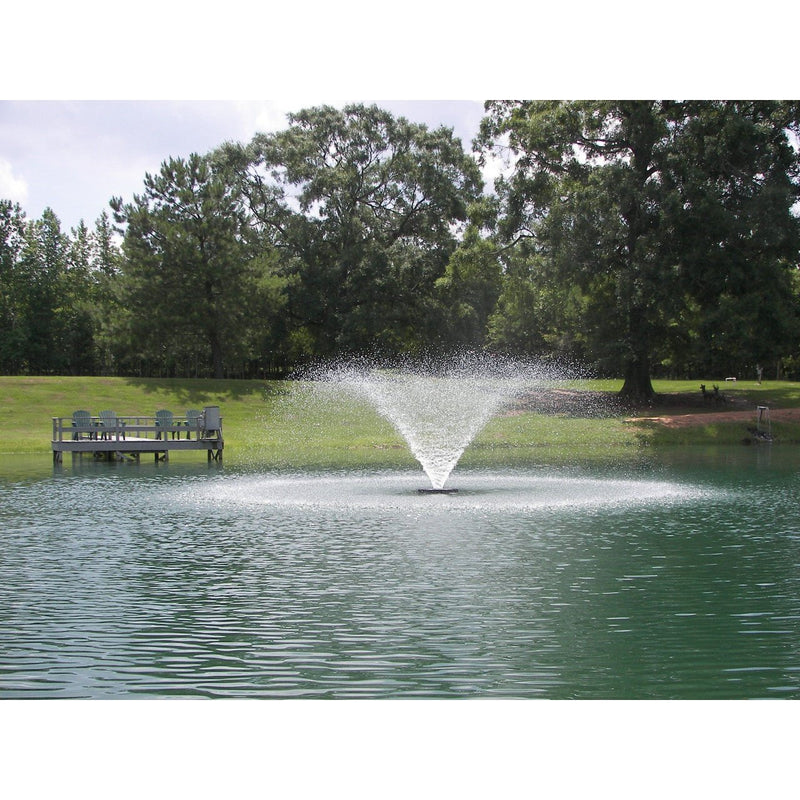
Mechanical systems like waterfalls, fountains, and air stones utilize the principle of turbulence. By moving deoxygenated water from the bottom of the pond to the surface, these systems maintain a "saturation deficit." This deficit provides the necessary partial pressure difference to drive oxygen molecules into the water column.
Subsurface Aeration Efficiency
Diffused aeration systems, or "bottom-up" systems, are the most efficient mechanical solution for deep water. These systems use a compressor to pump air through a weighted diffuser located at the pond floor. As millions of tiny bubbles rise, they create a laminar flow that pulls cool, deoxygenated water toward the surface.
The efficiency of this process is tied to the "contact time" and "surface area" of the bubbles. Smaller bubbles (fine-pore diffusion) provide a much larger total surface area for gas exchange than large bubbles. Additionally, the deeper the diffuser is placed, the longer the bubbles take to reach the surface, increasing the window for oxygen to dissolve into the surrounding fluid.
Benefits of Optimized Dissolved Oxygen Levels
Maintaining high DO levels (7.0 mg/L or higher) provides measurable improvements to the mechanical and biological efficiency of a pond system.
Enhanced Nitrification and Waste Processing
The nitrogen cycle is an aerobic process. Nitrifying bacteria, such as Nitrosomonas and Nitrobacter, require significant amounts of oxygen to convert toxic ammonia into nitrite and eventually into relatively harmless nitrate. When DO levels drop below 2.0 mg/L, nitrification ceases entirely, leading to rapid ammonia spikes that can kill fish even if oxygen is temporarily restored.
Pathogen Suppression and Fish Immunity
High oxygen levels support the fish's immune system by reducing cortisol levels associated with respiratory stress. Hypoxic conditions often lead to secondary infections, as opportunistic bacteria and parasites thrive in low-oxygen environments where the host's defenses are compromised.
Reduction of Organic Muck
Aerobic decomposition of organic matter (fish waste, leaves, and sludge) is up to 20 times faster than anaerobic decomposition. By maintaining oxygen at the pond bottom, you ensure that "muck-eating" bacteria can effectively process debris, preventing the buildup of hydrogen sulfide and methane gases.
Challenges and Common Pitfalls in Aeration
Many pond owners install aeration equipment that is either improperly sized or poorly positioned, leading to localized "dead zones" where oxygen remains critically low despite the appearance of water movement.
The "Waterfall Fallacy"
Waterfalls provide excellent surface agitation but often fail to oxygenate the deeper sections of a pond. Because oxygen-rich water is less dense than the cooler, deoxygenated water at the bottom, the waterfall return may simply "ride" across the surface without mixing. This creates thermal stratification, where the bottom of the pond becomes anoxic (zero oxygen), trapping fish in a shrinking layer of habitable water near the top.
Excessive Algal Loading
Heavy algae blooms are a major challenge during summer. While a green pond may have high oxygen levels at noon due to photosynthesis, the "respiratory load" at 3:00 AM can be catastrophic. If the mechanical aeration system cannot compensate for the combined oxygen consumption of the fish and the algae during the night, a crash is inevitable.
Overstocking and Biomass Ratios
Every pound of fish added to a pond increases the oxygen demand linearly. Many practitioners fail to account for the growth of their fish. A pond that was stable with five 6-inch koi may crash three years later when those same fish reach 18 inches, as their biomass and subsequent oxygen requirements have increased by an order of magnitude.
Limitations of Standard Aeration Methods
Even the most robust aeration system has physical limitations dictated by environmental variables.
The Saturation Cap
You cannot force water to hold more oxygen than its physical limit at a given temperature and pressure. No matter how many air stones you add, water at 90°F will never hold 12 mg/L of oxygen. In extreme heat, mechanical aeration can only ensure the pond stays at 100% saturation. If 100% saturation is not enough to meet the biological demand of an overstocked pond, the only solutions are to cool the water or reduce the fish load.
Altitude and Partial Pressure
Atmospheric pressure decreases as elevation increases. For ponds located at high altitudes, the partial pressure of oxygen is lower, meaning the water's saturation point is significantly lower than a pond at sea level. Practitioners in mountainous regions must upsize their aeration equipment to compensate for this reduced transfer efficiency.
Salinity Impacts
The addition of salt (sodium chloride), often used for medicinal purposes in koi ponds, reduces oxygen solubility. While the impact is minor at low concentrations (0.1% to 0.3%), heavy salt treatments during a heatwave can further squeeze the available oxygen supply.
Comparison of Aeration Technologies
Selecting the correct hardware depends on the pond's volume, depth, and biological load. The following table compares the two most common mechanical approaches.
| Feature | Surface Fountains | Subsurface Diffused Aeration |
|---|---|---|
| Primary Function | Aesthetics and surface agitation | Whole-column mixing and gas exchange |
| Oxygen Transfer Efficiency | Low to Moderate (1.5 - 2.5 lbs O2/hp-hr) | High (up to 10x more effective in deep water) |
| Depth Capability | Limited (effective in top 2-3 feet) | Excellent (effective at any depth) |
| Operating Cost | Higher (requires higher horsepower) | Lower (moves air, not heavy water) |
| Stratification Control | Poor | Excellent |
Practical Tips for Emergency and Long-Term Management
Immediate action is required when fish are observed piping. Follow these technical protocols to stabilize the system.
- Perform a Water Change: Replace 20-30% of the pond volume with cooler, de-chlorinated water. This immediately lowers the temperature and introduces higher oxygen concentrations.
- Install a Venturi Injector: If using a pressurized filter, a Venturi attachment can be added to the return line to vacuum air into the water flow without requiring a secondary pump.
- Increase Airflow Metrics: Aim for a minimum of 1 Cubic Foot per Minute (CFM) of air for every 1,000 gallons of water. For heavily stocked koi ponds, this should be increased to 1.5 or 2.0 CFM.
- Monitor with a DO Meter: Visual cues are unreliable. A digital Dissolved Oxygen meter provides real-time data in mg/L, allowing you to identify a pending crash before the fish show signs of distress.
- Shade the System: Reducing the solar load on the pond surface directly impacts water temperature. Use shade sails or floating plants to cover 40-60% of the surface area.
Advanced Considerations: The SOTR Metric
Serious practitioners should look at the Standard Oxygen Transfer Rate (SOTR) when selecting equipment. SOTR measures the amount of oxygen a system can transfer to water under standardized conditions (zero DO, 20°C, sea level).
When evaluating a compressor, check the CFM (Cubic Feet per Minute) at the specific depth of your pond. A pump rated for 4.0 CFM at the surface may only deliver 2.1 CFM at a depth of 6 feet due to backpressure. Utilizing weighted, non-kinking sinking tubing is also essential to maintain flow efficiency and prevent the compressor from overheating.
Furthermore, consider the "turnover rate." For effective aeration, the entire volume of the pond should be circulated through the aeration zone at least once every 1 to 2 hours. This prevents the formation of thermoclines and ensures that the beneficial bacteria in the filter receive a constant supply of oxygenated water.
Example Scenario: A 5,000-Gallon Koi Pond in July
Consider a 5,000-gallon pond with 15 adult koi (approximately 45 lbs of biomass). The water temperature is 85°F.
At 85°F, the saturation point is roughly 7.8 mg/L. Adult koi consume approximately 200-300 mg of O2 per kg of body weight per hour at this temperature. For 45 lbs (20 kg) of fish, the baseline oxygen consumption is roughly 6,000 mg per hour. This does not include the oxygen consumed by the filter bacteria or the nighttime respiration of algae.
If the pond only has a small fountain moving 500 GPH, the oxygen transfer rate will likely fail to keep up with the 6,000+ mg/hr demand. Within hours of the sun going down, the DO level could drop from 7.0 mg/L to 3.0 mg/L. By 4:00 AM, the level hits the lethal 2.0 mg/L threshold. Adding a 60-liter-per-minute (2.1 CFM) air pump with two large diffusers would provide approximately 15,000 mg of O2 transfer per hour, creating a safety margin that prevents the morning crash.
Final Thoughts
Dissolved oxygen is the most critical water quality parameter in pond management. It is the only variable that can cause a total loss of livestock in a matter of minutes. Understanding that heat and oxygen are fundamentally at odds allows you to prepare for seasonal spikes rather than reacting to emergencies.
Optimization of the aeration system involves more than just "adding bubbles." It requires a mechanical approach that considers water volume, depth, biomass, and the physics of gas solubility. By transitioning from an exposed, boiling environment to a sheltered, oxygenated system, you create a resilient habitat capable of withstanding the most extreme summer conditions.
Applying these principles ensures that your pond remains a balanced biological engine. Experiment with diffuser placement and monitor your DO levels regularly to fine-tune your setup. The goal is not just to keep fish from gasping, but to provide an environment where they can reach their full biological potential.