

Why Does Ice Formation Increase Fish Kill Risk?
Is your pond holding its breath? Winter ice acts as a lid, trapping toxic gases while starving your fish of oxygen. Ice isn't just cold; it's a seal. When gas exchange stops, the biological clock starts ticking. Learn how to break the seal and save your ecosystem this winter.
The winter environment in a closed-loop aquatic system is defined by a shift from atmospheric interaction to isolation. When surface temperatures drop below the freezing point, the formation of an ice sheet creates a physical barrier that terminates the natural diffusion of oxygen (O2) and the venting of metabolic byproducts. This transition initiates a race against the pond’s internal biological oxygen demand (BOD) and the accumulation of anaerobic gases.
Understanding the mechanical and chemical drivers of winter fish kill is essential for effective pond management. Practitioners must move beyond the superficial goal of "keeping a hole open" and instead focus on the underlying metrics of gas solubility, thermal stratification, and the stoichiometric requirements of the ecosystem. This article provides a technical analysis of the risks associated with ice formation and the engineering solutions required to maintain a resilient oxygen lifeline.
Why Does Ice Formation Increase Fish Kill Risk?
Ice formation increases fish kill risk by eliminating the interface between the water surface and the atmosphere. In a typical open-water state, oxygen enters the water through passive diffusion and mechanical agitation, while gases like carbon dioxide (CO2) and hydrogen sulfide (H2S) escape into the air. When ice seals the surface, the total dissolved oxygen (DO) present at the time of freezing becomes a finite resource that must last until the spring thaw.
The risk is compounded by the "Albedo Effect" and light attenuation. While clear ice allows some solar radiation to reach aquatic plants, a layer of snow as thin as four inches can block up to 99% of incoming light. This halts photosynthesis, the primary internal source of oxygen production. Without photosynthesis, the pond relies entirely on its initial oxygen reserves, which are rapidly consumed by the respiration of fish and the decomposition of organic matter on the pond floor.
Furthermore, ice prevents the venting of toxic metabolic byproducts. As aerobic bacteria exhaust the available oxygen, the pond shifts toward anaerobic decomposition. This process releases methane (CH4) and hydrogen sulfide (H2S), the latter of which is highly toxic to fish even at low concentrations. In a sealed environment, these gases dissolve back into the water column, lowering the pH and chemically "suffocating" the fish before the oxygen is even fully depleted.
The Mechanics of Winter Oxygen Depletion and Gas Toxicity
The depletion of oxygen under ice is a function of the Sediment Oxygen Demand (SOD) and the biological respiration of the resident biomass. Even at low temperatures where fish metabolism is significantly reduced, the baseline requirement for survival remains. In nutrient-rich ponds with high levels of "muck" or organic sludge, the SOD can account for over 90% of the total oxygen consumption.
As oxygen levels drop below 3.0 mg/L, most temperate fish species begin to experience physiological stress. Below 2.0 mg/L, mortality rates for sensitive species like trout and largemouth bass increase sharply. The accumulation of CO2 further complicates this by increasing the acidity of the water, which reduces the ability of fish hemoglobin to bind with what little oxygen remains—a phenomenon known as the Root Effect.
Hydrogen sulfide accumulation is perhaps the most critical silent killer. It is produced by sulfate-reducing bacteria in the anaerobic sediment layer. When the pond is sealed, H2S concentrations can rise above 0.5 mg/L, a level lethal to many species. Because H2S is highly soluble in cold water, it does not easily precipitate out, necessitating mechanical venting through an ice opening.
Thermal Stratification and Density Dynamics
Water exhibits a unique density-temperature relationship that is central to winter survival. Water is at its maximum density at 4°C (39.2°F). In a natural winter state, this "warm" 4°C water sinks to the bottom, while colder, less dense water (0°C) rises to the surface to freeze. This creates a "reverse stratification" that provides a thermal refuge for fish at the pond’s deepest points.
Maintaining this 4°C thermal refuge is critical. Improperly configured aeration systems can disrupt this layer, forcing the 4°C water to mix with the 0°C surface water. This results in "supercooling," where the entire water column drops toward 0°C. While many fish can survive 4°C indefinitely, 0°C water temperatures significantly increase the risk of metabolic collapse and secondary infections.
Technical Comparison: De-Icers vs. Diffused Aeration
Practitioners typically choose between two mechanical solutions: floating de-icers (heaters) and bottom-diffused aeration systems. Each has distinct mechanical efficiency profiles and operational limitations based on the pond's surface area and volume.
| Feature | Floating De-Icer (Heater) | Diffused Aeration (Bubbler) |
|---|---|---|
| Mechanism | Thermal Resistance (Heating) | Mechanical Agitation / Gas Lift |
| Energy Efficiency | Low (High Wattage Required) | High (Low CFM Requirements) |
| Gas Exchange | Localized at the hole | System-wide circulation |
| Primary Application | Small Koi Ponds / Shallow Features | Large Ponds / High Nutrient Loads |
| Risk Factor | Heating element failure | Supercooling / Thermal inversion |
De-icers work by maintaining a small area of water above freezing using a resistive heating element. They are effective for venting gases in very small volumes but do nothing to increase the total dissolved oxygen levels in the rest of the pond. In contrast, diffused aeration uses an onshore compressor to pump air through a weighted line to a diffuser at the bottom. As bubbles rise, they drag the 4°C water upward, melting the ice through friction and thermal transfer while simultaneously infusing the water with oxygen.
Practical Tips for System Configuration
To optimize a winter aeration system and avoid the risk of supercooling, the following best practices should be implemented:
- Diffuser Placement: Do not place diffusers at the deepest point of the pond. Instead, position them in a shallow area (roughly 25–50% of the maximum depth). This allows the deep-water thermal refuge to remain undisturbed while still maintaining an ice opening.
- System Sizing: Ensure the compressor provides at least 0.5 to 1.0 CFM (Cubic Feet per Minute) per acre of surface area. For high-biomass systems, this requirement may double.
- Operation Timing: Start the system before the first hard freeze. It is significantly more energy-efficient to prevent ice formation than to attempt to melt a thick ice sheet after it has established.
- Snow Removal: If the pond is large and non-aerated, clearing snow from 20-30% of the surface area can restart photosynthesis. However, this should only be done if the ice is physically safe (minimum 4 inches of clear ice).
Challenges and Common Mistakes
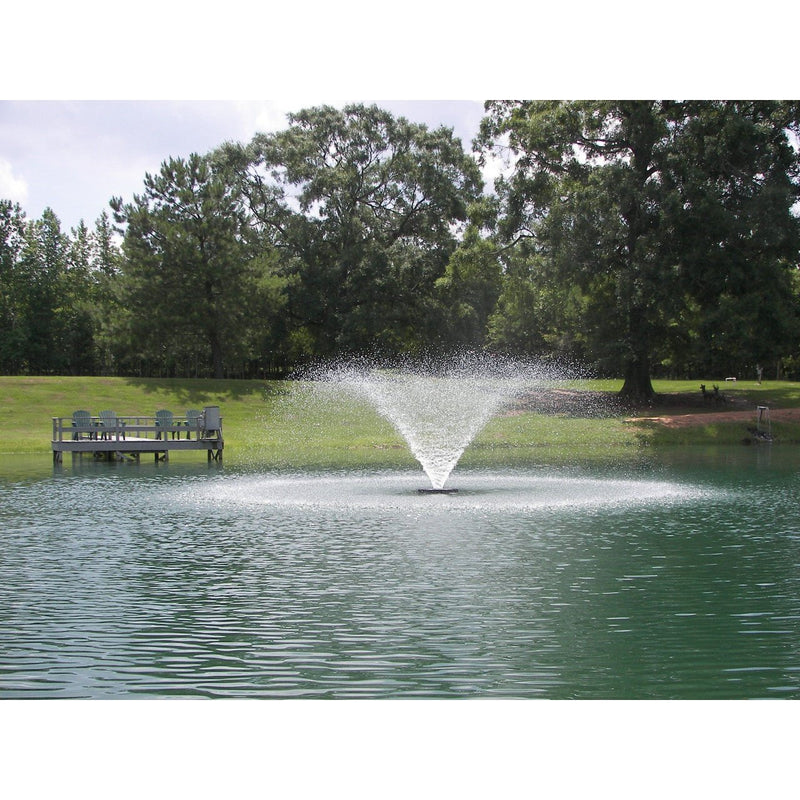
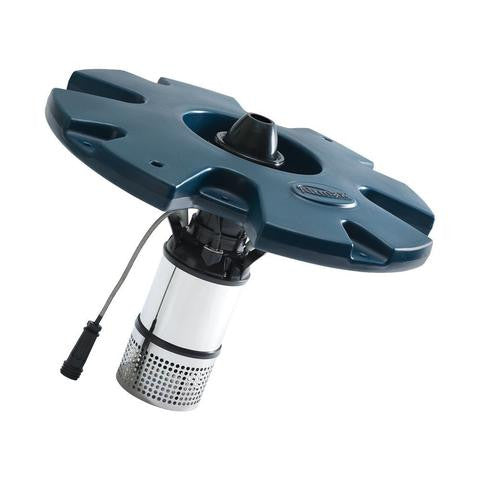
One of the most frequent errors in winter pond management is the use of surface fountains. Fountains are designed for summer aeration and work by spraying water into the air. In winter, this causes rapid heat loss through evaporation and convection, leading to the "ice volcano" effect and potentially freezing the entire water column. Fountains should be removed and replaced with subsurface aeration before the first freeze.
Another common mistake is "breaking" the ice manually. Striking the ice with a sledgehammer or heavy object creates powerful acoustic shockwaves that can rupture the swim bladders of dormant fish or cause lethal stress. If an ice opening must be created manually, a hot water bucket or a specialized ice saw should be used to minimize vibration.
Advanced Considerations: Calculating Theoretical Oxygen Demand
For serious practitioners, managing winter oxygen is a matter of stoichiometry. The Total Oxygen Demand (TOD) is the sum of the fish respiration rate (Rr) and the Sediment Oxygen Demand (SOD). In a sealed system, the rate of change in dissolved oxygen (dDO/dt) can be modeled by the equation: dDO/dt = P - (Rr + SOD), where P is photosynthesis.
Because P approaches zero under snow cover, the depletion rate becomes linear. By measuring the DO levels at the onset of ice cover and again two weeks later, a manager can project the "zero-oxygen date." If the projected date falls before the historical ice-out date, aggressive mechanical intervention (such as supplemental diffused aeration) is mandatory to prevent a total ecosystem collapse.
Example Scenario: 1-Acre Eutrophic Pond
Consider a 1-acre pond with a maximum depth of 12 feet and a high organic load. At the start of December, the pond freezes over. The initial DO is 10 mg/L. The estimated SOD is 0.5 mg/L per day, and fish respiration accounts for another 0.1 mg/L per day. Without any photosynthesis, the total oxygen depletion rate is 0.6 mg/L per day.
In this scenario, the pond will reach the critical stress threshold of 3.0 mg/L in approximately 12 days (7 mg/L / 0.6 mg/L/day). If the ice remains for three months, the pond will be completely anoxic long before spring. Installing a 1/4 HP diffused aeration system in 4 feet of water would maintain a 15-foot diameter opening, allowing for continuous gas venting and maintaining DO levels above 6.0 mg/L throughout the season.
Final Thoughts
Preventing winter fish kill is a technical challenge that requires a deep understanding of aquatic thermodynamics and gas kinetics. The formation of ice is not merely a change in temperature; it is a fundamental shift in the pond's chemical equilibrium. By recognizing the roles of Sediment Oxygen Demand and the toxic accumulation of hydrogen sulfide, pond managers can deploy targeted mechanical solutions.
The choice between de-icing and diffused aeration must be driven by the specific volume and nutrient profile of the water body. While de-icers provide a simple safety valve for small systems, larger ecosystems require the robust circulation and oxygenation provided by subsurface aeration. Proper configuration, specifically avoiding the supercooling of the thermal refuge, is the difference between a surviving population and a spring catastrophe.
Ultimately, a proactive approach—addressing muck accumulation in the fall and ensuring mechanical systems are operational before the freeze—minimizes the variables that lead to ecosystem failure. Monitoring dissolved oxygen levels and maintaining a clear interface for gas exchange ensures that the "suffocating seal" of winter remains a manageable environmental factor rather than a terminal event.