

What Happens When Dissolved Oxygen Falls Below 3 mg/L?
3 mg/L: The line between a pond and a grave. When oxygen hits 3mg/L, your pond stops being a habitat and starts being a hazard. Know the signs before the suffocation starts.
The management of dissolved oxygen (DO) is the most critical technical parameter in pond maintenance and aquaculture engineering. While many operators monitor water temperature or pH, DO levels dictate the biological capacity and mechanical requirements of the system. Dissolved oxygen is the concentration of non-compound oxygen gas ($O_2$) present in a liquid, typically measured in milligrams per liter (mg/L) or percent saturation.
The threshold of 3 mg/L represents a physiological tipping point for most aquatic organisms. Maintaining levels above this point requires a precise understanding of the thermodynamic, biological, and mechanical factors that influence gas transfer. This technical analysis explores the mechanics of oxygen depletion, the physics of gas solubility, and the efficiency of modern aeration systems.
What Happens When Dissolved Oxygen Falls Below 3 mg/L?
Dissolved oxygen is a finite resource governed by the balance between atmospheric diffusion, photosynthesis, and respiration. When the concentration falls below 3 mg/L, the system enters a state of clinical hypoxia. This level is recognized as the lethal limit for most warmwater fish species if maintained for prolonged periods [1.1.5, 1.1.7].
Biological systems undergo rapid degradation at these concentrations. Aerobic bacteria, which are responsible for the oxidation of ammonia and the decomposition of organic matter, lose efficiency. This slowdown triggers a shift toward anaerobic decomposition. Anaerobic processes are significantly less efficient and produce toxic byproducts such as hydrogen sulfide ($H_2S$) and methane ($CH_4$).
In aquaculture environments, 3 mg/L is the boundary where mortality risks escalate. While warmwater species like channel catfish or tilapia can survive short-term fluctuations, prolonged exposure leads to "piping" or gasping at the surface [1.1.5]. This behavior is a desperate mechanical attempt to access the oxygen-rich film at the air-water interface. Growth rates decline sharply once DO drops below 50% saturation, which is approximately 4 mg/L at 26°C [1.1.2].
The impact on fish physiology is comprehensive. Low DO levels increase stress, suppress the immune system, and inhibit reproductive cycles [1.1.6]. Larger fish typically expire before smaller fish because their higher body mass requires a greater absolute volume of oxygen to sustain metabolic functions [1.1.3, 1.1.4].
The Physics of Gas Solubility: Henry's Law and Temperature
The ability of water to hold oxygen is not constant. It is governed by Henry's Law, which states that the amount of dissolved gas in a liquid is directly proportional to its partial pressure above the liquid [1.6.3]. However, in practical pond management, temperature and salinity are the primary variables affecting the "saturation point."
Temperature has an inverse relationship with oxygen solubility. As water temperature increases, the kinetic energy of the water molecules increases, allowing dissolved oxygen to escape back into the atmosphere. This creates a dangerous paradox: higher temperatures increase the metabolic rates of fish and bacteria (increasing oxygen demand), while simultaneously reducing the water's capacity to hold oxygen [1.1.4, 1.2.5].
| Temperature (°C) | Freshwater Saturation (mg/L) | 35 ppt Salinity Saturation (mg/L) |
|---|---|---|
| 0 | 14.62 | 11.37 |
| 10 | 11.29 | 8.97 |
| 20 | 9.09 | 7.35 |
| 30 | 7.54 | 6.22 |
Table 1: Oxygen solubility at 1 atmosphere of pressure based on data from YSI and The Engineering ToolBox [1.2.1, 1.2.4].
Salinity also reduces solubility. Dissolved salts occupy space between water molecules, reducing the volume available for gas molecules. At 20°C, freshwater saturates at 9.09 mg/L, whereas seawater (35 ppt) saturates at only 7.35 mg/L [1.2.7]. High-altitude ponds face additional challenges; lower barometric pressure reduces the partial pressure of oxygen, leading to lower saturation levels compared to sea-level installations [1.2.5].
Measuring Oxygen Demand: BOD and COD
To maintain a pond above the 3 mg/L threshold, engineers must account for the total oxygen demand of the system. This is divided into two primary metrics: Biochemical Oxygen Demand (BOD) and Chemical Oxygen Demand (COD).
Biochemical Oxygen Demand (BOD)
BOD measures the amount of oxygen consumed by microorganisms as they decompose organic matter. The standard test, $BOD_5$, measures oxygen loss over a five-day incubation period at 20°C [1.5.1, 1.5.4]. In a pond environment, BOD is driven by fish waste, uneaten feed, and decaying plant matter. A high BOD indicates that biological activity is stripping oxygen faster than it can be replenished.
Chemical Oxygen Demand (COD)
COD provides a more comprehensive assessment by measuring the oxygen required to chemically oxidize all organic substances, including those that are not biodegradable [1.5.2, 1.5.5]. COD tests are faster, usually taking 2-3 hours, making them a preferred metric for industrial or heavily loaded pond systems where rapid data is required [1.5.5, 1.5.6].
Aeration Mechanics and Efficiency Metrics
When natural diffusion and photosynthesis are insufficient to maintain 3 mg/L, mechanical intervention is required. The efficiency of these systems is measured through Standard Oxygen Transfer Rate (SOTR) and Standard Aeration Efficiency (SAE).
SOTR is the mass of oxygen dissolved per unit of time in clean water at 20°C and 1 atmosphere [1.3.4, 1.3.5]. SAE translates this into energy efficiency, measured as kg of $O_2$ per kilowatt-hour (kWh).
Diffused Aeration Systems
These systems utilize shore-mounted compressors to push air through membrane diffusers located at the bottom of the pond. They are highly efficient because they maximize the "contact time" between the air bubbles and the water column. Fine-bubble diffusers are superior to coarse-bubble units because smaller bubbles provide a larger surface area relative to their volume [1.3.1, 1.3.6].
SAE Range: 2.0 – 8.0 kg $O_2$/kWh [1.3.2].
Surface Aeration Systems
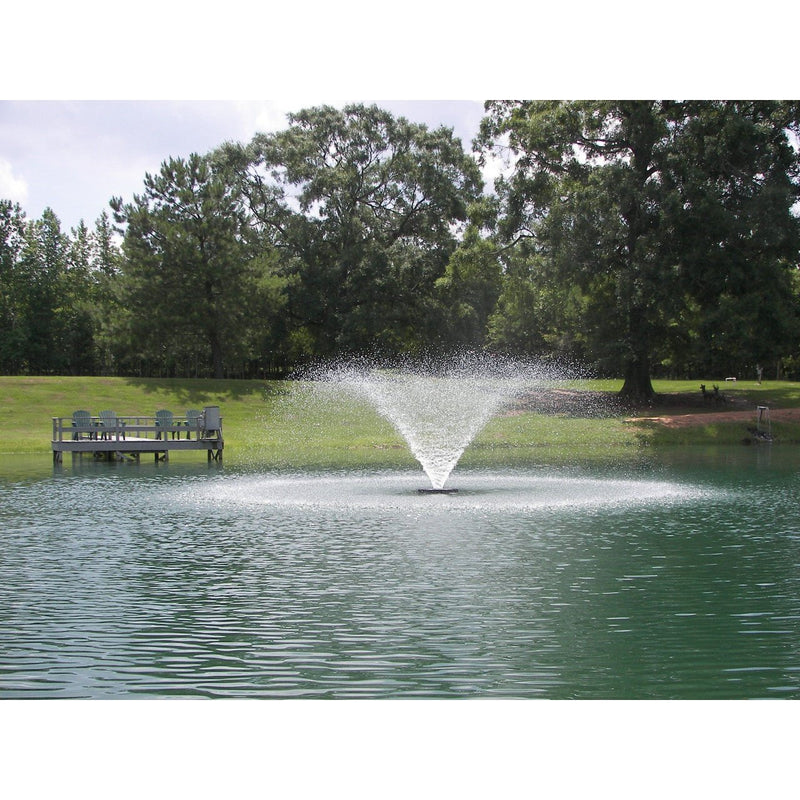
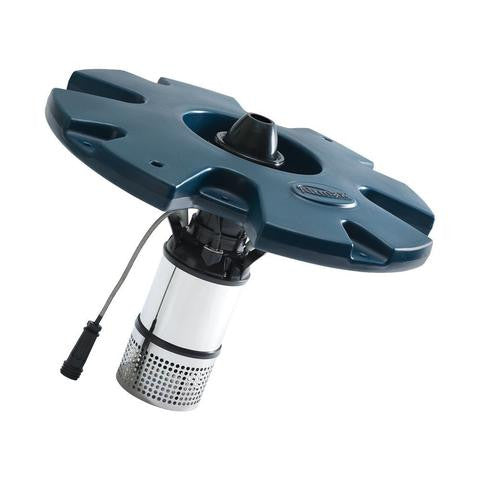
Floating paddlewheels or fountains splash water into the air. While these are effective at breaking up surface films and degassing carbon dioxide, they are generally less energy-efficient for deep-water oxygenation because they only treat the upper layer of the water column.
SAE Range: 1.0 – 2.0 kg $O_2$/kWh [1.3.2].
The Oxygen Transfer Coefficient ($K_{L}a$) is the fundamental formula used to calculate these rates. It describes how efficiently oxygen moves from the gas phase to the liquid phase [1.3.3, 1.7.2].
$OTR = K_{L}a \cdot (C_s - C)$
Where $C_s$ is the saturation concentration and $C$ is the current concentration. This formula demonstrates that oxygen transfer is fastest when the current DO is low (a high concentration gradient), and slows down as the water approaches saturation [1.7.5].
Monitoring Technology: Optical vs. Galvanic Sensors
Accurate monitoring is the only way to ensure DO does not dip toward the 3 mg/L danger zone. Modern facilities utilize two main types of sensors: Electrochemical and Optical.
Galvanic and Polarographic Sensors
These electrochemical sensors utilize a membrane and an electrolyte solution to create an electrical current proportional to the oxygen concentration [1.4.1].
- Advantages: Lower initial cost and fast response times [1.4.5].
- Disadvantages: They "consume" oxygen during measurement, meaning they require a constant flow of water past the sensor (flow dependency) [1.4.2]. They also require frequent membrane replacement and calibration [1.4.3].
Optical (Luminescent) DO Sensors
Optical sensors measure the quenching of luminescence in a light-sensitive dye. A blue LED excites the dye, and the rate at which the luminescence decays is measured; oxygen "quenches" this light [1.4.1, 1.4.4].
- Advantages: They do not consume oxygen and are not flow-dependent, making them ideal for stagnant pond environments [1.4.2, 1.4.4]. They have significantly lower maintenance requirements and longer calibration stability [1.4.3, 1.4.5].
- Disadvantages: Higher upfront capital expenditure [1.4.2].
Challenges and Common Mistakes
The most frequent error in pond management is relying on daytime DO readings. Photosynthesis by algae and plants produces oxygen during daylight hours, often leading to "supersaturation" (levels above 100%). However, at night, these same plants consume oxygen through respiration [1.1.2].
The "3 mg/L crash" almost always occurs in the pre-dawn hours. Operators who only test at noon may see healthy levels of 8-10 mg/L, unaware that the system is dropping to lethal levels at 4:00 AM. Continuous monitoring or automated SCADA systems are required to capture these nocturnal fluctuations.
Another common pitfall is over-aeration or "blind aeration." Operating high-horsepower units when DO is already at saturation is a waste of energy. Since oxygen transfer efficiency ($K_{L}a$) drops as water approaches saturation, the cost of adding that last 1 mg/L of oxygen is exponentially higher than adding oxygen when the pond is at 3 mg/L [1.7.2, 1.7.5].
Limitations of Mechanical Intervention
Mechanical aeration has physical limits. In extremely hot weather, the saturation point of water may only be 6 or 7 mg/L. No matter how much air you pump into the water, you cannot exceed the physical saturation limit dictated by Henry's Law without using pure oxygen injection [1.1.4, 1.2.4].
Furthermore, aeration alone cannot solve issues of massive organic loading. If the BOD is extremely high—due to an algae bloom die-off or excessive sludge—even industrial-grade diffusers may struggle to keep pace with the microbial oxygen demand. In these scenarios, physical removal of organic matter or chemical treatment of nutrients is a mandatory prerequisite to successful oxygenation.
Advanced Considerations: Nitrogen Supersaturation
Practitioners managing high-pressure systems must be aware of nitrogen supersaturation ($Gas Bubble Disease$). When air is injected under high pressure—such as in deep-water diffusers or venturi systems—nitrogen gas can also be forced into solution. If the total gas pressure (TGP) exceeds 110%, fish can develop gas bubbles in their tissues, which is often fatal. This is the mechanical trade-off for high-efficiency oxygenation at depth.
Example Calculation: Oxygen Transfer Requirement
Consider a pond with a volume of 10,000 cubic meters ($m^3$) where the DO has dropped to 3 mg/L. The target is to raise it to 6 mg/L to provide a safety buffer.
1. Identify the Deficit:
$6\text{ mg/L} - 3\text{ mg/L} = 3\text{ mg/L} \text{ (or } 3\text{ g/m}^3\text{)}$
2. Calculate Total Oxygen Required:
$3\text{ g/m}^3 \times 10,000\text{ m}^3 = 30,000\text{ grams (30 kg) of } O_2$
3. Account for Transfer Efficiency:
If using a surface aerator with an SAE of 1.2 kg $O_2$/kWh, and assuming a field transfer efficiency (FTE) of 50% due to non-standard conditions (temperature/impurity), the effective rate is 0.6 kg $O_2$/kWh.
4. Determine Energy Required:
$30\text{ kg} / 0.6\text{ kg/kWh} = 50\text{ kWh}$
This calculation demonstrates that simply "turning on the pump" is insufficient without calculating the mass balance of the gas transfer required to overcome the current deficit and the ongoing BOD.
Final Thoughts
The 3 mg/L threshold is the most significant metric in aquatic system health. It marks the transition from a productive aerobic environment to a stressed, anaerobic state that risks total crop or ecosystem loss. Effective management requires more than just mechanical hardware; it demands a data-driven approach to gas solubility, energy efficiency, and biological demand.
Engineers and pond managers must prioritize night-time monitoring and utilize high-efficiency diffused aeration to maximize oxygen transfer. By understanding the physics of Henry's Law and the mechanics of $K_{L}a$, operators can optimize their power consumption while ensuring the pond remains an "Oxygenated Oasis" rather than a hypoxic grave.
Continuous improvement in sensor technology, particularly the shift toward optical DO probes, allows for real-time adjustments that prevent the 3 mg/L crash. Precision oxygen management is the hallmark of a professional facility, turning a volatile biological system into a stable, predictable asset.