

How Algae Blooms Affect Dissolved Oxygen Levels
The green monster that feeds by day and kills by night. Algae is an oxygen factory when the sun is out, but it turns into a massive consumer the moment the lights go down. Don't let your pond be exposed to the bloom cycle.
Managing a pond ecosystem requires a precise understanding of the biochemical processes that drive water quality. Dissolved oxygen (DO) is the most critical variable in this equation, directly influencing the survival of aquatic life and the efficiency of nutrient cycling. Large-scale algae blooms disrupt the steady-state equilibrium of DO, creating dangerous fluctuations that threaten fish populations and promote anaerobic conditions. Technical pond management focuses on stabilizing these levels through mechanical aeration and nutrient control to prevent the "crash" that leads to total system failure.
How Algae Blooms Affect Dissolved Oxygen Levels
Algae blooms dictate the oxygen profile of a water body through a process known as the diurnal oxygen cycle. During daylight hours, algae and phytoplankton perform photosynthesis, a chemical process where sunlight, carbon dioxide, and water are converted into glucose and oxygen. In eutrophic systems with high algal density, this production often exceeds the saturation point of the water, leading to supersaturation. At this stage, DO levels can reach 150% to 200% of the theoretical saturation limit, which may cause gas bubble trauma in sensitive fish species.
The dynamic shifts radically when light levels drop. Photosynthesis ceases, and the algae transition exclusively to cellular respiration. This process consumes oxygen to metabolize the energy stored during the day. In a pond "exposed" to a massive bloom, the sheer biomass of the algae can deplete DO levels faster than atmospheric diffusion can replenish them. This creates a hypoxic (low oxygen) or anoxic (zero oxygen) environment, typically reaching its most critical point in the pre-dawn hours between 2:00 AM and 6:00 AM.
The ultimate risk occurs during an "algae crash," where the bloom dies off suddenly due to nutrient depletion, temperature shifts, or chemical treatment. As the dead algae decompose, aerobic bacteria proliferate to break down the organic matter. This massive surge in Biochemical Oxygen Demand (BOD) can strip the remaining oxygen from the water column within hours, resulting in a total fish kill. Technical oversight of these cycles is the difference between a productive ecosystem and a stagnant dead zone.
Mechanical Aeration Systems and Gas Transfer Physics
Maintaining stable DO levels requires mechanical intervention to overcome the limitations of natural atmospheric diffusion. Gas transfer occurs at the air-water interface, and the rate of transfer is governed by Henry's Law, which states that the amount of dissolved gas in a liquid is proportional to its partial pressure above the liquid.
Engineered aeration systems increase this interface through two primary methods: diffused aeration and surface agitation.
Diffused Aeration Technology
Diffused aeration uses a shore-mounted compressor to pump air through weighted tubing to diffusers located at the bottom of the pond. These diffusers break the air into millions of micro-bubbles. As these bubbles rise, they transfer oxygen to the water and create a vertical current that disrupts thermal stratification.
Efficiency in diffused systems is measured by Standard Oxygen Transfer Efficiency (SOTE). High-quality fine-bubble diffusers typically achieve an SOTE of approximately 6.5% to 7.0% per meter of depth. This means that deeper water provides a longer "residence time" for the bubbles, allowing for more efficient gas exchange. Coarse-bubble systems, while better for mixing and moving solids, only reach about 2.0% to 3.0% SOTE per meter.
Surface Aeration and Splashing
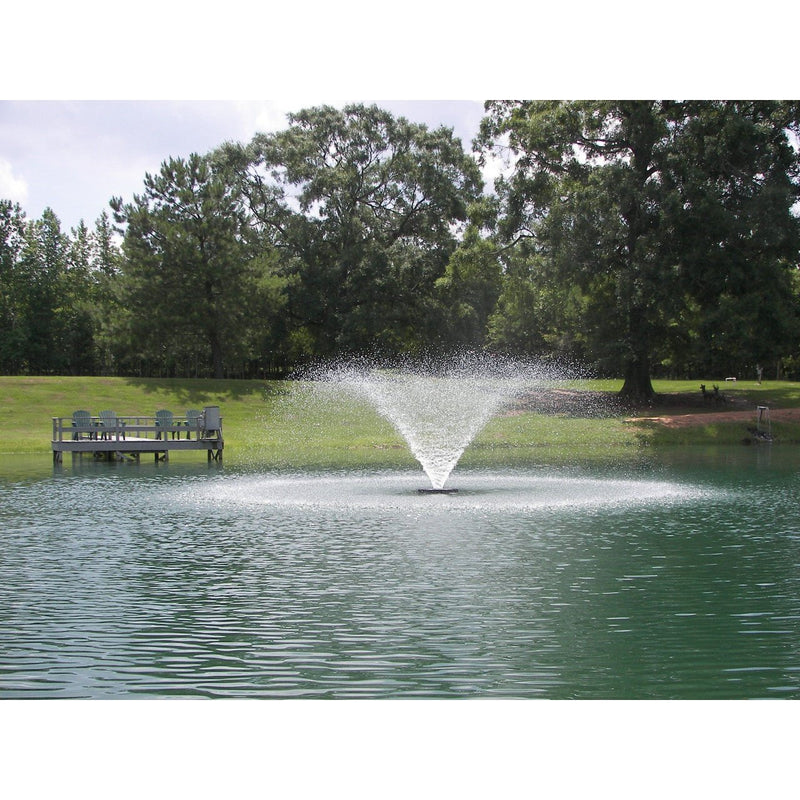
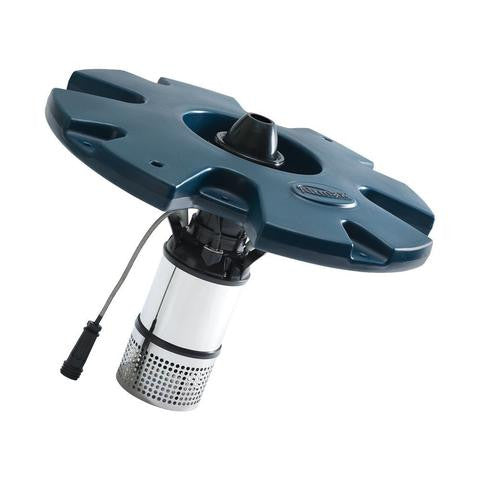
Surface aerators, including fountains and vertical pump agitators, draw water from the upper layers and spray it into the air. This increases the surface area for gas exchange and facilitates the venting of harmful gases like carbon dioxide and methane.
Performance is rated using Standard Aeration Efficiency (SAE), which measures the pounds of oxygen transferred per horsepower-hour (lb O2/hp-hr). Surface aerators often have SAE ratings between 2.5 and 3.0, making them highly effective for shallow ponds where diffused aeration lacks the depth to be efficient.
Benefits of Stabilized Dissolved Oxygen Levels
Optimizing DO levels through consistent management provides measurable improvements to the pond's chemical and biological health. Maintaining a minimum DO concentration of 5.0 mg/L ensures that the system stays in an aerobic state, which is vital for efficient nutrient processing.
Consistent oxygen levels support:
- Nitrification Efficiency: Nitrifying bacteria, such as Nitrosomonas and Nitrobacter, require approximately 4.6 lbs of oxygen for every 1 lb of ammonia oxidized into nitrate. Low DO inhibits this process, leading to toxic ammonia spikes.
- Organic Decomposition: Aerobic bacteria decompose organic sludge (muck) up to ten times faster than anaerobic bacteria. High DO at the pond bottom prevents the accumulation of organic matter that fuels future algae blooms.
- Phosphorus Sequestration: In an aerobic environment, phosphorus often binds to iron and settles into the sediment. Under anoxic conditions, this bond breaks, releasing phosphorus back into the water column to fuel further algal growth.
- Fish Metabolism and Growth: Fish exhibit optimal feed conversion ratios and growth rates when DO is maintained between 6.0 and 9.0 mg/L. Chronic stress from low DO (3.0 mg/L) suppresses the immune system and increases susceptibility to pathogens.
Challenges and Common Technical Pitfalls
The most frequent mistake in pond management is under-sizing the aeration system relative to the Chemical Oxygen Demand (COD) and BOD of the water body. Many operators rely on a "rule of thumb" for acreage that fails to account for depth, nutrient loading, and temperature variables.
Critical challenges include:
- Thermal Stratification: In summer, ponds develop a warm upper layer (epilimnion) and a cold, oxygen-depleted lower layer (hypolimnion). Introducing a powerful aerator into a stratified pond can cause a "turnover," where the anoxic bottom water mixes instantly with the surface water, dropping the overall DO to lethal levels.
- The Solubility Inverse: As water temperature increases, its ability to hold dissolved oxygen decreases. At 50°F (10°C), water can hold approximately 11.3 mg/L of DO at saturation. At 86°F (30°C), this drops to 7.5 mg/L. High-temperature events coincide with peak algae respiration, creating a "perfect storm" for hypoxia.
- Biofouling of Diffusers: Fine-bubble diffusers are prone to mineral scaling and biofilm accumulation. If not maintained, the backpressure on the compressor increases, reducing SOTE and shortening the lifespan of the equipment.
Limitations of Standard Management Methods
While aeration is a powerful tool, it has practical boundaries. Mechanical aeration alone cannot compensate for extreme nutrient pollution. If a pond receives massive runoff of nitrogen and phosphorus from surrounding agriculture, the biomass production will eventually exceed the mechanical capacity of any standard aeration system.
Surface aerators are limited by their "zone of influence." A single fountain may provide enough oxygen for a small radius but leave the rest of the pond stagnant. In very deep ponds (over 20 feet), surface units cannot penetrate the thermocline, leaving the bottom of the pond in a permanent state of anoxia. Conversely, diffused aeration is ineffective in water shallower than 4 feet because the bubbles reach the surface too quickly to transfer significant oxygen.
Comparative Analysis: Diffused vs. Surface Aeration
The selection of a system depends on pond morphology and the specific management goals. The following table summarizes the technical performance of the two primary aeration types.
| Parameter | Diffused Aeration | Surface Aeration |
|---|---|---|
| Optimal Depth | 8 to 20+ feet | 2 to 6 feet |
| SAE (lb O2/hp-hr) | 3.0 to 4.5 | 2.5 to 3.2 |
| Primary Function | Total pond de-stratification | Localized O2 boost & venting |
| Operating Cost | Lower (Higher O2/watt) | Higher (Energy used for splash) |
| Maintenance | Cleaning diffusers (2-4 years) | Regular motor inspection |
Practical Tips for Optimizing Oxygen Levels
Implementation of a technical management plan should prioritize data over estimation. Monitoring the pond's diurnal cycle using a DO meter provides the necessary metrics to adjust aeration runtimes.
Optimal practices include:
- Nighttime Operation: If energy costs are a concern, prioritize running aerators from dusk until dawn. This is the period when algae are consuming oxygen, and the risk of hypoxia is highest.
- Bottom-Up De-stratification: Start new aeration systems in stratified ponds slowly. Run the system for 15 minutes the first day, 30 minutes the second, and double the time daily until the pond is fully mixed. This prevents a sudden anoxic turnover.
- Nutrient Stripping: Use lanthanum-modified clay or aluminum sulfate (alum) to bind reactive phosphorus. Reducing the fuel for the algae bloom decreases the total oxygen demand of the system.
- Compressor Placement: House compressors in ventilated, weather-proof cabinets. Heat is the primary enemy of compressor diaphragms and pistons; keeping the unit cool extends maintenance intervals.
Advanced Considerations: The Alpha Factor and SOTR
For serious practitioners, calculating the Standard Oxygen Transfer Rate (SOTR) is essential. The SOTR is determined under laboratory conditions with clean water, but real-world pond water contains dissolved solids, surfactants, and organic matter that interfere with gas transfer.
The "Alpha Factor" ($\alpha$) is the ratio of oxygen transfer in pond water to that in clean water. In typical aquaculture or pond environments, $\alpha$ ranges from 0.4 to 0.8. This means your aeration system may only be 40% to 80% as effective as the manufacturer's specification. When designing a system for a high-density koi pond or a eutrophic lake, you must over-size the equipment to account for this efficiency loss.
Furthermore, elevation affects oxygen solubility. At higher altitudes, atmospheric pressure is lower, which reduces the partial pressure of oxygen and thus the saturation limit of the water. Systems installed in mountain regions must be calibrated to these lower pressure thresholds.
Example Scenario: Calculating Oxygen Demand
Consider a 1-acre pond with an average depth of 6 feet and a moderate algae bloom.
1. Calculate Volume: 1 acre-foot is 325,851 gallons. A 6-foot deep, 1-acre pond holds roughly 6 acre-feet or 1,955,106 gallons.
2. Determine Demand: A typical eutrophic pond may have a BOD of 10 mg/L. This equates to roughly 163 lbs of oxygen required to stabilize the organic load.
3. Select Equipment: A 1/2 HP diffused aeration system might have an SOTR of 1.2 lb O2/hr.
4. Adjust for Reality: Applying an Alpha Factor of 0.6 and a temperature correction, the actual transfer rate may drop to 0.5 lb O2/hr.
5. Conclusion: To meet the demand, multiple diffusers and a larger compressor would be required to ensure the system can overcome the nightly respiration cycle of the algae bloom.
Final Thoughts
The technical management of a pond requires moving beyond the visual "bloom" and focusing on the underlying oxygen dynamics. Algae represent a double-edged sword: a vital source of daytime oxygen that becomes a lethal liability at night. Successfully managing this cycle depends on robust mechanical aeration, precise sizing based on oxygen transfer physics, and proactive nutrient control.
By maintaining a minimum dissolved oxygen level of 5.0 mg/L, you ensure the dominance of aerobic processes, which keep the system clean and the water chemistry stable. Avoiding common pitfalls like sudden turnover and under-sized aeration will protect your biological investment.
The goal is to move the pond from a state of "Exposed Bloom" to "Sheltered Balance." This transition is achieved through engineering and observation. Practitioners should continue to monitor DO levels and adjust their systems as the biomass and temperature of the pond evolve throughout the season.