

The Truth About Pond Fountains: Do They Really Aerate Water?
A pretty fountain isn't always a healthy pond. Fountains look great, but do they actually breathe life into your pond? The answer depends on where the air is going. While the visual appeal of a spray pattern is undeniable, the mechanical efficiency of these systems often falls short of meeting the biological demands of a complex aquatic ecosystem.
Understanding the distinction between surface agitation and deep-water gas exchange is critical for any pond manager or property owner. The aesthetic value of a water feature must be weighed against the functional necessity of dissolved oxygen (DO) levels, especially in deeper water columns where thermal stratification creates isolated, toxic environments. This guide examines the technical realities of pond fountains, comparing them to strategic deep aeration systems through the lens of efficiency metrics, fluid dynamics, and biological oxygen demand.
The Truth About Pond Fountains: Do They Really Aerate Water?
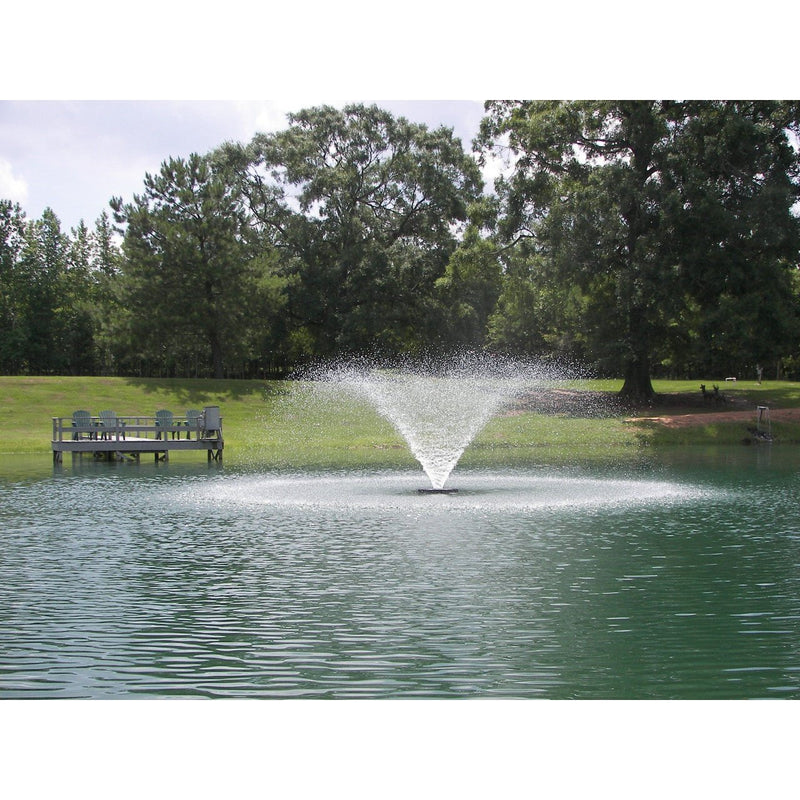
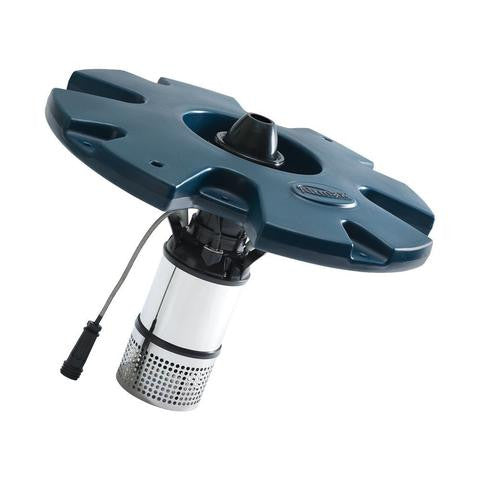
Pond fountains are primarily categorized as surface aerators. They operate by drawing water from the upper layers of the water column and propelling it into the atmosphere. As the water droplets travel through the air, they increase their surface area, allowing for a degree of gas exchange before falling back into the pond. This process increases dissolved oxygen levels, but its impact is almost exclusively limited to the surface.
In real-world applications, a fountain is an effective tool for localized oxygenation in shallow environments, typically those less than 6 feet deep. However, the physics of a fountain spray mean that the water being "aerated" is often the water that already contains the highest concentration of oxygen. In deeper ponds, a fountain acts as a decorative ornament that leaves the bottom layers stagnant. This leads to a phenomenon where the top few feet of the pond are healthy, while the depths remain anaerobic, accumulating muck and hazardous gases.
How Pond Aeration Mechanics Work
The efficiency of any aeration system is dictated by the Standard Oxygen Transfer Rate (SOTR) and the Standard Aeration Efficiency (SAE). These metrics allow for an objective comparison of how much oxygen is actually being introduced into the water per unit of energy consumed.
The Surface Agitation Process
Fountains rely on mechanical splashing. When water is shattered into droplets, the interface between the water and the atmosphere allows oxygen to diffuse into the liquid. This is governed by Henry’s Law, which states that the amount of dissolved gas in a liquid is proportional to its partial pressure above the liquid. Because fountains operate at the surface where the pressure is 1 atmosphere, the rate of diffusion is relatively fixed.
The Diffused Aeration Alternative
Deep-water or diffused aeration takes the opposite approach. A compressor located on the shore pumps air through weighted tubing to a diffuser membrane located at the bottom of the pond. This membrane releases thousands of micro-bubbles. As these bubbles rise, two distinct processes occur:
- Direct Transfer: Oxygen diffuses from the bubble into the water as it travels upward. Because the pressure is higher at the bottom of the pond, the solubility of oxygen is technically higher, improving the transfer rate.
- Induced Circulation: The rising column of bubbles creates an "airlift" effect, pulling cold, oxygen-depleted water from the bottom and forcing it to the surface. This mechanical mixing is what eliminates thermal stratification.
Benefits of Fountain-Based Aeration
While fountains have limitations, they provide specific advantages that make them suitable for certain configurations.
Localized Oxygenation: In very shallow ponds or narrow channels where bottom-mounted diffusers would create too much turbidity, a fountain provides a steady supply of oxygen to the surface dwelling organisms.
Volatile Gas Venting: Fountains are exceptionally good at venting off unwanted gases like carbon dioxide and ammonia that may accumulate in the upper water column. The high-velocity spray allows these gases to escape into the atmosphere more rapidly than passive diffusion.
Mosquito Control: Continuous surface agitation disrupts the surface tension required for mosquito larvae to breathe and for adults to lay eggs. This makes fountains a functional choice for ponds in residential areas where pest control is a priority.
Challenges and Common Mistakes
The most frequent error in pond management is assuming a fountain is a "set-it-and-forget-it" solution for water quality.
Under-Sizing the Motor: Many owners choose a fountain based on the spray height rather than the horsepower (HP) required to move a sufficient volume of water. A high-reaching, thin spray pattern provides significantly less aeration than a lower, wider, "heavy" spray pattern.
Neglecting the Thermocline: In ponds deeper than 8 feet, a thermocline forms—a sharp temperature gradient that separates the warm surface water (epilimnion) from the cold bottom water (hypolimnion). A fountain rarely has the suction power to draw water from below the thermocline. Consequently, the bottom of the pond remains "dead," allowing organic matter to decay anaerobically.
High Operational Costs: Moving water is significantly more energy-intensive than moving air. A 1-HP fountain motor will typically move less oxygen into the water than a 1/4-HP compressor-driven diffuser system, leading to higher electricity bills for inferior biological results.
Limitations: When a Fountain Is Not Enough
A fountain should not be the primary source of aeration in several specific scenarios:
- High Fish Density: In ponds with large populations of fish, especially sensitive species like trout or koi, the biochemical oxygen demand (BOD) is too high for a surface fountain to maintain. If the power fails or the temperature spikes, oxygen levels can drop to lethal levels in the bottom tiers of the pond.
- Excessive Muck Accumulation: If a pond has a thick layer of organic "muck" at the bottom, it needs oxygen at the sediment-water interface to support aerobic bacteria. Fountains cannot deliver oxygen to this interface, meaning the muck will continue to build up, eventually leading to a "turnover" event where toxic bottom water kills the pond's inhabitants.
- Large Surface Acreage: A single fountain has a limited "zone of influence." For large lakes, the energy required to aerate the entire surface using fountains is cost-prohibitive.
Technical Comparison: Purely Aesthetic vs. Strategic Aeration
To choose the correct system, one must evaluate the SAE (Standard Aeration Efficiency), which measures the pounds of oxygen transferred per horsepower per hour (lbs O2/hp-hr).
| Metric | Decorative Fountain | Sub-Surface Diffused Aeration |
|---|---|---|
| SAE (Efficiency) | 1.5 – 2.5 lbs O2/hp-hr | 2.5 – 4.5 lbs O2/hp-hr |
| Effective Depth | Surface to 6 feet | Bottom to 50+ feet |
| Destratification | Minimal / None | Complete / High |
| Maintenance | High (Underwater Motor) | Low (Shore-based Compressor) |
| Primary Focus | Visual Impact | Biological Health |
Practical Tips for Optimizing Fountain Aeration
If a fountain is required for aesthetic reasons, its aeration potential can be maximized with the following adjustments:
- Select a "V-Shaped" Nozzle: Avoid high-pressure, thin-stream nozzles. Patterns that create large volumes of heavy spray (coarser droplets) provide better gas exchange and more surface agitation.
- Run the System 24/7: Dissolved oxygen levels are lowest just before dawn due to plant respiration. Turning off the fountain at night removes the only source of oxygen during the pond’s most vulnerable hours.
- Placement Strategy: Position the fountain in the center of the pond to maximize the circulation of the surface layer. Avoid corners or sheltered areas where the water can become stagnant despite the fountain’s operation.
Advanced Considerations: The Role of Biochemical Oxygen Demand (BOD)
Professional pond managers calculate the required aeration based on the total oxygen demand of the pond. This includes the respiration of fish, the respiration of plants at night, and—most importantly—the oxygen required for the decomposition of organic matter by aerobic bacteria.
When a pond is stratified, the bottom sediment becomes anaerobic. Bacteria in this zone switch from aerobic to anaerobic decomposition, which is 20 to 30 times slower and produces toxic byproducts like hydrogen sulfide (H2S). A fountain does nothing to address the BOD at the pond's floor. To truly "breathe life" into a pond, the aeration system must deliver enough oxygen to the bottom to satisfy the sediment oxygen demand (SOD). If the SOD is not met, the pond will continue to age prematurely, a process known as eutrophication.
Example Scenario: Shallow vs. Deep Pond Management
Consider two different water bodies:
Scenario A: A 1/4-acre retention pond with a maximum depth of 4 feet. In this case, a 1/2-HP fountain is likely sufficient. Because the water is shallow, the splashing action can influence a large percentage of the total water volume. Thermal stratification is unlikely to be a major factor.
Scenario B: A 1-acre farm pond with a maximum depth of 12 feet. A fountain in this pond will provide an attractive display, but it will fail to reach the bottom 6 feet of water. Over time, the hypolimnion will become anoxic. In this scenario, the most efficient approach is to install a 1/4-HP diffused aeration system for biological health and, if desired, a separate fountain for aesthetics. The diffused system will move roughly 2,000 gallons of water per minute from the bottom to the top using very little power, while the fountain provides the visual finish.
Final Thoughts
The choice between a fountain and a deep-water aerator depends on the primary objective of the pond owner. If the goal is purely visual, a fountain is the superior choice. However, if the goal is to maintain a healthy, self-sustaining ecosystem with clear water and minimal muck buildup, a fountain is rarely a complete solution.
Relying solely on surface agitation in a deep pond is a gamble against the physics of water density and oxygen solubility. For serious practitioners, the most effective strategy is often a hybrid approach: using diffused aeration to handle the heavy lifting of gas exchange and destratification, while using a fountain for its aesthetic and surface-venting properties.
By focusing on where the air is going—rather than just how the water looks—you ensure that your pond is as healthy beneath the surface as it is beautiful above it. Application of these principles will lead to better water clarity, healthier fish populations, and lower long-term maintenance costs.