

Pond Fountain vs. Diffused Aeration: Which Gives You More Oxygen?
One looks good. One keeps the pond alive forever. Fountains are for the eyes, but diffusers are for the ecosystem. Which one does your pond actually need to survive the summer?
Managing an aquatic environment requires a shift from aesthetic preference to mechanical optimization. Most pond owners select equipment based on visual impact, yet the underlying biological processes—specifically nutrient cycling and gas exchange—are dictated by the physics of oxygen placement. This technical analysis examines the thermodynamic and mechanical differences between surface-level splashing and deep-water diffusion.
Energy expenditure in a pond system must translate directly into measurable oxygen gains. Understanding metrics like Standard Aeration Efficiency (SAE) is the only way to optimize a pond's long-term ecological stability. Data-driven decision-making ensures that the chosen system can handle the biological oxygen demand of the specific water body.
Pond Fountain vs. Diffused Aeration: Which Gives You More Oxygen?
Oxygen transfer efficiency is the primary metric for evaluating any aeration system. Standard Aeration Efficiency (SAE) measures the pounds of oxygen transferred per horsepower-hour (lb O2/hp-hr). This figure provides the baseline for comparing different mechanical approaches.
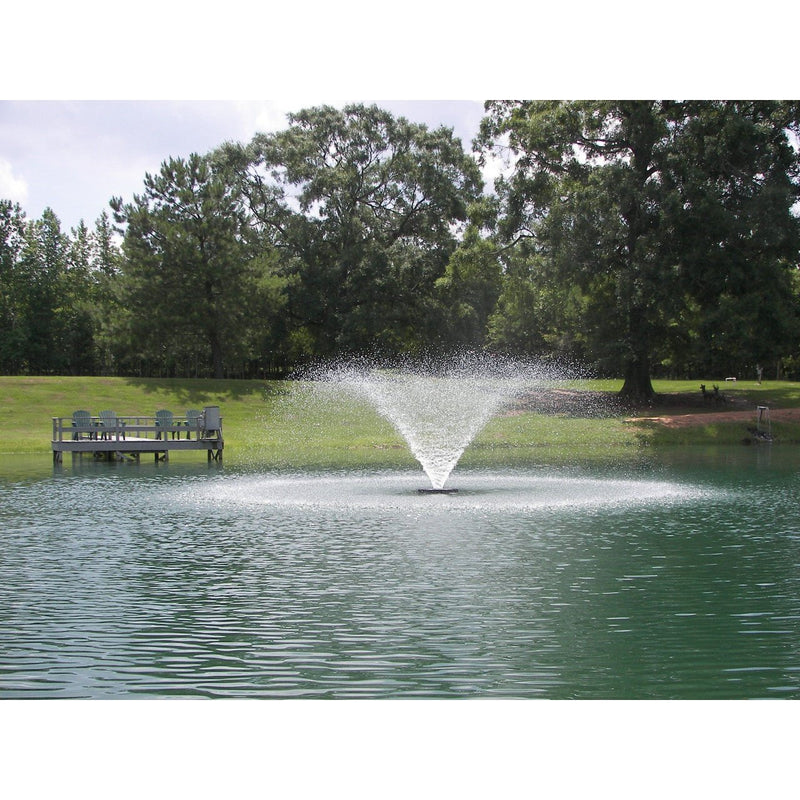
Decorative fountains typically provide an SAE between 1.5 and 2.5 lb O2/hp-hr. These units function by pumping water through a nozzle and into the atmosphere. The oxygen transfer occurs primarily through "surface flash," where individual water droplets absorb oxygen from the air before falling back into the surface layer. This process is effective for the top 3 to 5 feet of the water column, but it does little to address the deoxygenated water at the bottom.
In contrast, diffused aeration systems utilize shore-mounted compressors to deliver air through weighted tubing to membrane diffusers at the pond floor. These systems often exhibit an SAE of 2.0 to 4.0 lb O2/hp-hr, and this efficiency increases significantly with depth. The physics of diffused aeration rely on the "bubble column" effect, where billions of micro-bubbles rise to the surface. As depth increases, the "residence time"—the duration a bubble stays in the water—increases, allowing for higher Standard Oxygen Transfer Efficiency (SOTE).
Technical data indicates that fine-bubble membranes can achieve an SOTE of approximately 1.6% to 2.0% per foot of depth. A diffuser placed at 10 feet of depth provides roughly 16% to 20% OTE, whereas surface agitation is limited to a fixed OTE of approximately 1.6% to 3.2% because it only interacts with the topmost layer of the water column. For large-scale water bodies, the depth-dependent efficiency of diffusers makes them the superior choice for maximizing dissolved oxygen (DO) levels.
Mechanical Principles: How These Systems Operate
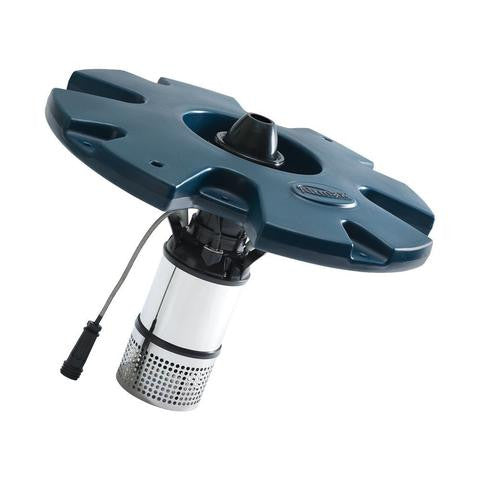
Fountains and diffusers utilize fundamentally different mechanical components to move oxygen into the water. A fountain is a centrifugal pump system. It consists of a motor, an impeller, and a nozzle housing. The motor spins the impeller at high RPMs to draw water in and force it through the nozzle. This requires moving a high mass (water is 830 times denser than air), which results in high electrical consumption per unit of oxygen transferred.
Diffused aeration systems rely on air compression. These systems typically use rocking piston compressors or rotary vane pumps. The compressor generates a volume of air measured in Cubic Feet per Minute (CFM) at a specific Pressure (PSI). This compressed air is forced through a fine-pore membrane, often made of EPDM (Ethylene Propylene Diene Monomer). The membrane contains thousands of tiny slits that open under pressure to release bubbles between 1 mm and 3 mm in diameter.
Smaller bubbles are mechanically superior for aeration because they have a higher surface-area-to-volume ratio. A 2 mm bubble has significantly more surface area relative to its volume than a 6 mm bubble, providing more opportunities for gas exchange. Furthermore, smaller bubbles rise more slowly—at a rate of approximately 0.8 to 1 foot per second—which increases the contact time between the air and the water. This "synergistic lift" or "chimney effect" pulls cold, oxygen-depleted water from the hypolimnion (bottom layer) to the surface for gas exchange.
Technical Advantages of Sub-Surface Diffusion
The most significant benefit of sub-surface aeration is the elimination of thermal stratification. During summer, ponds naturally separate into a warm, oxygen-rich top layer (epilimnion) and a cold, deoxygenated bottom layer (hypolimnion). Without circulation, the bottom layer becomes toxic, accumulating hydrogen sulfide (H2S) and ammonia (NH3).
Diffused aeration facilitates "precision vertical mixing," ensuring that the entire volume of the pond interacts with the atmosphere. This process supports aerobic bacteria at the pond floor. These bacteria are up to 10 times more efficient at breaking down organic muck than anaerobic bacteria. Constant movement also prevents "turnover" events, where a sudden storm or temperature change mixes the layers rapidly, leading to mass fish kills due to an abrupt drop in total dissolved oxygen.
Fountains, while providing some surface circulation, are mechanically incapable of reaching the lower layers in ponds deeper than 6 feet. They are effective at venting unwanted gases from the surface and preventing the growth of duckweed or watermeal, which thrive in stagnant, nutrient-rich surface water. However, they leave the "biological foundation" of the pond—the sediment-water interface—untreated.
Engineering Challenges and Maintenance Requirements
Every mechanical system faces degradation over time. Centrifugal pumps in fountains are susceptible to nozzle clogging and mechanical wear from abrasive sediments. Because the motor is submerged, seal failure can lead to catastrophic motor burnout. Periodic maintenance includes cleaning the intake screens and checking the integrity of the underwater power cable, which is a frequent point of failure due to aquatic wildlife or ice movement.
Diffused aeration systems face different challenges. The compressors are typically located on shore in a ventilated cabinet. The primary wear items are the internal cups and seals of the rocking piston, which require replacement every 2 to 3 years. The diffusers themselves can experience "pore fouling" from mineral deposits or biological growth. High-quality EPDM membranes are designed to "flex" during startup to shed these deposits, but occasional cleaning with a mild acid solution may be necessary in high-calcium environments.
Compressor backpressure is a critical metric for diffused systems. If the diffusers are placed too deep or the air lines are too narrow, the compressor must work harder to overcome the hydrostatic pressure. This increases the internal operating temperature and shortens the lifespan of the components. Proper engineering involves matching the compressor's PSI capabilities with the maximum depth of the pond to ensure optimal CFM delivery.
Environmental Limitations and Trade-offs
Fountains are poorly suited for extreme climates. In cold regions, they must be removed during the winter to prevent ice damage to the float and pump. This leaves the pond without aeration during the critical winter months when ice cover prevents natural gas exchange. Anoxic conditions can develop under the ice, leading to winter fish kills.
Diffused aeration is the preferred method for winter operation. The rising bubbles keep a small portion of the surface ice-free, allowing toxic gases to escape and atmospheric oxygen to enter. However, diffusers must be moved to shallower water during the winter in some managed fisheries to prevent "super-cooling," where the mixing process drops the entire water column to a temperature that is lethal to certain species.
Environmental depth is the ultimate constraint. In shallow water (less than 4 feet), diffusers lose their efficiency because the bubble has very little time to transfer oxygen before reaching the surface. In these scenarios, a high-volume surface aerator—which looks like a fountain but moves significantly more water without a decorative pattern—is often the more efficient choice.
Mechanical Performance Comparison
The following table illustrates the technical differences between decorative fountains and diffused aeration systems based on industry-standard engineering data.
| Metric | Decorative Fountain | Diffused Aeration |
|---|---|---|
| Standard Aeration Efficiency (SAE) | 1.5 – 2.5 lb O2/hp-hr | 2.0 – 4.0+ lb O2/hp-hr |
| Effective Aeration Depth | 0 – 6 feet | 8 – 50+ feet |
| Oxygen Transfer Mechanism | Surface Agitation (Splashing) | Bubble Column / Precision Mixing |
| Destratification Ability | Low (Surface only) | High (Total water column) |
| Winter Operation | Not Recommended | Highly Effective |
| Monthly Operational Cost | Higher (Pumping water) | Lower (Pumping air) |
Practical Tips for System Optimization
System sizing should be based on the pond's "turnover rate." A professionally designed system should be capable of moving the entire volume of the pond at least once every 12 to 24 hours. For diffused systems, this is calculated by the CFM of the compressor and the depth-dependent lifting capacity of the diffusers.
Utilizing a "hybrid approach" is often the most effective strategy for properties requiring both beauty and biological health. A bottom diffused system can run 24/7 to handle the heavy-duty biological work, while a decorative fountain can be placed on a timer for visual enjoyment during daylight hours. This reduces overall energy consumption while maintaining high dissolved oxygen levels.
Placement of diffusers is critical for maximizing circulation. In irregular-shaped ponds, multiple diffusers should be positioned in the deepest areas to ensure that no "dead zones" remain. Avoid placing diffusers in areas with heavy sediment accumulation without a base plate, as this can stir up muck and temporarily decrease water clarity.
Advanced Considerations in Fluid Dynamics
Engineers must account for the Biological Oxygen Demand (BOD) when sizing a system. BOD is the amount of dissolved oxygen needed by aerobic biological organisms to break down organic material present in a given water body at a certain temperature over a specific time period. If the pond has a high nutrient load from runoff or waterfowl, the SOTR of the aeration system must exceed the BOD to prevent oxygen depletion.
The "Kla" coefficient, or the volumetric mass transfer coefficient, is another advanced metric used to determine how quickly oxygen will dissolve into the water. This coefficient is influenced by the turbulence of the water and the surface area of the bubbles. Increasing the number of diffusers rather than the size of a single diffuser can improve the Kla by distributing the gas exchange across a larger area.
Hydrostatic pressure at depth significantly impacts compressor performance. For every 2.31 feet of depth, the water exerts 1 PSI of backpressure. A compressor rated for 10 PSI will lose a portion of its CFM output as it approaches its maximum pressure limit. Serious practitioners use pressure gauges to monitor system health and detect leaks or clogged diffusers early.
Example Scenario: One-Acre Pond Calculation
Consider a one-acre pond with an average depth of 10 feet. The total volume is approximately 3.26 million gallons. To achieve a single turnover in 24 hours, the system must move approximately 2,263 gallons per minute (GPM).
A 1-HP decorative fountain might move 150 GPM through a nozzle. This results in a turnover rate that is far too slow to prevent bottom-water stagnation. In contrast, a 1/2-HP rocking piston compressor connected to three fine-bubble diffusers at 10 feet of depth can move upwards of 2,500 GPM via the bubble column effect. The diffused system achieves the necessary turnover using half the horsepower of the fountain.
This scenario demonstrates the mechanical superiority of air-lift systems for volume management. While the fountain adds oxygen to the surface, the diffused system addresses the underlying cause of water quality issues—lack of circulation in the deep zones.
Final Thoughts
Selection of a pond aeration system must be based on mechanical requirements and biological goals. Fountains provide excellent surface agitation and aesthetic appeal, making them ideal for shallow, focal-point ponds where visual impact is the priority. They are effective tools for managing surface debris and adding sound, but they lack the power to treat the entire water column.
Diffused aeration systems represent a long-term investment in the biological legacy of a pond. By addressing the oxygen needs at the sediment-water interface, these systems facilitate nutrient cycling, muck reduction, and thermal destratification. They are the only viable solution for maintaining health in deep-water environments and preventing seasonal fish kills.
Understanding the metrics of SAE and SOTR allows for the design of a system that is both energy-efficient and ecologically effective. Whether choosing a decorative surface unit or an industrial-grade diffuser, the focus should remain on moving the most oxygen for every kilowatt-hour consumed. Proper mechanical optimization ensures that the pond remains a living, breathing ecosystem rather than a stagnant water body.