Pond Aeration Vs Algae Growth: The Oxygen Solution
Are you treating the symptom or the cause? Deep oxygen is nature's filter. Stop the cycle of chemical dependency. Most algae problems aren't caused by a lack of poison, but a lack of breath. Oxygenating the pond floor boosts the beneficial biology that starves algae of its fuel. Here is the science behind a self-cleaning ecosystem. ?? #PondManagement #EcoSystem #ClearWater #SustainableLiving
Managing an aquatic ecosystem requires a shift from reactive chemical application to proactive mechanical optimization. Many pond owners view algae as an invader to be killed with copper sulfate or diquat. This approach ignores the underlying nutrient imbalance that fuels the growth. True restoration begins at the pond floor where organic matter accumulates and consumes dissolved oxygen (DO).
Traditional chemical treatments often exacerbate the problem in the long term. When algae die off rapidly due to poisons, the biomass sinks to the bottom. This adds to the "muck" layer, which then decomposes and strips more oxygen from the water. Breaking this cycle involves introducing high volumes of atmospheric air into the lower strata of the water column.
Deep-water aeration acts as a mechanical catalyst for biological filtration. Higher oxygen levels at the sediment-water interface allow aerobic bacteria to process organic waste up to 20 times faster than anaerobic species. This process effectively starves algae by locking away the nutrients they need to bloom. Understanding the mechanical and chemical variables involved is essential for any serious practitioner.
Pond Aeration Vs Algae Growth: The Oxygen Solution
Aeration is the process of increasing the saturation of dissolved oxygen in a body of water. In a pond environment, algae growth is directly linked to nutrient availability, specifically phosphorus and nitrogen. When a pond lacks sufficient oxygen, it enters an anaerobic state. This state triggers a chemical release of nutrients from the bottom sediments back into the water column, a process known as internal loading.
The oxygen solution focuses on maintaining aerobic conditions throughout the entire water column. Sufficient dissolved oxygen levels—ideally above 5 mg/L—prevent the chemical reduction of iron. In oxygen-rich environments, phosphorus binds with ferric iron to form insoluble compounds that settle into the sediment. This mechanical-chemical "lock" makes the phosphorus unavailable to surface-dwelling algae.
Real-world applications of this concept are seen in municipal wastewater treatment and large-scale aquaculture. In these settings, technicians do not rely on chemicals to clear water. They utilize high-efficiency compressors and fine-bubble diffusers to maintain a high redox potential. This same industrial principle applies to decorative and recreational ponds, where the goal is a self-sustaining nutrient cycle.
Thermodynamics and Stratification: The Mechanical Barrier
Thermal stratification is a primary obstacle to natural pond health. During warmer months, the sun heats the surface water, making it less dense than the cooler water below. This creates three distinct layers: the epilimnion (warm top), the thermocline (middle transition), and the hypolimnion (cold, dark bottom). Without mechanical intervention, these layers do not mix.
The hypolimnion becomes an "oxygen desert" because it is cut off from atmospheric diffusion and photosynthesis. Organic matter continues to fall into this bottom layer, where bacteria consume the remaining oxygen during decomposition. Once the DO hits zero, the water becomes anoxic. This condition is the primary driver of foul odors (hydrogen sulfide) and massive nutrient spikes.
Subsurface aeration breaks this thermal barrier through a process called laminar flow. As air bubbles rise from a bottom-mounted diffuser, they pull the cold, dense water from the floor toward the surface. This vertical movement forces the entire pond volume to circulate, equalizing temperatures and ensuring that oxygen reaches the deepest points of the basin.
Mechanical Components of a Subsurface System
- Compressor: The engine that drives the system, typically a linear piston or rocking piston design for continuous 24/7 operation.
- Weighted Tubing: Sinking airlines that transport air from the shore-based compressor to the diffusers without floating to the surface.
- Diffusers: Manifolds equipped with micro-perforated membranes that break the air into millions of tiny bubbles to maximize surface area for oxygen transfer.
Chemical Mechanisms of Nutrient Sequestration
Phosphorus management is the core of algae control. In an anoxic pond floor, ferric iron (Fe3+) is reduced to ferrous iron (Fe2+). Ferrous iron is highly soluble and cannot hold onto phosphorus. Consequently, the phosphorus that was previously trapped in the mud is released into the water, providing a direct "fuel injection" for the next algae bloom.
Maintaining high DO levels at the sediment-water interface keeps iron in its ferric state. Ferric iron has a high affinity for orthophosphate. When these two meet in an aerobic environment, they form ferric hydroxyphosphate, a stable solid. This chemical sequestration effectively removes the limiting nutrient from the biological equation, preventing algae from reaching bloom density.
Aeration also influences the nitrogen cycle. Nitrifying bacteria, which convert toxic ammonia into nitrite and then into relatively harmless nitrate, are obligate aerobes. They require oxygen to perform this conversion. Low oxygen levels stall the nitrification process, leading to ammonia accumulation, which is toxic to fish and encourages the growth of specific types of nuisance aquatic plants.
Efficiency Metrics: CFM, HP, and Turnover Rates
Sizing an aeration system requires precise calculations based on surface acreage and average depth. A common industry standard is to provide 1 to 1.5 Horsepower (HP) per surface acre for standard recreational ponds. However, heavily stocked ponds or those with existing heavy muck layers may require up to 2 HP per acre to counteract the high biological oxygen demand (BOD).
Airflow is measured in Cubic Feet per Minute (CFM). For efficient oxygenation, systems should deliver approximately 1 to 2 CFM per 1,000 gallons of water. Deeper ponds are actually more efficient to aerate than shallow ones because the bubbles have a longer "hang time" in the water column, allowing for more oxygen transfer and creating a larger plume of moving water.
Turnover rate is the most critical metric for mechanical success. An optimized system should be capable of moving the entire volume of the pond—one acre-foot is 325,900 gallons—at least once every 24 to 48 hours. This constant turnover ensures that no stagnant, anoxic pockets can form. Systems that fail to meet this turnover rate will only provide localized benefits, leaving the majority of the pond floor in a state of decay.
Subsurface Aeration vs. Surface Agitation
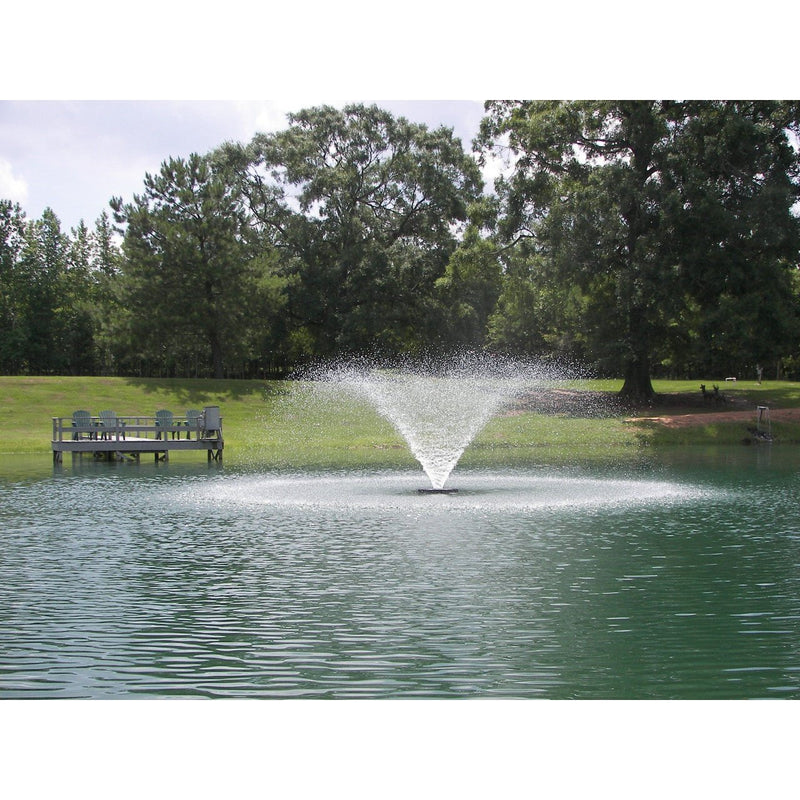
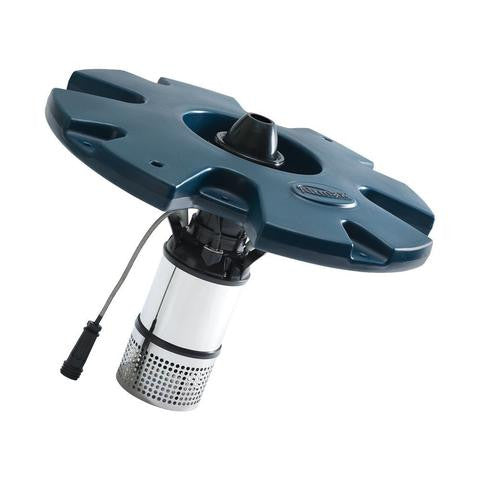
Choosing the correct equipment depends on the depth profile of the pond. Surface aerators, such as floating fountains or high-volume circulators, are effective in water shallower than 6 to 8 feet. They work by splashing water into the air to facilitate gas exchange. While visually appealing, they struggle to move water from the bottom of deep basins.
Subsurface diffused aeration is the superior choice for deep ponds. Because it operates from the floor, it utilizes the physics of rising air to move massive volumes of water with relatively low energy consumption. A 1/2 HP rocking piston compressor can often out-perform a 2 HP fountain in terms of total pond turnover and oxygen distribution at depth.
| Feature | Surface Aeration (Fountains) | Subsurface Diffused Aeration |
|---|---|---|
| Effective Depth | 1–6 Feet | 6–30+ Feet |
| Oxygen Transfer Efficiency | High at surface only | Highest at depth |
| Energy Consumption | High (1.5+ HP common) | Low to Moderate (1/4 to 3/4 HP) |
| Thermal Mixing | Minimal | Total (Disrupts thermocline) |
| Aesthetic Impact | High (Visual spray) | Low (Bubbles on surface) |
Algicide Limitations and Ecological Feedbacks
Chemical algicides provide a temporary reduction in algae biomass but fail to address the root cause. Copper sulfate, the most common treatment, is a heavy metal that does not biodegrade. It accumulates in the sediment and can reach toxic levels for benthic organisms like snails and beneficial bacteria. This toxicity slows down the natural decomposition process, leading to faster muck accumulation.
Killing a massive algae bloom with chemicals often results in a "rebound effect." As the algae die, they release all their stored phosphorus and nitrogen back into the water. This sudden nutrient spike, combined with the loss of oxygen during decomposition, creates the perfect environment for an even larger bloom to occur weeks later. This is the cycle of chemical dependency that frustrates many pond managers.
Furthermore, many cyanobacteria (blue-green algae) have evolved to survive in low-oxygen environments. They can regulate their buoyancy to move up and down the water column to find nutrients. Subsurface aeration disrupts this physical advantage by creating constant turbulence. The moving water prevents cyanobacteria from forming the dense surface mats that block sunlight and kill off beneficial submerged plants.
Implementation Protocols: Diffuser Placement and Scaling
Placement of diffusers determines the overall efficiency of the system. Diffusers should be located in the deepest parts of the pond to maximize the lift of the air plume. In irregularly shaped ponds, such as those with "coves" or "fingers," multiple diffusers are required. A single diffuser in the center will not circulate water trapped in distant corners.
Starting a system in an established pond requires a "stair-step" approach. If a system is turned on for 24 hours immediately in a stagnant pond, the sudden turnover can bring anoxic, toxic water to the surface too quickly, potentially causing a fish kill. The recommended protocol is to run the system for 30 minutes the first day, 1 hour the second, 2 hours the third, and double the time each day until 24-hour operation is reached.
Scalability is handled by manifolding multiple diffusers to a single compressor. For a 2-acre pond with a depth of 12 feet, a single 3/4 HP compressor might feed four separate diffusers. This distribution ensures that the entire pond floor is covered by "boils"—the surface expression of the rising air bubbles—indicating that the entire water column is being mixed.
Operational Maintenance and Failure Modes
Mechanical systems require regular maintenance to maintain peak performance. Compressor air filters must be checked and replaced every 3 to 6 months. A clogged filter restricts airflow, causing the motor to run hotter and reducing the lifespan of the internal diaphragms or pistons. Higher temperatures also decrease the density of the air being pumped, lowering the oxygen transfer rate.
Diffuser membranes can become fouled by calcium deposits or "biofilm" over time. This increases the backpressure on the system, which can be monitored using a pressure gauge at the compressor. If pressure rises 2-3 PSI above the initial installation level, the diffusers likely need cleaning. Most high-quality membranes are self-cleaning via expansion, but they should still be inspected annually.
Leaks in the weighted tubing are a common failure mode. A leak reduces the volume of air reaching the diffuser, which drastically lowers the turnover rate. Technicians should look for "weak boils" on the surface. Because air takes the path of least resistance, a small puncture in the line can lead to a complete loss of aeration at the intended site. Regular pressure testing ensures the integrity of the delivery system.
Advanced Aeration Analytics and Monitoring
Serious practitioners use data to tune their systems. Dissolved Oxygen (DO) meters and Redox Potential (ORP) sensors provide real-time feedback on the health of the water. Monitoring DO at dawn is the most critical test. If DO levels remain above 5 mg/L at 5:00 AM, the aeration system is successfully counteracting the nighttime respiration of the pond's biology.
ORP (Oxidation-Reduction Potential) measures the "cleansing power" of the water. A positive ORP (above +200mV) indicates an aerobic environment where organic matter is being oxidized efficiently. A negative ORP suggests an anaerobic state where nutrients are being released and muck is accumulating. Adjusting compressor run times or adding diffusers based on ORP readings allows for mechanical optimization that saves electricity while maintaining water quality.
IoT-integrated controllers are now becoming common for large-scale pond management. These systems can automatically adjust compressor speeds based on temperature and DO sensors. During a hot summer afternoon, the system may ramp up to counteract lower oxygen solubility. On a cool, windy autumn day, it might scale back to save energy. This data-driven approach removes the guesswork from pond management.
Calculated Scenario: 1-Acre Retention Pond Analysis
Consider a 1-acre retention pond with an average depth of 6 feet and a maximum depth of 10 feet. The pond has a history of heavy filamentous algae growth and a 6-inch muck layer on the floor. Calculating the volume yields approximately 6 acre-feet of water, or roughly 1.95 million gallons.
To achieve a 24-hour turnover, the system must move 1,354 gallons per minute (GPM). A subsurface system with two quad-disk diffusers powered by a 1/2 HP rocking piston compressor would be the technical recommendation. This setup provides approximately 4.5 CFM at 10 feet of depth. The rising air plumes from two diffusers at this depth would move significantly more than the required 1,354 GPM through induced flow.
Within the first 60 days of operation, the practitioner would observe a change in the sediment color from black (anaerobic) to brown (aerobic). Water clarity would increase as the beneficial bacteria consume the suspended organic solids. The phosphorus levels would drop as the iron-binding mechanism is restored. This scenario demonstrates how mechanical specs directly translate to ecological outcomes.
Final Thoughts
Sustainable pond management is achieved through the optimization of the oxygen cycle rather than the application of toxins. By addressing the thermal and chemical barriers at the pond floor, a manager can transform a stagnant basin into a self-cleaning ecosystem. The transition from anaerobic decay to aerobic vitality is a measurable mechanical process backed by fluid dynamics and redox chemistry.
Successful implementation requires an understanding of depth, volume, and turnover rates. While surface fountains offer aesthetic value, subsurface diffused aeration provides the deep-tissue oxygenation necessary for long-term algae suppression. Serious practitioners should prioritize airflow metrics and diffuser placement to ensure that the biological filters—the bacteria—have the fuel they need to perform.
Investing in high-quality mechanical aeration reduces long-term costs associated with chemical treatments and muck removal. It creates a stable environment that supports fish health and prevents the hazardous nutrient spikes that lead to massive algal blooms. Experimenting with system timing and monitoring dissolved oxygen levels will provide the insights needed to master any aquatic environment.