

Pond Aeration and Fish Health: Preventing Summer and Winter Fish Kills
Why pay for the same fish twice? A fish kill is the most expensive mistake a pond owner can make. Aeration isn't just an accessory; it's the cheapest insurance policy you'll ever buy for your ecosystem. Investing in a robust aeration strategy prevents the catastrophic $5,000 restocking bill by utilizing the pennies of prevention through consistent mechanical oxygenation.
When a pond's biological oxygen demand exceeds its natural replenishment rate, the result is rapid mortality. This technical guide examines the mechanics of dissolved oxygen, the physics of gas transfer, and the hardware specifications required to maintain a stable aquatic environment.
Pond Aeration and Fish Health: Preventing Summer and Winter Fish Kills
Dissolved oxygen (DO) is the primary limiting factor in any high-density aquatic system. Unlike terrestrial environments where oxygen is abundant at roughly 20.9% of atmospheric volume, water holds oxygen in milligrams per liter (mg/L) or parts per million (ppm). In most freshwater ponds, saturation levels range from 7 to 14 mg/L depending on temperature and atmospheric pressure.
Fish health is directly correlated with these levels. Warm-water species like Largemouth Bass and Channel Catfish require a minimum of 3.0 mg/L to avoid acute stress, while cold-water species like Trout necessitate levels above 5.0 mg/L. When DO levels drop below 2.0 mg/L, most teleost fish face hypoxia, leading to metabolic failure and death.
Summer fish kills typically occur during periods of high thermal stress and stagnant air. As water temperature increases, its physical capacity to hold dissolved gases decreases—a principle governed by Henry's Law. Simultaneously, the metabolic rate of the fish increases, doubling for every 10°C rise in temperature (the Q10 effect). This creates a "scissors effect" where oxygen supply drops just as biological demand peaks.
Winter kills are mechanically different. They occur when ice cover prevents atmospheric gas exchange. While cold water holds more oxygen than warm water, the lack of light penetration (especially with snow cover) halts photosynthesis. Submerged organic matter continues to decompose, consuming the remaining DO and releasing toxic gases like hydrogen sulfide (H2S) and carbon dioxide (CO2). Without a "vent" created by aeration, these gases reach lethal concentrations.
The Physics of Oxygen Transfer and System Mechanics
Aeration systems operate on the principle of increasing the surface area-to-volume ratio of the water-air interface. According to the gas transfer equation, the rate of oxygen movement depends on turbulence, the interfacial area, and the oxygen deficit (the difference between current DO and saturation).
Henry's Law and Partial Pressure
Henry’s Law states that the amount of a gas that dissolves in a liquid is proportional to the partial pressure of that gas in equilibrium with the liquid. In a pond, this means oxygen will naturally diffuse into the water until the pressure is equalized. Mechanical aerators accelerate this process by creating turbulence.
Subsurface aeration utilizes compressors to pump air to the pond floor. As bubbles rise, they transfer oxygen through their surface area. Furthermore, the rising column of bubbles creates an "airlift" effect, pulling oxygen-depleted water from the bottom (the hypolimnion) to the surface (the epilimnion) for atmospheric contact. This process effectively de-stratifies the water column, eliminating the thermocline.
Biological Oxygen Demand (BOD)
BOD is a measure of the oxygen consumed by microorganisms while decomposing organic matter. A pond with high "muck" levels has a high BOD. Aeration supports aerobic bacteria, which are up to 20 times more efficient at breaking down organic waste than anaerobic bacteria. By maintaining aerobic conditions at the pond floor, aeration reduces the accumulation of nutrient-rich sediment, which otherwise fuels algae blooms and further oxygen depletion.
Practical Benefits of Mechanical Aeration
The most measurable benefit of aeration is the stabilization of diurnal oxygen fluctuations. In a non-aerated pond, DO levels peak in the afternoon due to photosynthesis and bottom out just before sunrise due to plant and fish respiration.
Consistent aeration flattens this curve. It provides a safety net during cloudy days when photosynthesis is inhibited. Additionally, it improves the Feed Conversion Ratio (FCR) in aquaculture settings. Fish in well-oxygenated water process nutrients more efficiently, leading to faster growth rates and better immune responses.
Beyond fish health, aeration mitigates the risk of "pond turnover." This occurs when a sudden weather event, like a cold heavy rain or high wind, causes the stagnant, anoxic bottom water to mix rapidly with the oxygen-rich surface water. If the oxygen demand of the bottom water is high enough, it can strip the entire water column of DO in minutes, causing a total fish kill.
Common Challenges and Implementation Mistakes
System under-sizing is the most frequent error in pond management. Many owners select aerators based on surface acreage without accounting for depth or biological load. A shallow one-acre pond requires different hardware than a ten-foot-deep one-acre pond because the volume of water and the pressure (PSI) required to reach the bottom vary significantly.
Improper Diffuser Placement
Diffusers must be placed at the deepest point of the pond to maximize the "lifting" of the water column. However, if the pond is already stratified in mid-summer, starting the system at full capacity can be fatal. This is known as "initial turnover."
Rapidly mixing anoxic bottom water can instantly deplete the surface oxygen. Best practices dictate a "staged startup" for existing ponds: running the system for 15 minutes the first day, 30 the second, and doubling the time daily until the water column is safely mixed.
Neglecting Maintenance
Compressors are mechanical devices that require periodic service. Diaphragms in rocking-piston compressors typically have a lifespan of 12 to 24 months of continuous operation. Failing to replace these before they rupture leads to a total loss of aeration, often at the height of summer when the pond is most vulnerable.
Limitations and Design Constraints
Aeration is not a universal cure for all pond issues. In very shallow ponds (less than 4-5 feet), bottom-diffused aeration is relatively inefficient because the bubbles reach the surface too quickly to provide significant gas transfer. In these scenarios, surface aerators or paddlewheels are superior because they physically agitate the water surface.
Environmental constraints also play a role. In high-altitude regions, lower atmospheric pressure reduces the saturation level of DO. A pond at 5,000 feet elevation will naturally hold less oxygen than one at sea level, requiring more aggressive aeration to support the same biomass.
Electrical availability is another constraint. Running high-voltage lines to a remote pond can be cost-prohibitive. While solar aerators exist, they often lack the battery capacity to run throughout the night—the exact time when oxygen demand is highest.
Technical Comparison: Aeration Efficiency
Choosing the right technology requires understanding Standard Aeration Efficiency (SAE), measured in pounds of oxygen transferred per horsepower per hour (lb O2/hp-hr).
| System Type | Avg. SAE (lb O2/hp-hr) | Best Application |
|---|---|---|
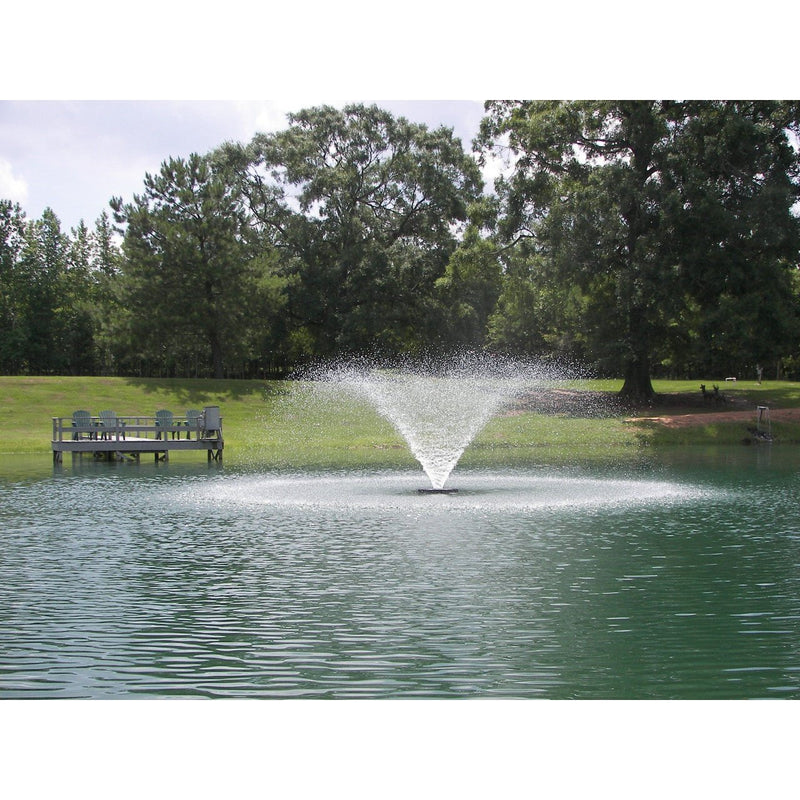
| Decorative Fountains | 1.5 – 2.5 | Small, shallow ornamental ponds. |
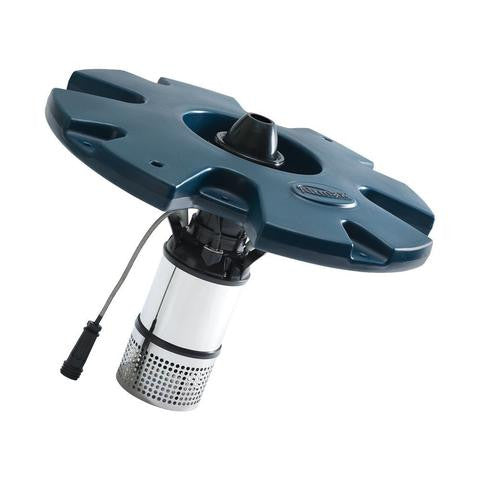
| Surface Aerators | 2.6 – 3.2 | Shallow ponds (< 6ft) and emergency use. |
| Paddlewheel Aerators | 2.5 – 4.0 | Large commercial aquaculture ponds. |
| Bottom Diffused (Fine Bubble) | 1.0 – 4.0* | Deeper ponds (> 8ft) for de-stratification. |
*Note: Fine bubble efficiency increases significantly with depth, potentially exceeding 10 lb O2/hp-hr in deep-water industrial applications.
Best Practices for Pond Oxygen Management
Monitoring is the foundation of a successful aeration program. Handheld Dissolved Oxygen meters provide real-time data that allows for proactive adjustments. If readings consistently drop below 5.0 mg/L in the morning, the system is likely undersized or the biological load is too high.
Operational timing is equally critical. While some owners run systems 24/7, others use timers to save on electricity. If using a timer, the system must run from midnight until several hours after sunrise. This covers the "respiratory trough" where plants and algae are consuming oxygen rather than producing it.
Diffuser maintenance is often overlooked. In hard water, calcium carbonate can build up on the membranes, increasing backpressure on the compressor. This reduces CFM (cubic feet per minute) and can overheat the motor. Annual cleaning with a mild acid solution or mechanical scrubbing ensures the fine pores remain open for optimal bubble production.
Advanced Considerations: SOTE and VFDs
For larger estates or commercial facilities, understanding Standard Oxygen Transfer Efficiency (SOTE) is necessary. SOTE measures the percentage of oxygen delivered that actually dissolves into the water. In bottom-diffused systems, SOTE increases by approximately 6.9% per meter of depth. This makes deep-water placement a massive driver of energy efficiency.
Variable Frequency Drives (VFDs) represent the cutting edge of pond aeration. By linking a DO probe to a VFD-controlled compressor, the system can automatically ramp up during low-oxygen events and slow down during the afternoon when photosynthesis is providing "free" oxygen. This precision reduces energy consumption by 30-50% while providing a more stable environment for the fish.
Scenario: Calculating Oxygen Demand
Consider a 1-acre pond with an average depth of 6 feet, containing 2,000 lbs of fish. During a summer heatwave (30°C), the saturation level of DO is approximately 7.5 mg/L.
If the fish consume 0.01 lbs of oxygen per 100 lbs of body weight per hour, they require 0.2 lbs of O2 per hour. However, the sediment and plankton (BOD) often consume three to four times more than the fish. The total demand may reach 0.8 to 1.0 lbs of O2 per hour. Using a surface aerator with an SAE of 3.0, a 1/3 HP motor would be the theoretical minimum to maintain balance. To include a safety factor for "the doldrums" (cloudy, windless days), a 1/2 HP or 3/4 HP system would be the professional recommendation.
Final Thoughts
Maintaining a healthy pond requires a shift from viewing aeration as an "add-on" to seeing it as the structural foundation of the ecosystem. The cost of electricity and occasional maintenance is negligible compared to the financial and emotional toll of losing a mature fish population.
Data-driven decisions regarding system type, sizing, and placement are the only way to ensure long-term stability. By understanding the physics of gas transfer and the biological needs of the species being managed, pond owners can effectively "insure" their waterbody against the most common causes of mortality.
Implementing these strategies allows for higher stocking densities, clearer water, and a resilient environment that can withstand the extremes of both summer heat and winter ice. Experimenting with monitoring tools and optimized run times will provide the specific data needed to fine-tune any system for peak efficiency.