Common Pond Aeration Mistakes That Lead to Algae Blooms
Wrong aeration can actually make algae worse. Avoid these 3 critical mistakes. Poorly designed aeration can stir up nutrients from the bottom without oxygenating them, leading to an algae explosion. Learn the right way to maintain order in your ecosystem.
Pond management often relies on the assumption that any movement of water is beneficial. However, the physics of fluid dynamics and the biochemistry of nutrient cycling dictate that imprecise aeration is worse than no aeration at all. To move from a state of Algal Chaos to one of Aerated Order, a practitioner must understand the relationship between dissolved oxygen (DO), thermal stratification, and benthic nutrient sequestration.
When aeration is implemented incorrectly, it fails to achieve its primary objective: the maintenance of an aerobic environment at the sediment-water interface. Instead, it can become a mechanism for internal nutrient loading, where legacy phosphorus trapped in the muck is mechanically redistributed into the photic zone, fueling the very blooms the system was intended to suppress.
Common Pond Aeration Mistakes That Lead to Algae Blooms
Common pond aeration mistakes typically stem from a failure to account for the pond's specific bathymetry and volume. One of the most frequent errors is the use of undersized equipment. When a compressor or fountain lacks the power to move the entire volume of the water column, it creates localized mixing without achieving full destratification. This partial mixing brings nutrient-rich, anoxic water from the bottom (the hypolimnion) into the upper layers (the epilimnion), effectively fertilizing the surface algae without providing enough oxygen to facilitate nutrient binding.
Another critical mistake is improper diffuser placement. Positioning diffusers in shallow areas of a deep pond leaves the deepest, most stagnant pockets untouched. These "dead zones" continue to accumulate hydrogen sulfide and ammonia, which can be suddenly released during a weather-induced turnover event. Furthermore, elevating diffusers off the bottom to "protect" them from muck actually prevents the system from oxygenating the sediment-water interface, where the most vital chemical reactions occur.
Finally, the timing of aeration startup is a common point of failure. Initiating a high-powered bottom-diffused system in the middle of a hot summer in a previously stagnant pond can trigger a "rapid turnover." This event forces a sudden drop in total dissolved oxygen as the high-oxygen surface water is diluted by the massive volume of oxygen-depleted bottom water, often resulting in immediate fish kills and subsequent algae surges as the biomass decomposes.
The Mechanics of Gas Exchange and Destratification
Aeration operates on the principle of increasing the surface area for gas exchange and physically breaking the thermal layers that isolate bottom water. In a stratified pond, water is divided by a thermocline—a thin layer where temperature changes rapidly. The water below this line is denser, colder, and, in many cases, completely devoid of oxygen (anoxic).
Bottom-diffused aeration uses a compressor to pump air through weighted tubing to diffusers located at the pond's deepest point. These diffusers release millions of micro-bubbles. As these bubbles rise, they act as a "bubble curtain" or airlift pump, entraining large volumes of water and pulling it toward the surface. This process, known as induced vertical mixing, forces the cold, anoxic bottom water to the surface where it can vent harmful gases like methane and absorb atmospheric oxygen.
The efficiency of this process is measured by the Oxygen Transfer Efficiency (OTE). For diffused systems, OTE increases with depth; typically, the transfer rate is approximately 1.6% per foot of depth. Therefore, a diffuser at 10 feet is significantly more efficient at dissolving oxygen than one at 2 feet. Once the water column is fully mixed, the temperature and oxygen levels become uniform, a state known as "isothermal."
Benefits of Technical Aeration Implementation
The primary benefit of a correctly engineered aeration system is the stabilization of the nitrogen and phosphorus cycles. When dissolved oxygen levels at the sediment-water interface are maintained above 4 mg/L, phosphorus becomes chemically bound to iron in the sediment. This sequestration makes the nutrient unavailable to floating algae, effectively "starving" the bloom at its source.
Furthermore, aerobic conditions support the proliferation of aerobic bacteria, which are up to 20 times more efficient at decomposing organic matter than their anaerobic counterparts. This leads to a measurable reduction in "muck" or organic sludge accumulation. Over time, a well-aerated pond will experience an increase in volume as the legacy organic layer is processed into carbon dioxide and vented.
From a biological standpoint, aeration "levels the playing field" for more desirable aquatic organisms. Harmful cyanobacteria (blue-green algae) have evolved to thrive in stagnant, stratified water because they can regulate their buoyancy to move between the nutrient-rich bottom and the sunlit top. Constant circulation disrupts this advantage, favoring beneficial green algae and diatoms that form the base of a healthy food web.
Challenges in Maintaining Aerated Order
One of the most significant challenges is managing the "Oxygen Demand" (OD) of a pond. The BOD (Biochemical Oxygen Demand) and SOD (Sediment Oxygen Demand) represent the amount of oxygen required by microorganisms to break down organic matter. In highly eutrophic ponds, the SOD can be so high that an undersized aeration system cannot keep up, resulting in a net loss of dissolved oxygen despite the system running 24/7.
Mechanical failure also poses a significant risk. In a pond that has become dependent on artificial aeration to maintain its aerobic state, a power outage or compressor failure during a heatwave can lead to a rapid return to anoxia. Because the biomass in an aerated pond is often higher due to improved conditions, the subsequent "crash" can be more severe than if the pond had never been aerated.
Additionally, the cost of operation for high-SAE (Standard Aeration Efficiency) systems must be balanced against the pond's size. While bottom-diffused systems are more efficient for deep water, the initial capital expenditure for compressors, cabinets, and weighted airlines can be a barrier for some practitioners.
Limitations and Environmental Constraints
Aeration is not a "magic bullet" for ponds with massive external nutrient loading. If a pond receives constant runoff from agricultural fertilizers or septic leaching, no amount of oxygenation will fully stop algae growth. In these cases, aeration is merely a life-support system that prevents fish kills but does not achieve water clarity.
Environmental depth is a hard constraint for diffused aeration. In ponds shallower than 6 feet, the "rise time" of bubbles is insufficient to create significant vertical movement. In these shallow basins, surface aerators or horizontal mixers are often the only viable option, despite their lower OTE. Conversely, in extremely deep lakes (over 40 feet), the pressure required to pump air to the bottom may exceed the capabilities of standard linear or rocking piston compressors, requiring specialized high-pressure equipment.
Technical Comparison: Surface vs. Bottom-Diffused Aeration
Selecting the correct system requires an analysis of the pond's physical characteristics. The following table compares the two primary methods based on mechanical and efficiency metrics.
| Metric | Surface Aeration (Fountains/Bubblers) | Bottom-Diffused Aeration |
|---|---|---|
| Ideal Depth | 0 to 6 feet | 8 to 40+ feet |
| Oxygen Transfer Rate (OTE) | Low (1.6% - 3.2% total) | High (approx. 1.6% per foot of depth) |
| Standard Aeration Efficiency (SAE) | 1.5 to 2.0 kgO2/hr/kW | 3.5 to 4.0 kgO2/hr/kW |
| Primary Mechanism | Water-to-Air contact (splashing) | Induced Vertical Mixing / Air-to-Water contact |
| Electricity in Water | Yes (high voltage cable) | No (air lines only) |
| Nutrient Sequestration | Limited to surface layers | Total water column / Benthic zone |
Practical Tips for System Optimization
To maximize the efficiency of an aeration system and avoid common pitfalls, practitioners should follow these best practices:
- Sizing for Turnover: Aim for at least one full volume turnover every 24 hours. To calculate this, determine the total pond volume in gallons and match it to the GPM (gallons per minute) flow rate of your chosen diffuser system.
- The Slow-Start Protocol: When installing a system in an established, stagnant pond, use a staggered startup. Run the system for 30 minutes on Day 1, 1 hour on Day 2, and double the time daily until reaching 24-hour operation. This prevents "thermal shock" and rapid DO depletion.
- Diffuser Placement: Place diffusers at the deepest point of the pond, but avoid the very center if it is a narrow "bowl" shape. Instead, distribute diffusers across the deep zones to ensure no "dead spots" remain.
- Pressure Management: Use weighted tubing (sink tubing) for all underwater runs to prevent "floating line" syndrome, which can lead to damage from boat propellers or UV degradation. Monitor the pressure gauge on the compressor; a sudden rise indicates a clogged diffuser, while a drop indicates a leak.
Advanced Considerations for Serious Practitioners
For those managing large-scale or high-value ecosystems, advanced metrics like the "Oxygen Injection Rate" (OIR) become critical. This calculation accounts for the specific oxygen demand of the pond's biomass and sediment. If the OIR is lower than the SOD, the pond will eventually transition back to an anaerobic state during peak summer temperatures, regardless of system operation.
Another factor is the impact of "Pressure Loss" due to friction in the airlines. For long runs (over 500 feet), the diameter of the airline must be increased to prevent the compressor from overheating. A rocking piston compressor might produce 2.0 CFM (cubic feet per minute) at the head, but if the airline is too narrow, the actual CFM at the diffuser may be significantly lower, reducing the turnover rate.
Practitioners should also consider the "Nitrification Potential." Aeration facilitates the conversion of toxic ammonia into nitrite and then into nitrate. However, this process consumes alkalinity. In "soft water" ponds with low buffering capacity, heavy aeration can lead to pH swings that stress aquatic life. Monitoring KH (carbonate hardness) alongside DO levels is a hallmark of professional-grade management.
Example Scenario: The 1-Acre Deep Pond
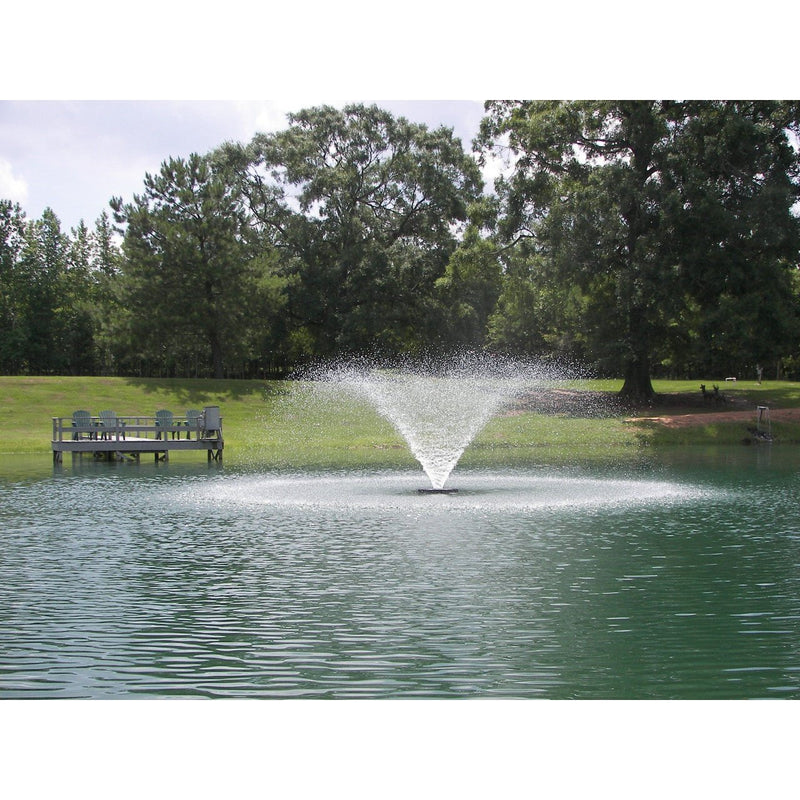
Consider a 1-acre pond with a maximum depth of 15 feet and an average depth of 8 feet. The total volume is approximately 2.6 million gallons. Using a surface fountain would provide aesthetic value but would only circulate the top 2–4 feet, leaving the bottom 11 feet anoxic and nutrient-heavy.
A serious practitioner would instead install a 1/2 HP rocking piston compressor driving two fine-bubble diffusers placed at 14 feet. At this depth, the OTE is approximately 22%. The rising bubbles would move approximately 2,500 gallons of water per minute. In 24 hours, this system would move 3.6 million gallons, achieving 1.38 turnovers per day. This ensures the entire water column remains isothermal and oxygenated, effectively locking phosphorus into the sediment and preventing the "Algal Chaos" typically seen in late July.
Final Thoughts
Effective pond aeration is a precise mechanical intervention into a complex biological system. When done correctly, it transforms a pond from a nutrient-leaking liability into a stable, self-clearing ecosystem. By focusing on deep-water destratification and maintaining the aerobic state of the benthos, you can suppress algae growth and reduce organic muck without the constant need for chemical additives.
Success requires more than just "bubbles." It requires a commitment to proper sizing, strategic placement, and a technical understanding of how oxygen interacts with pond chemistry. As you apply these principles, remember that aeration is a foundational tool; it supports all other management efforts by creating an environment where nature's own filtration systems can function at peak efficiency. For those seeking long-term clarity and health, the transition from haphazard movement to engineered order is the only sustainable path forward.