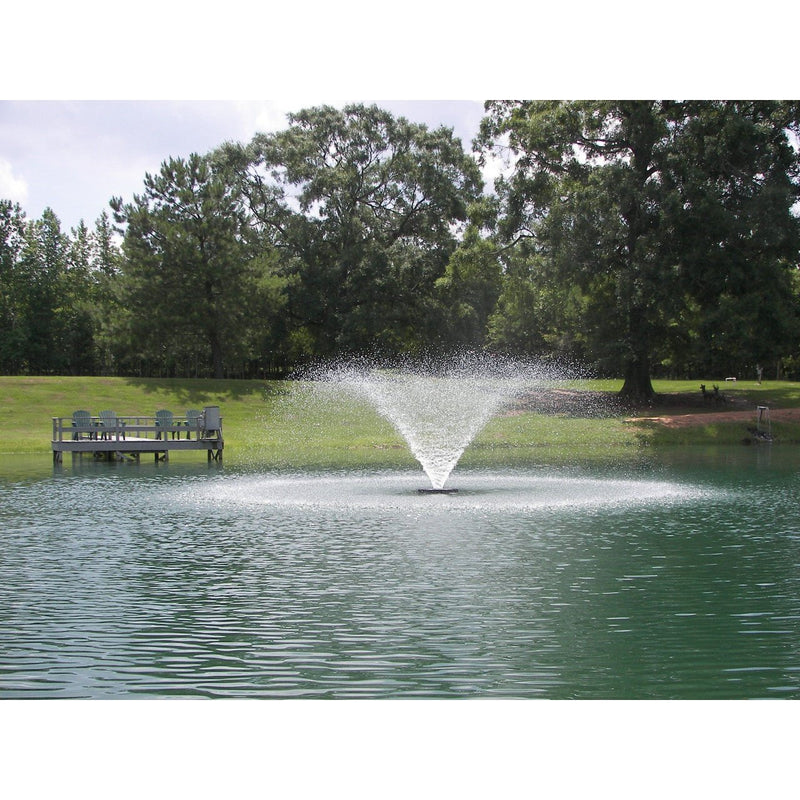


How Much of a Pond Can One Fountain Aerate?
Don't mistake a pretty splash for a healthy pond ecosystem. Many pond owners think one fountain covers the whole pond, but the math says otherwise. Learn how to calculate the actual aeration footprint of your fountain before your fish pay the price.
Understanding the mechanical limitations of surface-level agitation is critical for maintaining biological stability in aquatic environments. While a floating fountain provides visual interest, its primary role in an ecosystem is the transfer of atmospheric oxygen into the upper layer of the water column. In technical terms, this is a localized process governed by the Standard Oxygen Transfer Rate (SOTR) and the mechanical displacement of water.
The footprint of a fountain—the specific area where it can maintain dissolved oxygen (DO) levels above the 5.0 mg/L threshold required for most aquatic life—is surprisingly small. Relying on visual spray to judge health is an error in management that often leads to thermal stratification and the development of anaerobic "dead zones" at the pond floor.
How Much of a Pond Can One Fountain Aerate?
A single pond fountain typically aerates a surface area proportional to its horsepower (HP) and pump flow rate, but this effect is largely confined to the top 4 to 6 feet of the water column. For most standard decorative fountains, a baseline efficiency of 1 to 2 horsepower per surface acre is the industry standard for basic water quality management.
This footprint exists as a "zone of influence." Near the fountain, water droplets are pulverized into the atmosphere, creating a high surface-area-to-volume ratio that allows for rapid gas exchange. As these oxygenated droplets return to the surface, they create a ripple effect that facilitates further diffusion. However, the energy required to move water decreases exponentially as the distance from the pump increases.
In real-world applications, a 1-HP fountain can effectively maintain oxygen levels for a 0.5 to 1-acre pond if the pond is shallow and relatively uniform in shape. If the pond is deeper than 6 feet, the fountain’s footprint effectively shrinks to only the upper thermal layer, leaving the lower depths entirely un-aerated. This creates a volume-based limitation rather than just a surface-area one.
The Mechanics of Surface Aeration and Gas Exchange
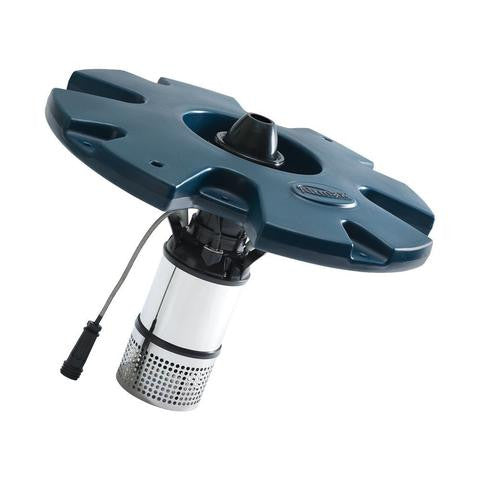
Surface aeration operates through mechanical agitation. The fountain's impeller draws water from the intake—usually located just 1 to 3 feet below the float—and forces it through a nozzle. This process relies on two primary mechanical principles to increase dissolved oxygen levels.
First, the spray pattern increases the surface area of the water in contact with the atmosphere. Smaller droplets, often produced by "trumpet" or "v-shaped" patterns, provide more surface area for oxygen to dissolve into the liquid. Second, the impact of the falling water creates turbulence. This turbulence breaks the surface tension of the pond, allowing for "passive" gas exchange across the entire ripple zone.
Mechanical efficiency is measured via the Standard Aeration Efficiency (SAE), which typically ranges from 1.5 to 2.5 lbs of O2 per horsepower-hour for high-quality fountains. In comparison, dedicated surface aerators (which focus on volume rather than display height) can reach 3.0 lbs of O2 per HP-hr. The tradeoff for the "pretty splash" is a direct reduction in mechanical oxygen transfer efficiency.
Calculating Your Aeration Footprint
To determine the exact footprint of a fountain, one must calculate the Actual Oxygen Requirement (AOR) of the pond and compare it to the SOTR of the equipment. Biological Oxygen Demand (BOD) is the amount of oxygen required by microorganisms to decompose organic matter and by fish for respiration.
The standard formula for sizing a fountain based on surface area is:
Required HP = (Surface Acres × Loading Factor) / Efficiency Coefficient
The Loading Factor varies based on the pond's condition. A clean, newly dug pond may have a factor of 1.0, while an older pond with heavy muck and high fish density may require a factor of 2.5 or higher. If a 1-acre pond has a high organic load, a single 1-HP fountain will likely fail to meet the BOD, resulting in a shrinking aeration footprint that eventually covers only the immediate 20-30 feet around the unit.
Depth also dictates the calculation. Because fountains draw water from the surface, they do not contribute to the "Airlift" effect seen in bottom-diffused systems. For ponds where the depth exceeds 6 feet, the volume below the 6-foot mark must be excluded from the fountain's aeration footprint calculations. This "unreachable" volume continues to consume oxygen through benthic decomposition, often at a rate faster than the fountain can replenish it from the top down.
Benefits of Fountain Aeration
Fountains remain a staple of pond management for specific, measurable reasons beyond aesthetics. They are highly effective at saturating the "epilimnion," or the warm top layer of the pond, where fish often congregate during the day.
- Immediate Surface Saturation: Fountains are unparalleled at quickly raising DO levels in the top 2 feet of water, which can prevent immediate fish kills during sudden summer temperature spikes.
- Venting Harmful Gases: The agitation helps vent carbon dioxide, methane, and hydrogen sulfide that can build up at the surface.
- Reduction of Surface Algae: Constant surface movement disrupts the growth of filamentous algae and duckweed, which prefer stagnant conditions.
- Ease of Installation: Floating units are self-contained and do not require the complex underwater piping or bathymetric mapping needed for bottom-diffused systems.
Challenges and Common Mistakes
The most frequent error in pond management is assuming that surface movement equals total-pond health. This "Surface Guess" often leads to catastrophic failures in deeper water bodies.
A common pitfall is the use of decorative nozzles that prioritize height over flow. A "Geyser" pattern might look impressive, but the restricted nozzle design significantly reduces the Gallons Per Minute (GPM) of water being moved. High-pressure, low-volume sprays are inefficient aerators. Owners should look for "V-shaped" or "Fan" patterns that move the maximum volume of water possible.
Another significant challenge is thermal stratification. During summer, the sun heats the surface water, making it less dense than the cool water at the bottom. A fountain only circulates the warm top layer. This leaves the bottom layer deoxygenated. If a sudden storm or cold snap occurs, the pond can "turn over," mixing the deoxygenated bottom water with the surface water and instantly dropping DO levels across the entire pond, often resulting in a total fish kill.
Limitations of the Fountain Footprint
Environmental constraints often dictate where a fountain's footprint ends. In ponds with irregular shapes, such as "L" or "U" shapes, the aeration footprint is blocked by land masses. Oxygen does not "turn corners" effectively; the mechanical energy is dissipated by the shoreline.
Furthermore, fountains are "active heaters" during the peak of summer. By spraying water into the hot air, they can actually increase the overall temperature of the pond through heat exchange with the atmosphere. Since warmer water holds less dissolved oxygen than cooler water, a fountain can inadvertently lower the pond's maximum oxygen-carrying capacity while trying to increase it.
In ponds deeper than 8 feet, the fountain's aeration footprint effectively becomes two-dimensional. It manages the surface area, but it fails to address the "benthic" layer where organic muck accumulates. Without oxygen at the bottom, aerobic bacteria cannot survive, and the pond begins to accumulate "muck" or "sludge" that fuels future algae blooms.
The Surface Guess vs. The Precision Depth
The following table compares the mechanical efficiency and footprint of a standard 1-HP Floating Fountain (The Surface Guess) versus a 1-HP Bottom-Diffused System (The Precision Depth).
| Metric | 1-HP Floating Fountain | 1-HP Bottom-Diffused System |
|---|---|---|
| Effective Depth | 0 to 6 Feet | 0 to 40+ Feet |
| Oxygen Transfer (SAE) | 1.5 - 2.5 lbs O2 / HP-hr | 2.0 - 4.0 lbs O2 / HP-hr (Depth Dependent) |
| Destratification Power | Low (Surface Only) | High (Full Column Turnover) |
| Primary Goal | Aesthetics + Surface DO | Total Ecosystem Health + Muck Reduction |
| Energy Consumption | High (to lift water weight) | Low (to compress air) |
Practical Tips for Optimizing Fountain Performance
If a fountain is the chosen method for aeration, several adjustments can maximize its effective footprint. Placement should be central to the largest open area of the pond to allow ripples to travel the maximum distance before hitting the shoreline.
- Maximize GPM: Choose "high-flow" nozzles over "high-head" nozzles. Every gallon of water moved is a gallon of water oxygenated.
- Run 24/7: Oxygen levels are lowest just before dawn due to plant respiration. Turning the fountain off at night is the most common cause of morning fish kills.
- Clear the Intake: Algae and debris clogging the intake screen will reduce GPM and shrink the aeration footprint almost immediately.
- Monitor Temperature: If surface temperatures exceed 85°F, consider adding a bottom-diffuser to assist the fountain, as the fountain's footprint will naturally shrink as DO saturation limits drop.
Advanced Considerations: Altitude and SOTR
For professional practitioners, calculating the aeration footprint must account for altitude and barometric pressure. At higher elevations, the partial pressure of oxygen is lower, which reduces the rate at which oxygen can dissolve into the water. A fountain rated for 2.0 lbs of O2/hr at sea level may only provide 1.6 lbs/hr at 5,000 feet of elevation.
Furthermore, the Biological Oxygen Demand (BOD) of a pond is not static. It peaks during late summer when water temperatures are high and organic decomposition is at its maximum. Sizing a fountain for the "average" day is a recipe for failure. Systems must be sized for the "Peak Loading" period—the hottest, most stagnant week of the year. If the fountain's footprint cannot cover the entire pond during this peak period, supplemental aeration is required.
Scenario: The 1-Acre Retention Pond
Consider a 1-acre stormwater retention pond with a maximum depth of 5 feet. In this scenario, a 1.5-HP floating fountain with a high-flow V-pattern would be highly effective. Because the pond is shallow, the fountain’s intake (drawing from 2-3 feet) is able to pull water from near the bottom, effectively circulating the entire water column. The aeration footprint would likely cover the entire acre, maintaining DO levels and preventing stagnation.
In contrast, if that same 1-acre pond was a dug pond with a center depth of 15 feet, that same 1.5-HP fountain would only aerate the top 4-6 feet. This would leave a 9-foot layer of deoxygenated water at the bottom. In this case, the fountain’s footprint is "incomplete," and a bottom-diffused system would be technically mandatory to prevent the pond from becoming a methane-producing "sludge pit."
Final Thoughts
Relying on a fountain for total pond health is a strategy that depends entirely on the physical dimensions and biological load of the water body. A fountain's aeration footprint is a localized zone of high-intensity gas exchange that excels at surface saturation but struggles with depth and volume. For shallow, ornamental ponds, a well-sized fountain provides sufficient oxygen while offering the benefit of sound and movement.
However, as pond depth and organic complexity increase, the footprint of a single fountain inevitably shrinks relative to the pond’s total volume. Serious practitioners must move beyond "The Surface Guess" and employ precision math to ensure that the oxygen supply meets the biological demand of the entire water column.
Owners are encouraged to verify their pond's depth and volume before selecting equipment. Combining a decorative fountain for surface aesthetics with a bottom-diffused system for deep-water stability often represents the most efficient and ecologically sound approach to modern pond management. Applying these technical principles ensures that the "pretty splash" is backed by a robust, oxygen-rich environment capable of supporting life year-round.