

How Much Electricity Does a Pond Aerator Actually Use?
Is your pond 'beauty' cost killing your budget? Fountains are for looks; diffusers are for life. Running a pond aerator doesn't have to break the bank. In fact, a high-efficiency system often uses less power than a single lightbulb. We compare the monthly costs of fountains vs. bottom-diffused systems so you can keep your pond healthy and your bill low.
Maintaining aquatic health requires an objective assessment of energy expenditure versus biological gain. While decorative surface units are popular for their visual profile, their mechanical efficiency for large-scale aeration is often suboptimal. Understanding the metrics of Standard Aeration Efficiency (SAE) and the mechanical draw of different pump types allows pond managers to optimize both oxygen levels and operational budgets.
How Much Electricity Does a Pond Aerator Actually Use?
Pond aeration electricity consumption is a function of motor horsepower, run time, and mechanical load. For small residential systems, power draw may be as low as 40 to 80 watts. Larger commercial systems or decorative fountains can draw 1,500 watts or more per hour.
In technical terms, the consumption is measured in kilowatt-hours (kWh). A standard high-efficiency bottom-diffused compressor, such as a 1/4 HP rocking piston model, typically draws between 100 and 115 watts. Running 24/7, this equates to roughly 2.4 to 2.7 kWh per day. At a national average rate of $0.15 per kWh, the operational cost is approximately $0.36 to $0.40 per day, or $11 to $12 per month.
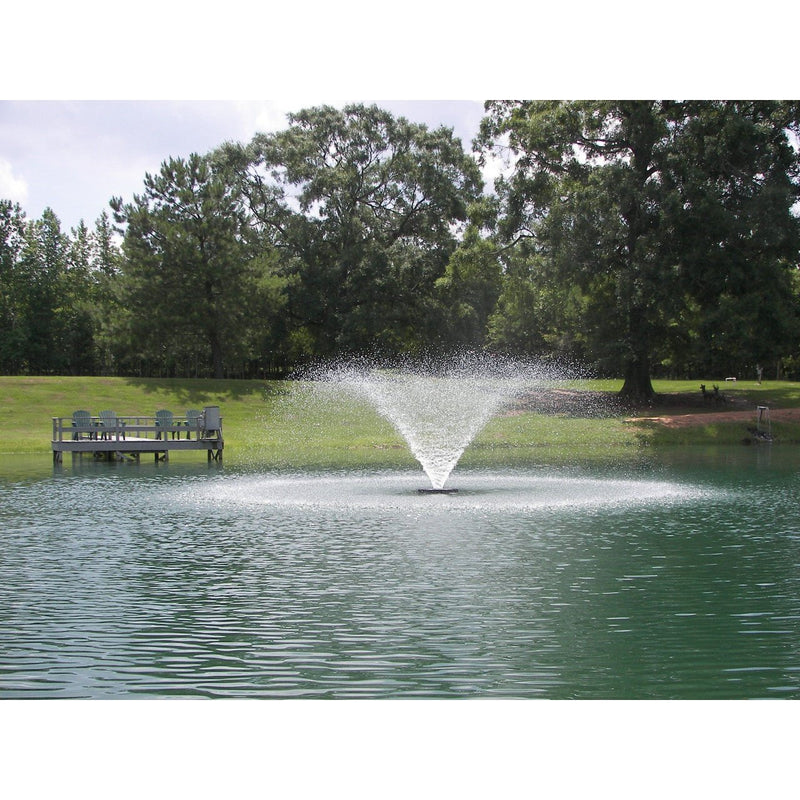
Conversely, a 1 HP decorative fountain can draw 1,000 watts or more. Continuous operation of such a unit consumes 24 kWh per day, resulting in a monthly cost of approximately $108. This reflects a nearly 1,000% increase in energy expenditure for a system that often provides less total oxygen transfer to the bottom of the water column than a low-wattage diffuser.
How It Works: The Mechanics of Aeration and Energy Draw
Aeration systems operate on two distinct physical principles: surface splashing and sub-surface diffusion. Each has a specific relationship with energy consumption and fluid dynamics.
Surface Aeration Mechanics
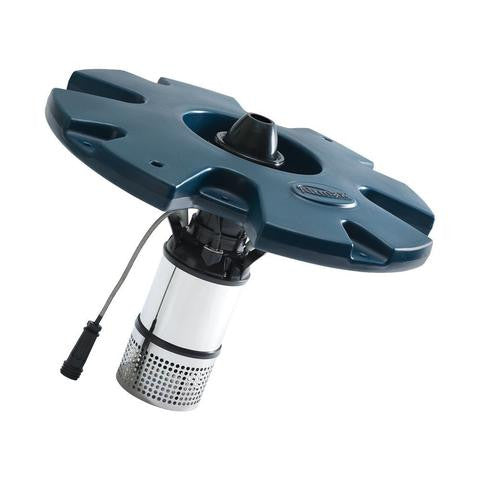
Surface aerators and fountains utilize high-speed propellers or impellers to move mass quantities of water into the atmosphere. This process relies on the atmosphere-water interface for gas exchange. The energy requirement is high because the motor must physically lift water against gravity.
In these systems, the "High-Active Draw" is a result of the motor working to move a heavy medium (water) at high velocity. Friction within the pump housing and nozzle resistance further increases the mechanical load. Efficiency is often measured in Gallons Per Minute (GPM), but for biological health, the more critical metric is the Standard Aeration Efficiency (SAE), which measures pounds of oxygen transferred per horsepower-hour.
Sub-Surface Diffusion Mechanics
Bottom-diffused systems utilize shore-mounted compressors to push air through weighted tubing to membrane diffusers at the pond floor. This method leverages "Passive-Efficiency Flow." Instead of moving the water to the air, it moves the air through the water.
The compressor must overcome the hydrostatic pressure of the water column. This is calculated as 0.433 PSI per foot of depth. A compressor at 10 feet of depth must generate at least 4.33 PSI plus friction loss (typically 1-2 PSI for tubing and diffuser resistance) to deliver air. Because air is significantly less dense than water, the motor requires far less energy to move a high volume of air than a surface pump requires to move an equivalent volume of water.
Benefits of Energy-Efficient Aeration
The primary advantage of optimizing for efficiency is the reduction of long-term operational overhead. However, the technical benefits extend into mechanical longevity and ecological stability.
Lower wattage systems generate less internal heat. Heat is the primary cause of motor insulation failure and bearing wear. A system drawing 80 watts is under significantly less thermal stress than a 1,000-watt unit, often leading to a service life that is 2-3 times longer.
Furthermore, efficient bottom-diffused systems provide total water column destratification. By moving air from the bottom, they create a "chimney effect" that pulls oxygen-depleted water from the hypolimnion (bottom layer) to the surface. This ensures that the entire pond volume is biologically active, supporting aerobic bacteria that decompose organic muck.
Challenges and Common Mistakes
The most frequent error in pond management is equates horsepower with aeration effectiveness. In many cases, a 1/2 HP surface fountain provides less dissolved oxygen (DO) than a 1/8 HP linear diaphragm diffuser.
Another challenge is "Backpressure Accumulation." If a compressor is paired with an undersized airline or a clogged diffuser, the backpressure increases beyond the motor's design limits. This causes the motor to draw more amperage, increasing electricity costs and causing the thermal overload switch to trip frequently.
Common pitfalls include:
- Undersizing the airline: Using 3/8" tubing for runs over 100 feet increases friction, forcing the compressor to work harder.
- Neglecting diffuser maintenance: Calcium buildup on membranes increases the PSI required to push air, raising the watt draw.
- Improper depth placement: Placing a low-pressure linear pump at depths exceeding 8 feet will cause the diaphragm to fail prematurely due to excessive head pressure.
Limitations of High-Efficiency Systems
While bottom-diffused systems are the gold standard for energy efficiency, they have realistic constraints. In shallow ponds (less than 4-5 feet deep), the air bubbles do not have enough "rise time" to create a significant water current. In these environments, the volume of water moved per watt is lower.
Environmental limitations also include the lack of aesthetic impact. If the goal is a visual centerpiece for a commercial property or golf course, a sub-surface diffuser will only produce a small "boil" on the surface. For these applications, the trade-off between energy cost and visual marketing must be balanced.
Comparison: Fountain vs. Diffused Systems
The following table compares the typical mechanical and financial metrics for a 1-acre pond at 10 feet average depth.
| Metric | 1 HP Aerating Fountain | 1/4 HP Diffused System |
|---|---|---|
| Wattage Draw | 1,100 Watts | 115 Watts |
| Daily kWh (24h) | 26.4 kWh | 2.76 kWh |
| Monthly Cost (@$0.15/kWh) | $118.80 | $12.42 |
| Oxygen Transfer Depth | Surface to 4-6 feet | Total Water Column (10ft+) |
| Maintenance Interval | Annual (Propeller/Seals) | Bi-Annual (Filter/Diaphragm) |
Practical Tips for Optimizing Efficiency
To maximize the O2/Watt ratio, specific tuning adjustments should be made during installation.
- Use Weighted Airline: This ensures the tubing remains at the bottom without the use of bricks or ties, which can kink the line and increase backpressure.
- Optimize Diffuser Placement: Place diffusers in the deepest part of the pond. This maximizes the "lifting rate" of the water, moving more volume for the same amount of air.
- Check Pressure Gauges: Install a PSI gauge at the compressor. If the pressure rises 2-3 PSI above the initial install level, it is time to clean the diffusers.
- Implement Timers (If Applicable): In ponds with low biological load, running the system 12 hours a day (typically at night when DO levels are lowest) can halve the electricity bill while maintaining safety.
Advanced Considerations: PSI and CFM Curves
Serious practitioners must look at the manufacturer’s flow curves. A compressor's output is not a static number; it is a curve of Cubic Feet per Minute (CFM) versus PSI.
As depth (and therefore PSI) increases, the volume of air delivered (CFM) decreases. For example, a rocking piston compressor might deliver 4.5 CFM at 0 PSI (surface), but only 3.2 CFM at 10 PSI (approx. 20 feet deep). When calculating energy efficiency, you must calculate the "Watts per CFM at Depth."
Scaling considerations for larger lakes may involve using Rotary Vane compressors or high-volume Blowers. While these units have a higher initial watt draw, their ability to drive dozens of diffuser stations makes them more efficient on a "per-acre" basis than installing multiple smaller units.
Example: The 1-Acre Pond Scenario
Consider a 1-acre pond with a maximum depth of 12 feet. The manager is choosing between two 1/2 HP systems.
System A is a 1/2 HP surface aerator drawing 560 watts. It moves 400 GPM but only affects the top 5 feet of water. The monthly cost is ~$60. The bottom 7 feet of the pond remain anaerobic (oxygen-free), leading to muck accumulation.
System B is a 1/2 HP rocking piston compressor drawing 410 watts. It delivers 5.2 CFM to three diffusers placed at the bottom. This circulates the entire 1-acre volume twice per day. The monthly cost is ~$44. System B provides 100% water column coverage for 26% less electricity.
Final Thoughts
Efficient pond aeration is a balance of mechanical precision and physical reality. While fountains provide undeniable aesthetic value, they are rarely the most cost-effective tool for maintaining deep-water biological health. By shifting focus to sub-surface diffused systems, pond owners can achieve superior oxygenation with a fraction of the energy consumption.
The data consistently demonstrates that low-wattage, high-pressure compressors offer the highest Standard Aeration Efficiency for deep water. This approach not only stabilizes the ecosystem but also preserves the operational budget by minimizing "High-Active Draw" in favor of "Passive-Efficiency Flow."
Applying these principles requires careful sizing and an understanding of backpressure. Practitioners are encouraged to monitor their systems' PSI and wattage to ensure they remain within the optimal performance window. Experimenting with diffuser placement and timing can further refine these results, leading to a healthier pond and a lower utility bill.