How Deep Should Diffusers Be Placed in a Pond for Best Results?
Depth is the secret lever of pond aeration. Are you pulling it correctly? Placement isn't about where it's easiest to drop the diffuser—it's about physics. We explain why the deepest point of your pond is the most powerful spot for your aeration system.
Aeration systems operate on the principle of gas transfer across a liquid interface. The efficiency of this transfer is governed by several physical variables, including bubble surface area, contact time, and hydrostatic pressure. While many pond owners view diffuser placement as a matter of convenience, the vertical position of the diffuser within the water column determines the system's overall oxygen transfer efficiency (OTE) and volumetric turnover rate.
Understanding these mechanics is essential for optimizing energy consumption and maintaining biological stability. A misplaced diffuser leads to localized aeration, where the surface layers are over-oxygenated while the bottom remains anaerobic. This technical guide examines the data-driven reasons for deep-water placement and how to calibrate your system for maximum output.
How Deep Should Diffusers Be Placed in a Pond for Best Results?
The optimal depth for diffuser placement is generally the deepest point of the pond. In most managed water bodies, this ensures that the entire water column is engaged in the circulation process. When a diffuser is placed at the maximum depth, the rising column of bubbles initiates a laminar flow that carries oxygen-depleted water from the hypolimnion (the bottom layer) to the epilimnion (the surface layer).
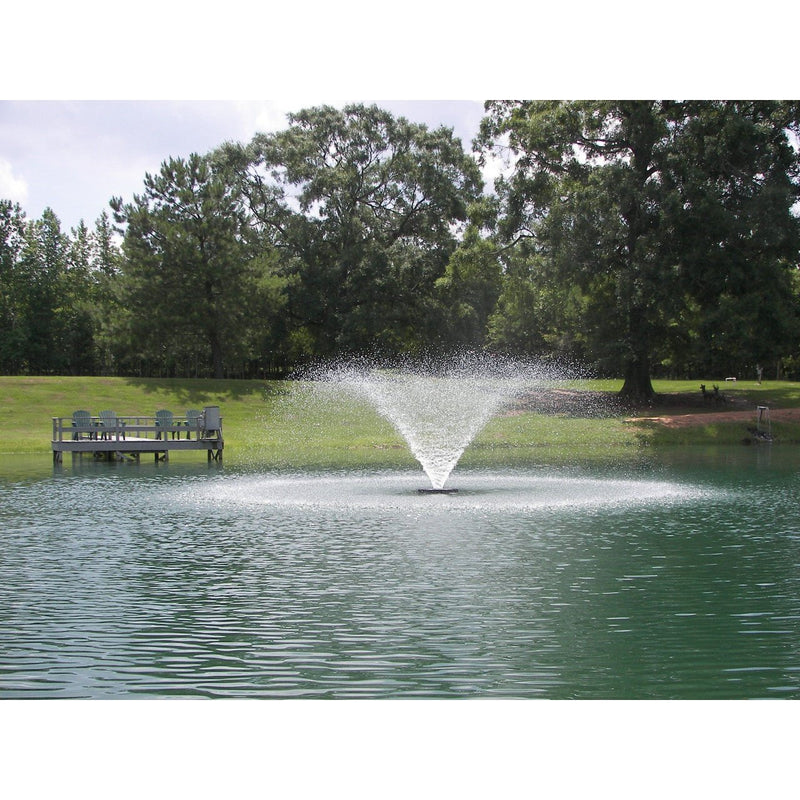
Physics dictates that as bubbles rise, they expand due to decreasing hydrostatic pressure. This creates a "V-shaped" plume or "boil" at the surface. The deeper the starting point, the wider the area of influence becomes by the time the bubbles reach the surface. For example, a diffuser at 15 feet of depth can move approximately 4.5 million gallons of water per day, whereas the same diffuser at 30 feet can move up to 16.7 million gallons.
In practical terms, placing diffusers at a minimum of 8 feet is recommended for most ponds to achieve significant turnover. However, if the pond's maximum depth is shallower, the diffuser should still be placed at the deepest available point to prevent the formation of stagnant, anaerobic pockets. The objective is to eliminate thermal stratification, which occurs when water layers fail to mix, leading to a dangerous lack of oxygen at the pond floor where organic decomposition is most active.
The Mechanics of Depth: Why Pressure and Time Rule Oxygenation
Depth influences aeration through two primary mechanisms: bubble residence time and hydrostatic pressure. These factors directly impact the Standard Oxygen Transfer Rate (SOTR).
Bubble Residence Time
The amount of time a bubble spends in the water column determines how much gas can be exchanged. In shallow water, bubbles reach the surface quickly, resulting in poor transfer efficiency. Fine-bubble diffusers achieve an oxygen transfer efficiency of approximately 6.9% per meter of depth. By doubling the depth, the system essentially doubles the opportunity for oxygen molecules to migrate from the air bubble into the liquid phase.
Hydrostatic Pressure and Saturation
Hydrostatic pressure increases with depth at a rate of approximately 0.43 PSI per foot. This pressure compresses the air within the bubbles and increases the saturation concentration of dissolved oxygen (DO). A higher saturation point creates a larger "saturation deficit" compared to the ambient DO of the water. According to the gas transfer equation, the rate of oxygen movement is proportional to this deficit; therefore, deeper water naturally facilitates faster and more efficient oxygenation.
Volumetric Entrainment
When bubbles rise, they do not move alone. They pull surrounding water molecules upward through a process called entrainment. This creates a vertical current that is the primary driver of pond mixing. The longer the bubble column, the more momentum the upward current gains, allowing it to displace larger volumes of stagnant bottom water. This ensures that the aerobic bacteria responsible for muck decomposition have the oxygen they need to function.
Strategic Placement for Maximum Volumetric Turnover
Achieving a complete turnover of the pond's volume is the goal of any high-performance aeration system. Placement strategy must account for pond geometry and the specific needs of the ecosystem.
The Deepest Point Rule
To maximize the "V-pattern" of circulation, the diffuser must sit at the bottom of the deepest basin. If a pond has multiple deep "holes" or basins separated by shallow ridges, a single diffuser will only circulate the water in its immediate basin. In these scenarios, multiple diffusers are required, each positioned in a separate deep zone to ensure horizontal and vertical mixing across the entire water body.
Avoiding Shorelines and Obstructions
Placing a diffuser too close to the shoreline limits its circulation pattern. The rising plume will hit the shore or the pond's bank, disrupting the laminar flow and reducing the effective area of aeration. A central location within the deep zone is preferred to allow the oxygenated water to spread outward in all directions upon reaching the surface.
Interactions with Underwater Topography
Underwater structures, such as rock piles or fallen trees, can obstruct the flow of water. While these are beneficial for fish habitat, diffusers should be positioned in clear areas to avoid trapping bubbles or creating "dead spots" where water remains stagnant. Precision placement ensures that the energy expended by the compressor translates into the highest possible volume of moving water.
Benefits of Precision Deep-Water Placement
Precision in depth selection provides measurable improvements in water quality and system longevity.
- Elimination of Thermal Stratification: By pulling cold water from the bottom, deep aeration breaks the thermocline, ensuring a uniform temperature throughout the pond.
- Reduction of Muck and Sludge: Increased oxygen levels at the pond floor support aerobic bacteria, which decompose organic matter much faster than anaerobic processes.
- Prevention of Fish Kills: Uniform oxygen distribution prevents the sudden "turnover" events that occur after storms, where anaerobic water mixes with the surface and suffocates aquatic life.
- Improved Energy Efficiency: Higher oxygen transfer efficiency per foot of depth means the compressor does not have to run as long to achieve the same DO levels as a surface-mounted system.
- Inhibition of Algae Growth: Proper circulation keeps nutrients like phosphorus sequestered in the sediment, making them unavailable for surface-level algae blooms.
Operational Challenges and Mechanical Pitfalls
While depth is a lever for efficiency, it also places specific demands on the mechanical components of the system.
Back-Pressure and Compressor Selection
Every foot of water depth adds approximately 0.43 PSI of resistance. A diffuser at 10 feet creates 4.3 PSI of back-pressure, while one at 20 feet creates 8.6 PSI. Standard diaphragm compressors often fail or lose significant CFM (Cubic Feet per Minute) output when pushing against more than 6 feet of water. For deep-water applications, rocking piston compressors are mandatory as they are designed to maintain high CFM output at pressures exceeding 10-20 PSI.
Friction Loss in Tubing
Long runs of air tubing increase the total back-pressure on the system due to friction. Using 3/8-inch ID (inner diameter) tubing for runs over 100 feet can cause significant pressure drops. For deep-water placement far from the shore, transitioning to 1/2-inch or 3/4-inch weighted tubing is necessary to reduce the workload on the compressor and prevent overheating.
Diffuser Fouling
Diffusers at the bottom of a pond are subject to "fouling" from biofilms, mineral deposits (like calcium), and sediment. If a diffuser becomes clogged, the back-pressure rises, and the OTE drops. High-quality membrane diffusers are designed to "flex" and shed debris, but they still require periodic inspection every 2-4 years to maintain peak performance.
Constraints and Environmental Limitations
There are specific situations where maximum depth placement may not be the ideal strategy.
Winter Aeration and Super-Cooling
In climates where ice forms, running a deep-water aerator in the winter can be detrimental. Aggressive mixing can lead to "super-cooling," where the entire water column is cooled to near-freezing temperatures, potentially killing fish that rely on the slightly warmer 39°F (4°C) water at the bottom. In winter, diffusers should be moved to shallower water (approx. 3-5 feet) to maintain an opening in the ice for gas exchange without disturbing the deep-water thermal mass.
Cold-Water Fish Refuges
Species such as trout require cold, oxygenated water. If a pond is shallow and the aerator is too powerful, it may warm the entire pond to temperatures above the trout’s survival threshold. In these cases, placing the diffuser 2-3 feet away from the absolute deepest point or using a less aggressive turnover rate can preserve a cold-water refuge at the bottom.
Shallow Pond Limitations
In ponds with a maximum depth of less than 5 feet, sub-surface aeration loses its primary advantage of bubble residence time. In these environments, the OTE is so low that surface aerators or paddlewheels may be more efficient at introducing oxygen through mechanical splashing.
Precision Depth vs. Random Placement
The following table compares the metrics of a system placed at the deepest point versus one dropped randomly in a mid-depth area.
| Metric | Precision Deep Placement (15ft) | Random/Shallow Placement (5ft) |
|---|---|---|
| Oxygen Transfer Efficiency | ~20-25% | ~5-8% |
| Water Volume Moved (Daily) | 4.5 Million Gallons | ~1 Million Gallons |
| Destratification Capability | Total Water Column | Surface Layers Only |
| Compressor Type Required | Rocking Piston | Diaphragm/Linear |
| Long-term Muck Reduction | High (Active Decomposition) | Minimal (Anaerobic Bottom) |
Practical Implementation and System Optimization
Executing a successful installation requires precise measurement and the right hardware.
- Map the Depth: Use a weighted line or a fish finder to map the pond's topography before installation. Identify the deepest basin and mark it with a buoy.
- Check Compressor PSI Ratings: Verify that your compressor is rated for the back-pressure at your target depth. If your pond is 15 feet deep, ensure the compressor can handle 6.5 PSI plus friction loss without overheating.
- Use Self-Weighted Air Lines: Traditional PVC or poly tubing will float when filled with air. Weighted air lines stay at the bottom, ensuring the diffuser remains in its precise location and preventing damage from boat propellers or fishing lures.
- Install Check Valves: A check valve prevents water from flowing back into the air line when the compressor is shut off. This reduces the pressure spike upon restart and extends the life of the compressor seals.
- Manifold Balancing: If running multiple diffusers of different depths from one compressor, use a valved manifold to balance the airflow. Air follows the path of least resistance; without balancing, the shallowest diffuser will take all the air, and the deepest will receive none.
Advanced Metric Analysis: SOTR and OTE
For serious practitioners, evaluating the Standard Oxygen Transfer Rate (SOTR) is the only way to accurately size a system. SOTR is measured in pounds of O2 per hour under standard conditions (20°C at sea level).
The formula for Oxygen Transfer Rate in the field (OTRf) accounts for variables like water temperature, elevation, and current DO levels. OTE increases by roughly 2% for every foot of submergence for fine-bubble systems. This means a system at 20 feet is significantly more "productive" in terms of oxygen mass transfer than a system at 10 feet, even if the CFM output is slightly lower due to pressure.
When calculating the needs of a high-load pond (such as a commercial koi farm or a wastewater lagoon), engineers must balance the SOTR against the Biological Oxygen Demand (BOD) of the pond. Deep placement allows for a lower total air volume (CFM) to satisfy the same BOD, reducing total energy expenditure.
Applied Scenario: 1-Acre Pond Calculation
Consider a 1-acre pond with a maximum depth of 12 feet.
Step 1: Determine Pressure.
12 feet x 0.43 PSI/ft = 5.16 PSI. Adding 0.5 PSI for friction loss in 100 feet of 1/2-inch tubing equals 5.66 PSI total system pressure.
Step 2: Choose Compressor.
A diaphragm pump might be rated at 2.5 CFM at 0 PSI, but it may drop to 0.8 CFM at 5.66 PSI. A rocking piston compressor rated at 2.0 CFM will maintain nearly its full 2.0 CFM at that pressure, providing over twice the actual air volume.
Step 3: Placement.
By placing the diffuser at the 12-foot mark, the "V-pattern" of the rising bubbles will create a circulation diameter of approximately 30-36 feet at the surface. This ensures that the water from the deepest, coldest part of the pond is cycled through the surface for oxygenation at least once every 24-48 hours.
Final Technical Synthesis
Maximizing the effectiveness of pond aeration is a direct function of physical placement. By utilizing the deepest point of the pond, you harness hydrostatic pressure to increase gas transfer efficiency and extend bubble residence time for superior oxygenation.
A deep-water system does more than just bubble; it drives a vertical convection current that eliminates stagnation, accelerates muck decomposition, and stabilizes the entire ecosystem against environmental stressors. While the initial equipment requirements for deep-water systems—specifically rocking piston compressors and weighted lines—are higher, the long-term biological and operational benefits provide a significant return on investment.
Serious pond management requires moving beyond guesswork. Map your depths, calculate your pressures, and place your diffusers where the physics of the water column can do the heavy lifting for you. Application of these principles ensures a resilient, aerobic environment that supports higher fish densities and clearer water.