

Pond Aeration: Too Little Or Too Much Is Not A Good Thing
Aeration remains the most critical mechanical intervention in pond management. It dictates the metabolic rate of the ecosystem, the efficiency of nutrient cycling, and the survival of high-value aquatic species. However, the prevailing industry "more is better" mindset often leads to hydraulic inefficiencies and biological stress. Balancing the Dissolved Oxygen (DO) levels requires more than just high-volume air injection; it requires an understanding of gas solubility, pressure gradients, and fluid dynamics.
Achieving the ideal oxygen environment involves a precise calibration of air-to-water ratios. When aeration systems are poorly designed, they create excessive turbulence that can hinder rather than help the pond. This guide examines the technical thresholds of pond oxygenation, moving past surface-level assumptions into the engineering principles of aquatic life support.
The term "over-aeration" is often misunderstood in the context of pond management. In a strictly biological sense, it is difficult to provide too much oxygen for fish, as most species possess physiological mechanisms to regulate gas exchange at the gills. The reality of over-aeration lies in the mechanical and physical consequences of excessive gas injection and water movement rather than the oxygen molecule itself.
Physical over-aeration occurs when the volume of air introduced exceeds the pond's capacity to absorb it efficiently or when the resulting turbulence disrupts the pond's structural and thermal integrity. This manifests in three primary ways: gas supersaturation, sediment resuspension, and the elimination of thermal refugia. These are not myths but documented physical phenomena that occur when aeration systems are oversized or incorrectly positioned.
In real-world applications, such as commercial aquaculture or high-density koi ponds, over-aeration is often a symptom of "Standard Bubbler Overload." This occurs when an owner attempts to compensate for high organic loads by using high-velocity, coarse-bubble diffusers. While the visible "boil" on the surface may look impressive, the actual oxygen transfer efficiency is often lower than a smaller, more precisely calibrated fine-bubble system.
Aeration Mechanics and Oxygen Transfer Efficiency
Understanding how aeration works requires a look at the Gas Transfer Equation: dC/dt = KL(A/V)(Cs - Cm). This equation describes the rate of oxygen movement between air and water. The variable KL represents the liquid-film coefficient, which is directly affected by turbulence. A/V is the ratio of the air-water interfacial area to the water volume, and (Cs - Cm) is the concentration gradient, or the "driving force" of the transfer.
Maximizing oxygen transfer efficiency (OTE) relies on increasing the surface area (A) of the air bubbles. This is why fine-bubble diffusers are technically superior to coarse-bubble systems. A single 10mm coarse bubble has significantly less surface area than a thousand 1mm fine bubbles, even though the total volume of air is the same. Smaller bubbles also rise more slowly through the water column, increasing the "contact time" during which oxygen can diffuse into the liquid phase.
System calibration must also account for the Alpha and Beta factors. The Alpha factor represents the ratio of oxygen transfer in pond water versus clean water, usually affected by dissolved solids and surfactants. The Beta factor accounts for the ratio of oxygen saturation in pond water versus clean water, influenced by salinity and temperature. Ignoring these variables leads to under-performing systems that consume excessive energy for minimal biological gain.
Benefits of Precision-Calibrated Aeration
A properly calibrated aeration system provides a stable environment for aerobic bacteria. These microbes are responsible for the nitrification process—converting toxic ammonia into nitrite and then into relatively harmless nitrate. When oxygen levels are maintained at 100% saturation without excessive turbulence, these bacterial colonies thrive on the surface of the pond substrate and filter media, maximizing nutrient sequestration.
Continuous, steady-state aeration prevents the accumulation of stagnant, anaerobic zones at the pond bottom. In these "dead zones," anaerobic bacteria produce methane, carbon dioxide, and hydrogen sulfide. These gases are not only toxic to fish but can cause sudden "turnover" events if a storm or a high-powered aerator suddenly mixes the layers. Precision aeration ensures a gentle, consistent vertical mix that vents these gases safely and continuously.
Thermal stability is another significant advantage. While some stratification is natural, extreme temperature gaps between the surface and the bottom can stress fish. A well-designed subsurface diffused system creates a laminar flow that slowly circulates water, equalizing the temperature throughout the pond. This prevents the "thermal shock" that often occurs during the heat of summer or the transition into winter.
Challenges and Common Mistakes
The most common mistake in pond aeration is the use of high-velocity, coarse-bubble stones or pipes. These systems create massive "macroturbulence" which does not necessarily translate to high dissolved oxygen. Instead, the rapid rise of large bubbles creates a localized "chimney effect," where water is pulled up so quickly that it doesn't have time to absorb the oxygen from the air. This is a classic case of mechanical energy being wasted.
Another pitfall is the failure to account for "Biological Oxygen Demand" (BOD). In ponds with high levels of organic muck or heavy fish populations, the bacteria decomposing the waste can consume oxygen faster than a standard bubbler can supply it. If the aeration system is simply "turned up" without addressing the underlying organic load, the resulting turbulence can stir up even more muck, further increasing the BOD and creating a downward spiral of water quality.
Inappropriate diffuser placement often leads to "short-circuiting." If a diffuser is placed too close to a pump intake or a waterfall, the oxygen-rich water may be immediately removed from the pond or lose its gas through surface agitation before it can circulate to the deeper, oxygen-starved areas. Proper placement requires a map of the pond's bottom contours to ensure the bubbles travel the longest possible path through the water column.
Limitations and Environmental Constraints
Oxygen solubility is governed by Henry’s Law, which states that the amount of dissolved gas in a liquid is proportional to its partial pressure above the liquid. As water temperature increases, its ability to hold oxygen decreases. For example, at 10°C (50°F), water can hold approximately 11.3 mg/L of oxygen at saturation. At 30°C (86°F), that capacity drops to 7.5 mg/L. Aeration cannot bypass this physical law; it can only help the water reach its maximum possible saturation.
Environmental factors like altitude also play a role. Ponds located at higher elevations experience lower atmospheric pressure, which reduces the "driving force" of oxygen into the water. A system that works perfectly at sea level will be significantly less effective in a mountain environment. Engineers must size compressors and diffusers to compensate for this loss of pressure to maintain the required DO levels.
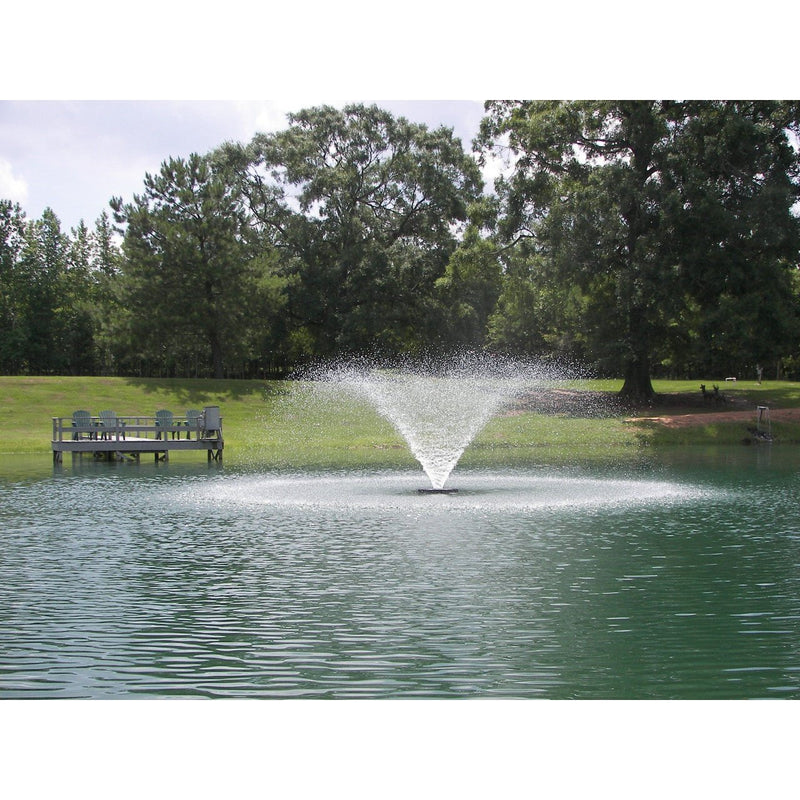
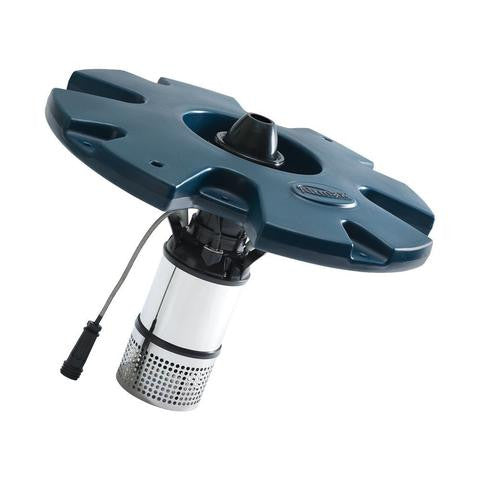
Shallow ponds (less than 4 feet deep) present a unique limitation for subsurface diffused aeration. Because the bubbles have such a short distance to travel to the surface, the contact time is minimal. In these scenarios, surface agitators or fountains may be more effective, although they are less energy-efficient. Standard subsurface systems are best utilized in depths of 6 to 15 feet where the water pressure assists in the oxygen transfer process.
Comparison: Standard Bubbler Overload vs. Pro-Level Calibration
The following table compares the metrics of a typical "Standard Bubbler" setup versus an engineered "Pro-Level Calibration" system for a 1-acre pond.
| Feature | Standard Bubbler Overload | Pro-Level Calibration |
|---|---|---|
| Bubble Size | Coarse (5mm - 15mm) | Fine (0.5mm - 2mm) |
| Oxygen Transfer Efficiency | 0.5 - 1.5 lbs O2 / HP-hr | 2.5 - 4.5 lbs O2 / HP-hr |
| Energy Consumption | High (Oversized compressors) | Optimized (Low-wattage linear or rocking piston) |
| Sediment Disturbance | Significant (High velocity) | Minimal (Laminar, low-velocity rise) |
| Gas Saturation Risk | Potential for Supersaturation | Controlled Saturation (100-105%) |
Practical Tips and Best Practices
Gradual system startup is essential when installing aeration in an existing pond. If you have a pond that has been stagnant for years, do not run the aerator 24/7 immediately. Doing so can cause a rapid turnover of anaerobic water and toxic gases, leading to an immediate fish kill. Follow a "stair-step" routine: Run the system for 30 minutes on Day 1, 1 hour on Day 2, and double the time daily until reaching 24-hour operation.
Monitor your dissolved oxygen levels using a digital DO meter rather than relying on visual cues. Aim for a steady 6 mg/L to 8 mg/L for most freshwater species. If levels exceed 110% saturation at the surface, you are likely over-aerating, which increases the risk of gas bubble disease. Checking DO levels at dawn is particularly useful, as this is when oxygen is at its daily minimum due to overnight plant respiration.
Position diffusers in the deepest areas of the pond to maximize the "airlift" effect. As bubbles rise, they pull water with them, creating a vertical current. If you have multiple diffusers, spread them out to ensure there are no "dead spots" where water remains stagnant. Avoid placing diffusers directly under overhanging trees, as the rising humidity and splashing can encourage fungal growth on branches.
Advanced Considerations: Gas Bubble Disease
Gas Bubble Disease (GBD) is the aquatic version of "the bends" in divers. It occurs when the total dissolved gas pressure (TDGP) in the water exceeds the atmospheric pressure, usually above 110-115% saturation. When fish swim in supersaturated water, the excess gas is absorbed into their blood. If the fish then moves to shallower water (lower pressure), the gas comes out of solution and forms bubbles in the tissues, fins, and eyes.
Prevention of GBD requires managing the "plunge pool" effect and excessive air injection. In systems with high-pressure waterfalls or venturi injectors, air can be forced into the water at pressures higher than the surface atmosphere. This creates a state of supersaturation that a standard bubbler cannot easily rectify. Technical practitioners use "de-gassing" towers or shallow-water agitation to vent excess nitrogen and oxygen before it reaches the main fish population.
Total Dissolved Gas (TDG) monitoring is a more advanced metric than simple DO monitoring. While DO only measures oxygen, TDG measures the sum of all dissolved gases (oxygen, nitrogen, argon, etc.). If the TDG is too high, even if the DO is perfect, the fish remain at risk. In high-intensity systems, maintaining a balance between oxygenation and de-gassing is a mandatory engineering requirement.
Example: Calibrating a 10,000 Gallon Koi System
Consider a 10,000-gallon koi pond with a heavy fish load and high summer temperatures. A "Standard Bubbler" approach might involve a 100-watt compressor pushing air through two large air stones. This setup might move enough air, but the coarse bubbles create a violent surface churn that stresses the fish and keeps fine debris in suspension, making the water look "cloudy."
A "Pro-Level Calibration" would replace the stones with four EPDM fine-bubble disc diffusers and a 60-watt high-efficiency linear piston pump. By splitting the air among more diffusers, the volume of air per diffuser is lower, creating a gentle "curtain" of fine bubbles. This increases the OTE by 40% while reducing energy consumption by 40%. The result is a higher dissolved oxygen level (8.2 mg/L vs 6.5 mg/L) with significantly clearer water and less mechanical stress on the fish.
Total energy savings over one year would be approximately 350 kWh, and the reduction in mechanical maintenance (cleaning diffusers) would drop from monthly to bi-annually. This example demonstrates that efficiency is found in the distribution and bubble size rather than raw air volume.
Final Thoughts
Effective pond aeration is a science of balance, not a contest of volume. The objective is to maintain dissolved oxygen levels that support the biological demand of fish and bacteria while avoiding the hydraulic and pathological risks of over-aeration. Moving from a "bubbles are good" mentality to an "efficiency-first" approach is the mark of a serious practitioner.
Focus on the quality of the air-water interface by using fine-bubble technology and strategic diffuser placement. By monitoring dissolved oxygen and understanding the physical limits of gas solubility, you can create an environment that is clear, stable, and biologically productive. Experiment with your system’s calibration, and always prioritize laminar, consistent flow over chaotic turbulence.