

Can You Over-Aerate a Pond? Myths vs. Reality
More bubbles doesn't always mean better water quality. Is it possible to have too much of a good thing? While high oxygen is great, chaotic turbulence can destroy your pond's thermal layers. Here is how to find the perfect balance.
Pond aeration serves as a fundamental mechanical process designed to increase dissolved oxygen (DO) levels and facilitate gas exchange. Many operators assume that increasing the volume of air injected into a system directly correlates with improved biological health. However, fluid dynamics and gas laws dictate a more complex reality where excessive energy input leads to diminishing returns or system failure.
Managing a pond requires an understanding of the relationship between oxygen saturation, thermal stratification, and sediment stability. When aeration systems are oversized or poorly configured, they transition from beneficial life-support systems to agents of environmental stress. This article examines the technical thresholds of aeration and provides a framework for optimizing oxygen transfer without inducing mechanical or biological degradation.
Can You Over-Aerate a Pond? Myths vs. Reality
The short answer is yes, though the mechanisms of "over-aeration" are often misunderstood. In technical terms, over-aeration refers to the point where the energy used for air injection creates negative externalities that outweigh the benefits of increased dissolved oxygen. This manifests as gas supersaturation, thermal destabilization, or excessive sediment suspension.
One common myth is that more bubbles automatically lead to more oxygen. In reality, oxygen transfer efficiency (OTE) is governed by the surface area of the bubbles and the contact time with the water column. If a system produces massive amounts of coarse bubbles, the resulting chaotic turbulence may move water effectively but fail to increase DO levels efficiently while simultaneously scouring the pond bottom.
In real-world aquaculture and limnology, over-aeration is frequently observed in systems where high-horsepower surface aerators are used in shallow basins. These units can create high-velocity currents that stress aquatic organisms and prevent the settling of organic solids. Understanding the distinction between "Ordered Aeration" and "Chaotic Turbulence" is critical for maintaining a stable benthic environment.
Mechanics of Oxygen Transfer and Gas Laws
The process of aeration is governed by Henry’s Law, which states that the amount of dissolved gas in a liquid is proportional to its partial pressure above the liquid. In a pond setting, we aim to equilibrate the water with atmospheric oxygen. However, temperature plays a decisive role; cold water holds significantly more oxygen than warm water.
Standard Aeration Efficiency (SAE) is the metric used to evaluate how many pounds of oxygen are transferred per horsepower-hour. When a system is over-engineered, the SAE drops because the water reaches a point of diminishing returns near the saturation limit. Pushing more air into water that is already at 95% saturation requires exponentially more energy than aerating water at 20% saturation.
Ordered Aeration focuses on creating a laminar-like flow that moves the entire water column toward the surface for atmospheric exchange. This contrasts with chaotic systems that create localized high-energy zones. High-energy zones increase friction and heat, which can actually lower the local solubility of gases while increasing the metabolic rate of the pond's inhabitants.
Thermal Destratification and Heat Flux
Natural ponds often develop thermal layers: the epilimnion (top), metalimnion (middle), and hypolimnion (bottom). Aeration is frequently used to break this stratification to prevent the bottom layer from becoming anoxic. However, total destratification is not always desirable, especially in deeper ponds that support cold-water species.
Excessive aeration can eliminate the "cool water refuge" at the bottom of a pond during summer months. By forcing warm surface water down to the bottom, the overall mean temperature of the pond rises. This increase in temperature accelerates the decomposition of organic matter, which in turn increases the Biological Oxygen Demand (BOD), potentially negating the gains made by the aeration system.
In winter climates, over-aeration can lead to super-cooling. If the air temperature is significantly lower than the water temperature, aggressive aeration will rapidly strip heat from the water column. This can lead to the formation of "anchor ice" or cause the entire pond to reach temperatures near 0°C, which is lethal for many temperate fish species that rely on the stable 4°C water at the bottom.
Chaotic Turbulence vs. Ordered Aeration
Fluid dynamics within a pond are often categorized by the Reynolds number, a dimensionless value that helps predict flow patterns. Chaotic Turbulence is characterized by high Reynolds numbers, where eddies and vortices dominate the flow. While this mixing is aggressive, it is energetically inefficient and creates high-shear environments that can damage delicate microorganisms and plankton.
Ordered Aeration utilizes lower-velocity, high-volume displacement. Using fine-pore diffusers at the deepest point of the pond creates a "bubble plume" that acts as an air-lift pump. This plume draws water from the bottom and moves it to the surface in a structured column. This method maximizes the "contact time" between the air and water, allowing for better gas exchange without the destructive forces of high-velocity mechanical churning.
Tables comparing these two approaches often show that Ordered Aeration provides a more uniform DO profile across the entire pond. Chaotic systems often result in "dead zones" where water circulates in tight circles and never reaches the surface, even though the area near the aerator appears highly active.
Biological Impacts of Excessive Aeration
Gas Bubble Disease (GBD) is a primary concern when gas levels exceed 100% saturation. This often occurs when air is introduced under high pressure or when rapid temperature changes occur. If the total dissolved gas pressure exceeds the atmospheric pressure, gases can come out of solution inside the tissues of fish, forming bubbles in the blood or behind the eyes.
Constant high-velocity currents also force fish to swim continuously to maintain position. This increases their metabolic rate and caloric requirements. In a production environment, this translates to poorer feed conversion ratios (FCR). In an ornamental pond, it can lead to chronic stress, making the fish more susceptible to pathogens like Ichthyophthirius multifiliis or Aeromonas bacteria.
Furthermore, the physical shearing forces of excessive turbulence can disrupt the "biofloc" or the beneficial microbial communities that reside in the water column. These microbes are essential for nitrogen cycling. If the turbulence is too high, the bacterial colonies cannot aggregate into the clusters needed to effectively process ammonia and nitrite.
Sediment Dynamics and Nutrient Loading
The bottom of a pond is a reservoir for nutrients like phosphorus and nitrogen. In a healthy system, these nutrients are often sequestered in the sediment. Excessive aeration, particularly from surface splashers or poorly placed diffusers, can create "bottom scouring." This physical disturbance kicks the nutrients back into the water column.
Re-suspending phosphorus is a leading cause of sudden algae blooms. Even if oxygen levels are high, the influx of nutrients can trigger massive growth of cyanobacteria (blue-green algae). These blooms are often followed by a crash, where the dying algae consume all the oxygen the aeration system was designed to provide, leading to a catastrophic system failure.
Total Suspended Solids (TSS) also increase with over-aeration. High TSS levels reduce light penetration, which can kill off beneficial submerged aquatic vegetation (SAV). It also irritates the gills of fish, causing mucus buildup and reduced respiratory efficiency. Maintaining a calm benthic zone is essential for long-term pond stability.
Limitations: When High Aeration Is Not Ideal
Certain environments are naturally low-oxygen or rely on specific chemical gradients. For instance, heavily planted ponds (water gardens) rely on the photosynthetic activity of plants. Aggressive aeration can strip the CO2 required for plant growth during the day, leading to stunted vegetation and an increase in pH.
In specialized aquaculture, such as larval rearing, any significant turbulence is fatal. The delicate larvae cannot navigate through high-energy water and often die from exhaustion or physical impact. In these cases, aeration must be restricted to very fine, low-pressure diffusion or indirect oxygenation through a separate tank.
Economic constraints also limit the utility of high-output aeration. The cost of electricity for running high-horsepower compressors 24/7 can quickly exceed the value of the fish being raised. If the system is over-designed, the operator is essentially paying for energy that is being lost to the atmosphere as heat and noise.
Practical Tips for Optimization
Finding the "Goldilocks zone" for aeration requires precise measurement and mechanical adjustment. The following steps can help optimize a system for maximum efficiency:
- Monitor Dissolved Oxygen (DO) at Dawn: Oxygen levels are always lowest just before sunrise. Use a digital DO meter to check levels at this time. If the levels are consistently above 6 mg/L without the aerator running, you may be able to reduce your aeration schedule.
- Utilize Variable Frequency Drives (VFDs): For larger systems, a VFD allows you to adjust the speed of the motor based on real-time oxygen needs. This prevents the "all or nothing" approach that leads to over-aeration.
- Optimize Diffuser Placement: Place diffusers in the deepest part of the pond to maximize the vertical rise, but ensure they are elevated slightly off the bottom (e.g., on a stand) to prevent sediment scouring.
- Implement Timers: In many ponds, aeration is only necessary at night when plants are respiring. Using a timer can reduce energy consumption by 50% or more while maintaining safe DO levels.
- Check for Gas Supersaturation: If you see bubbles forming on the skin of fish or on the walls of the pond, your system is likely injecting too much air under too much pressure.
Advanced Considerations: The SOTR Metric
Serious practitioners use the Standard Oxygen Transfer Rate (SOTR) to design their systems. SOTR measures how much oxygen a system can move into clean water at standard conditions (20°C, 1 atm). However, real-world conditions (Actual Oxygen Transfer Rate or AOTR) are always lower due to salinity, temperature, and organic load.
Calculating the AOTR involves applying the "alpha" and "beta" factors. The alpha factor represents the ratio of oxygen transfer in pond water versus clean water. In ponds with high organic loads, the alpha factor can be as low as 0.5, meaning you need twice as much aeration as you would in a clean tank. Over-aerating often happens when operators ignore these coefficients and simply add more "bubbles" to compensate for poor water chemistry.
Computational Fluid Dynamics (CFD) modeling is now becoming accessible for large-scale pond design. These models can predict "dead zones" and help engineers place aerators in a way that promotes a single, unified circular flow (toroidal flow) rather than multiple clashing currents. This is the pinnacle of Ordered Aeration.
Example Scenario: The 1-Acre Retention Pond
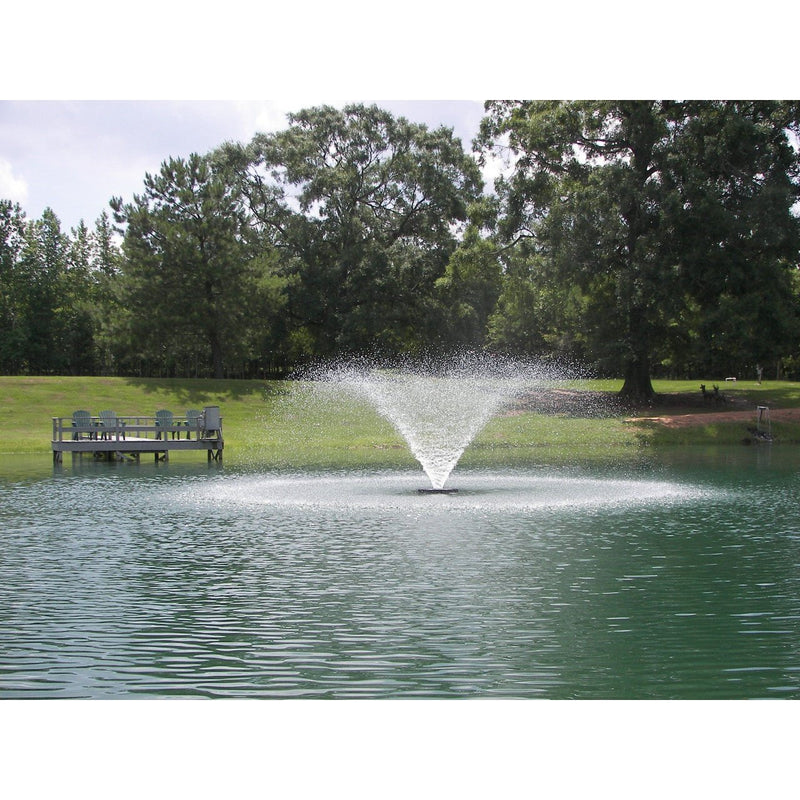
Consider a 1-acre pond with an average depth of 6 feet. An operator installs two 1-HP surface fountains thinking more power is better. The fountains create massive spray patterns and high-velocity surface ripples. Within a month, the pond turns a murky brown and a thick layer of algae forms on the surface.
Technical analysis reveals the following: The surface fountains were only aerating the top 2 feet of water. The high velocity at the surface created a "short-circuit" where oxygenated water stayed at the top. Meanwhile, the mechanical vibration and wind-driven currents disturbed the shallow edges, suspending clay particles (high TSS). The bottom remained anoxic, but the "over-aerated" surface gave a false sense of security.
The solution was to replace the 2-HP surface system with a single 1/2-HP rocking piston compressor connected to three fine-pore diffusers on the bottom. This reduced energy costs by 75%, cleared the water by allowing solids to settle, and ensured that the entire 6-foot water column was oxygenated through an ordered air-lift plume. The DO levels stabilized at 7 mg/L throughout the pond.
Final Thoughts
Efficient pond management relies on the precision of oxygen delivery rather than the sheer volume of air. Over-aeration is a mechanical inefficiency that disrupts thermal stability, stresses aquatic life, and contributes to nutrient imbalances. By focusing on Ordered Aeration and understanding the underlying gas laws, an operator can maintain a healthier environment with significantly lower energy inputs.
Every system has a unique saturation threshold influenced by depth, temperature, and biological load. Monitoring these variables allows for the fine-tuning of aeration equipment to meet the Actual Oxygen Transfer Rate without crossing into the territory of chaotic turbulence. Balancing these factors is the difference between a thriving ecosystem and a high-maintenance liability.
Practitioners should continue to explore the relationship between fluid dynamics and microbial health. As sensor technology becomes more affordable, the shift toward automated, demand-based aeration will likely become the standard. For now, observing the physical behavior of the water and the physiological health of the fish remains the best way to determine if your pond is getting "too much of a good thing."