

Can One Aerator Handle an Irregular-Shaped Pond?
Pond curves are beautiful until they become oxygen-free dead zones. Irregular ponds require more than just power; they require strategy. Learn how to map your pond's shape for 100% oxygen coverage.
Managing an aquatic ecosystem with a complex geometry—such as L-shapes, kidney curves, or ponds with central islands—presents a specific mechanical challenge. Standard aeration models often assume a uniform, circular, or rectangular basin. In these idealized shapes, a single central point of aeration creates a predictable circular turnover pattern. However, irregular boundaries disrupt these fluid dynamics, leading to pockets of stagnant water that bypass the primary circulation current.
Ensuring total oxygen saturation requires moving beyond simple horsepower ratings. It necessitates a volumetric and spatial analysis of the water body to ensure that every cubic meter of water is cycled through the air-water interface within a specific timeframe. This technical guide examines the physics of aeration in irregular basins and provides the engineering frameworks needed to eliminate anoxic zones.
Can One Aerator Handle an Irregular-Shaped Pond?
The short answer is typically no, at least not with a single point of diffusion. While the compressor (the aerator motor) may have the rated capacity to handle the total volume of a pond, the physical distribution of that air is the limiting factor. In an irregular-shaped pond, landmasses, bends, and varying depths act as hydraulic barriers.
In a circular pond, a central diffuser creates a toroidal (doughnut-shaped) circulation pattern. The rising bubble plume pulls water from the bottom to the surface, where it spreads out radially, sinks at the edges, and returns along the bottom to the center. In an L-shaped pond, this radial flow cannot "turn the corner" with enough velocity to pull water from the far end of the second leg. The result is a stagnant dead zone where organic muck accumulates and dissolved oxygen (DO) levels plummet.
Real-world applications such as golf course water hazards or decorative estate ponds frequently suffer from this "isolated basin" effect. Even if a single large aerator provides massive oxygen transfer at its location, the hydraulic residence time in the distant coves becomes too high. Without active turnover, these areas become breeding grounds for anaerobic bacteria and nuisance algae.
How to Map Your Pond for 100% Oxygen Coverage
Mapping an irregular pond requires dividing the complex geometry into "simple basins." This process ensures that the mechanical output of the aeration system matches the physical constraints of the shoreline.
Phase 1: Volumetric Calculation of Sub-Basins
Calculate the volume of the pond by breaking it into sections. For an L-shaped pond, treat it as two rectangles. For a kidney-shaped pond, approximate it as two overlapping circles. Precision in volume calculation is mandatory to determine the required turnover rate, which should ideally be once every 12 to 24 hours.
Measure the maximum length, width, and average depth of each sub-basin. Use a shape factor (typically 0.8 to 0.9 for natural shorelines) to adjust for curves. The goal is to determine the Total Gallons per sub-basin to size the specific CFM (Cubic Feet per Minute) requirements for those zones.
Phase 2: Identifying Obstructions and Friction Points
Islands, shallow bars, and sharp bends are friction points that kill water velocity. A submerged island acts as a baffle, redirecting the horizontal current back toward the center and leaving the water behind the island untouched. On your map, mark these as "Flow Breakpoints." Each breakpoint typically requires a dedicated diffuser to maintain momentum.
Phase 3: Diffuser Placement Strategy
Strategic placement involves positioning diffusers at the deepest points within each sub-basin. The "Airlift Effect" is more efficient in deeper water because the bubbles have a longer contact time with the water column and can entrain a larger volume of water as they rise.
A diffuser at a depth of 15 feet can move significantly more water—approximately 4.5 million gallons per day—compared to the same unit at 5 feet. Therefore, maximize depth where possible, but ensure that the plume's reach overlaps with the adjacent diffuser's reach to eliminate gaps.
Benefits of Distributed Aeration Strategy
Implementing a distributed system rather than a single-point system offers measurable improvements in water chemistry and mechanical efficiency.
The primary benefit is the elimination of thermal stratification throughout the entire water column. In summer, ponds naturally separate into a warm, oxygen-rich upper layer (epilimnion) and a cold, oxygen-depleted bottom layer (hypolimnion). Distributed aeration breaks this thermocline in every corner of the pond, preventing the buildup of hydrogen sulfide and methane in isolated pockets.
Uniform circulation also enhances the efficiency of aerobic bacteria. These microbes require oxygen to digest "muck"—the organic sludge composed of fish waste and decaying vegetation. When oxygen is present across 100% of the pond floor, muck decomposition happens at an accelerated rate, significantly reducing the need for mechanical dredging.
Furthermore, distributed systems offer mechanical redundancy. If one diffuser in a four-unit system becomes clogged or requires maintenance, the other three units continue to provide a baseline of oxygenation. This prevents a total system failure that could lead to a catastrophic fish kill during a heatwave.
Challenges and Common Mistakes in Complex Aeration
The most frequent error in irregular pond aeration is "Short-Circuiting." This occurs when the intake and the discharge of the circulation pattern are too close together. In an irregular pond, placing two diffusers too close to each other causes their plumes to compete for the same water, leaving the distant shorelines stagnant.
Undersizing the compressor to save on initial capital expenditure is another common pitfall. Designers often calculate the total surface acreage and choose a kit rated for that size, forgetting that irregular shapes require more diffusers. Each additional diffuser adds back-pressure to the system. If the compressor cannot maintain the required PSI (Pounds per Square Inch) at the depth of the furthest diffuser, air will take the path of least resistance and only exit through the shallowest or closest unit.
Failing to account for friction loss in the delivery lines is a technical oversight that can cripple a system. Running 500 feet of 3/8-inch tubing to a distant cove results in a significant pressure drop. Without calculating the PSI loss over that distance, the distant diffuser may underperform, failing to reach the required turnover rate for its sub-basin.
Limitations of Aeration in Irregular Ponds
Even the most advanced aeration system has physical boundaries. Very narrow channels or extremely shallow coves (under 3 feet deep) are difficult to aerate using subsurface diffusion. The bubble plume in shallow water does not have enough vertical travel to create a strong enough "lift" to move water horizontally over long distances.
In these specific scenarios, subsurface aeration may need to be supplemented with horizontal aspirators or circulators. These units sit near the surface and push water laterally, making them ideal for moving water through narrow "bottlenecks" where a vertical plume would be ineffective.
Environmental constraints also play a role. In very large, irregularly shaped reservoirs, the cost of running thousands of feet of weighted tubing and the electrical demand of high-horsepower compressors may become prohibitive. In such cases, management must prioritize the most critical areas, such as fish spawning grounds or intake zones for irrigation, while accepting lower DO levels in remote, naturalized coves.
Comparison: Single High-HP Unit vs. Distributed Low-HP Units
The choice between a single powerful unit and multiple smaller units is often a trade-off between simplicity and efficiency.
| Feature | Single High-HP Surface Aerator | Distributed Sub-Surface Diffusion |
|---|---|---|
| Oxygen Transfer Efficiency | High (at surface), Low (at depth) | Highest (total water column) |
| Coverage in Bends/Coves | Poor; creates "Line of Sight" dead zones | Excellent; targeted placement |
| Maintenance Requirement | Medium; floating unit requires retrieval | Low; shore-based compressor |
| Electrical Efficiency | Lower (high splash energy loss) | Higher (utilizes physics of buoyancy) |
| Cost per Sub-Basin | High | Low |
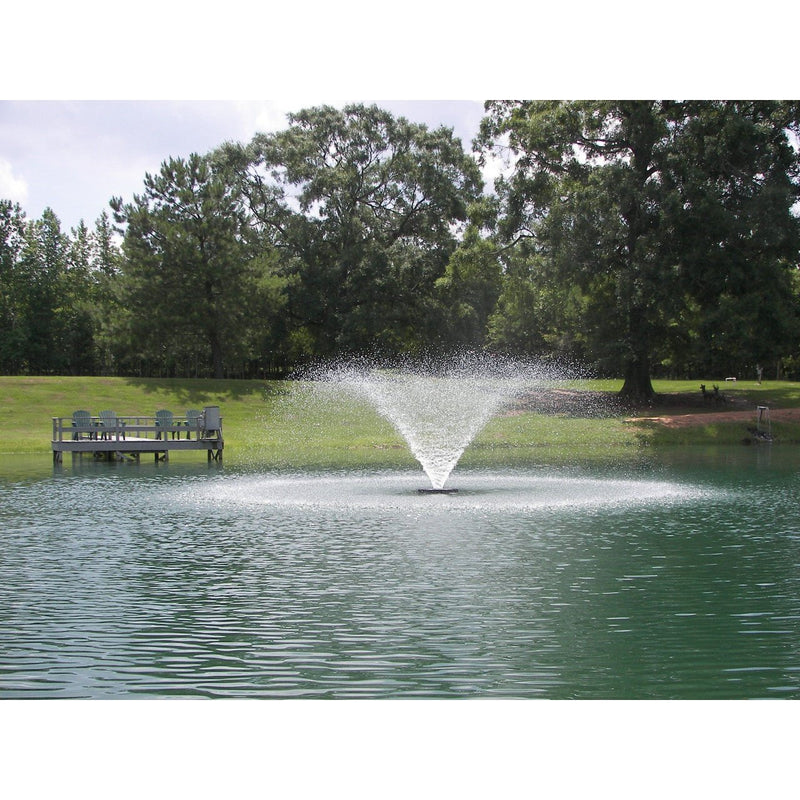
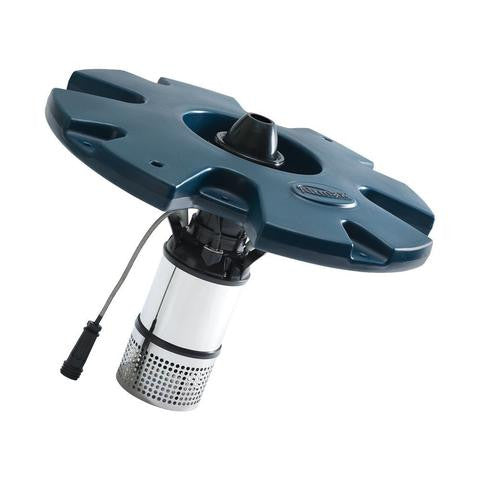
Distributed diffusion is almost always the superior choice for irregular shapes because it addresses the core issue of spatial stagnation. While a single large fountain might look impressive, its mechanical work is localized, whereas multiple diffusers operate as a synchronized network to move the entire mass of the pond.
Practical Tips for Optimizing Irregular Pond Aeration
To maximize the performance of a distributed system, follow these technical best practices:
Use weighted (self-sinking) tubing for all submerged runs. Standard poly-tubing will float when filled with air, creating a navigation hazard and allowing the lines to shift, which disrupts your carefully mapped diffuser placement. Weighted tubing remains anchored exactly where you drop it.
Install a pressure gauge and individual manifold valves at the compressor cabinet. This allows you to "balance" the system. If one diffuser is in shallower water than another, it will naturally take more air. By slightly closing the valve to the shallow diffuser, you force more air to the deeper or more distant units, ensuring uniform output across the entire network.
Monitor the "boil" on the surface. A healthy aeration plume should create a gentle, steady turbulence at the surface. If the boil is too violent, the diffuser may be undersized for the CFM being pushed through it, leading to excessive back-pressure and premature compressor wear. If there is no boil, check for leaks or depth-pressure imbalances.
Clean your diffuser membranes annually. In ponds with high mineral content or heavy muck, the tiny pores in the diffusers can become clogged with calcium or bio-films. A simple cleaning or replacement of the membrane maintains the fine-bubble output necessary for efficient oxygen transfer.
Advanced Considerations: Turnover and Gas Transfer Physics
Serious practitioners must look at the Oxygen Transfer Rate (OTR) and the Biological Oxygen Demand (BOD). In an irregular pond, the BOD may vary by section. For example, a cove where autumn leaves accumulate will have a higher BOD than a clean, sandy-bottomed section of the main basin.
Calculating the "Airlift Ratio" is essential for professional-grade setups. This is the ratio of water moved per volume of air injected. This ratio is non-linear and improves with depth. In a complex pond, you may choose a larger, more efficient diffuser for the deep main basin and multiple smaller, coarse-bubble diffusers for the shallower peripheral zones to manage the energy-to-turnover balance.
Consider the "Startup Protocol" for ponds that have been stagnant for years. Rapidly aerating an anoxic irregular pond can cause a sudden turnover of "bad water" (low DO, high CO2/H2S) into the upper layers, potentially shocking the fish. For irregular ponds, start one diffuser at a time, running each for only an hour the first day and doubling the time daily until 24/7 operation is reached. This staggered approach allows the gas exchange to happen safely and prevents "turnover shock" in isolated basins.
Example Scenario: The 1-Acre L-Shaped Pond
Consider a 1-acre pond in a sharp "L" configuration. The long leg is 300 feet by 100 feet with a depth of 12 feet. The short leg is 100 feet by 135 feet with a depth of 6 feet.
A single-point aerator placed in the center of the 12-foot leg would successfully aerate that basin but would fail to reach the end of the 6-foot leg. To fix this, a 1/2 HP rocking piston compressor is used with a three-valve manifold.
Two diffusers are placed in the 12-foot leg, spaced 150 feet apart to create overlapping toroidal currents. The third diffuser is placed at the far end of the 6-foot leg. Because the 6-foot diffuser has less head-pressure to overcome, the manifold valve for that line is partially closed to balance the airflow with the deeper units. This setup ensures that the entire 1-acre volume is turned over 1.5 times every 24 hours, maintaining 100% oxygen coverage despite the sharp 90-degree bend.
Final Thoughts
Achieving 100% oxygen coverage in an irregular-shaped pond is a matter of mechanical strategy rather than brute force. By breaking the pond into manageable sub-basins and mapping diffuser placement to overcome hydraulic barriers, you can eliminate the stagnant dead zones that compromise water quality.
Focus on data-driven decisions: calculate your volumes, account for friction loss in your tubing, and use a manifold system to balance pressure across your network. A well-engineered distributed aeration system doesn't just keep fish alive; it optimizes the biological processing of organic waste, leading to a clearer, healthier, and more stable aquatic environment.
Implementing these technical frameworks ensures that your pond's beauty is supported by a robust, oxygen-rich foundation. Experiment with placement, monitor your dissolved oxygen levels, and refine your circulation patterns to suit the unique geography of your water body.