

Can Aeration Prevent Fish Kills During a Heat Wave?
Hot water holds less oxygen. Don't let your pond become a trap this summer. When the temperature rises, oxygen levels plummet. Aeration is the only thing standing between a healthy pond and a total fish kill.
Managing a pond during a heat wave requires a fundamental understanding of fluid dynamics, thermodynamics, and biological respiration. As ambient temperatures climb, the physical capacity of water to retain dissolved oxygen (DO) decreases in a predictable, non-linear fashion. This physical reality creates a precarious environment where the supply of oxygen is at its lowest just as the biological demand from fish and microbes reaches its peak.
To maintain a stable ecosystem, pond managers must shift from passive observation to active mechanical intervention. This involves calculating the specific oxygen requirements of the water body and deploying aeration systems capable of meeting that demand under extreme thermal stress. Relying on natural diffusion or wind-driven gas exchange is often insufficient when water temperatures exceed 80°F (26.7°C).
This article provides a technical framework for evaluating and implementing aeration strategies. We will examine the mechanics of gas transfer, the math behind oxygen saturation, and the performance metrics of various mechanical systems. The goal is to provide a data-driven approach to preventing hypoxia-related mortality in aquatic populations.
Why Aerate In Hot Weather?
Aeration is a mechanical process designed to increase the rate of oxygen transfer from the atmosphere into the water column. In the context of a heat wave, its primary function is to replace the oxygen consumed by fish, plants, and decomposing organic matter at a rate that exceeds the biological oxygen demand (BOD). Without mechanical aeration, many ponds reach a state of hypoxia—where DO levels fall below the threshold required to sustain life—during the overnight hours when photosynthesis ceases.
The core mechanism of aeration involves increasing the surface area of the water-air interface. This is achieved either by splashing water into the air (surface aeration) or by pumping air through the water (diffused aeration). By creating turbulence and breaking the surface tension, these systems facilitate the diffusion of oxygen molecules into the water and the venting of harmful gases like carbon dioxide, methane, and hydrogen sulfide.
In real-world applications, aeration is the standard practice in commercial aquaculture and high-value ornamental ponds. It acts as a biological life-support system, providing a safety margin when environmental conditions deteriorate. During a heat wave, the role of aeration shifts from general water quality maintenance to emergency survival, as it prevents the catastrophic DO crashes that typically occur between 2:00 AM and 6:00 AM.
Thermodynamics and the Physics of Gas Solubility
The relationship between water temperature and dissolved oxygen is governed by Henry’s Law, which states that the amount of dissolved gas in a liquid is proportional to its partial pressure above the liquid. However, temperature is a critical variable: as water molecules gain kinetic energy, they move more rapidly, allowing dissolved gas molecules to escape the liquid phase more easily. Consequently, the saturation point for oxygen drops as the temperature increases.
For example, fresh water at sea level can hold approximately 14.6 mg/L of oxygen at 32°F (0°C). By the time the water reaches 77°F (25°C), the saturation level drops to 8.3 mg/L. At 95°F (35°C), the capacity is further reduced to roughly 6.9 mg/L. This represents a reduction of over 50% in total holding capacity from freezing to high summer temperatures. The following table illustrates this inverse relationship:
| Temperature (°C / °F) | DO Saturation (mg/L at 1 atm) | Relative Capacity (%) |
|---|---|---|
| 0°C / 32°F | 14.6 | 100% |
| 10°C / 50°F | 11.3 | 77% |
| 20°C / 68°F | 9.1 | 62% |
| 25°C / 77°F | 8.3 | 57% |
| 30°C / 86°F | 7.6 | 52% |
| 35°C / 95°F | 6.9 | 47% |
This physical limitation is exacerbated by the metabolic requirements of fish. Because fish are ectothermic (cold-blooded), their metabolism scales with water temperature. According to the Q10 temperature coefficient, a 10°C increase in temperature typically doubles the metabolic rate of an organism. This creates a "deadly squeeze": the water holds less oxygen, while the fish require significantly more to stay alive.
Mechanical Efficiency: SOTR vs. AOTR
When selecting an aeration system, it is vital to distinguish between Standard Oxygen Transfer Rate (SOTR) and Actual Oxygen Transfer Rate (AOTR). Manufacturers typically provide SOTR, which is measured in clean water at 20°C (68°F) at zero initial dissolved oxygen. This metric allows for a standardized comparison between units but does not reflect performance in a real-world pond during a heat wave.
To determine the AOTR, several correction factors must be applied to the SOTR. These factors account for the actual water temperature, the target DO level, and the presence of dissolved solids or organic matter. The standard formula for AOTR is:
AOTR = SOTR × ? × [(? × C_sat,T - C_actual) / C_sat,20] × ?^(T-20)
In this equation, ? (alpha) represents the ratio of oxygen transfer in pond water vs. clean water (usually 0.6 to 0.9). ? (beta) accounts for salinity and dissolved solids (usually 0.95 to 0.98 for fresh water). C_sat,T is the saturation concentration of oxygen at the current temperature, and C_actual is the current DO level. ? (theta) is a temperature correction factor, typically set at 1.024.
During a heat wave, the AOTR is significantly lower than the SOTR. As the water temperature rises (T increases) and the saturation point (C_sat,T) falls, the driving force for oxygen transfer decreases. This means that an aerator that is sufficient in the spring may be woefully inadequate in July. Proper sizing must prioritize the AOTR under worst-case scenario conditions (highest expected temperature and lowest target DO).
Comparing Aeration Systems: Surface vs. Diffused
There are two primary mechanical approaches to pond aeration: surface units and subsurface diffused systems. Each has distinct performance metrics and mechanical trade-offs that influence their suitability for heat wave mitigation.
Surface Aerators and Agitators
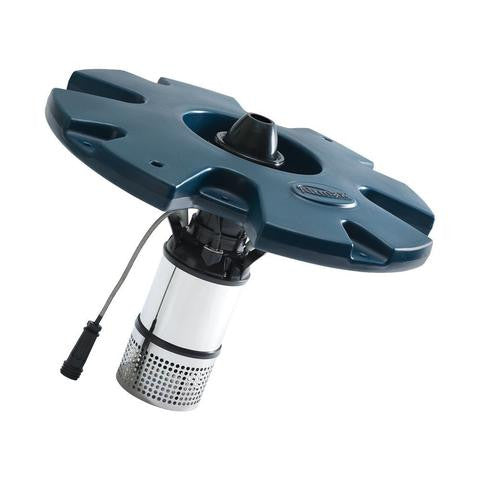
Surface aerators utilize a motor-driven impeller to splash water into the air. These units are characterized by a high Standard Aeration Efficiency (SAE), often ranging from 2.6 to 3.2 lbs of O2 per horsepower-hour (lb O2/hp-hr). They are exceptionally effective at rapid gas exchange and venting CO2. Because they operate at the surface, they provide immediate relief in the upper layers of the water column.
However, surface aerators have a limited effective depth. They rarely impact water deeper than 6 to 10 feet. In deep ponds, they may fail to address the oxygen-depleted water at the bottom, leaving a large portion of the pond uninhabitable for fish during the heat of the day. They are best suited for shallow ponds (under 8 feet deep) or for providing emergency "oxygen sanctuaries" where fish can congregate.
Subsurface Diffused Air Systems
Diffused systems use shore-mounted compressors to pump air through weighted tubing to diffusers located on the pond floor. As the bubbles rise, they create a vertical current that pulls deoxygenated water from the bottom to the surface. This process, known as destratification, ensures that the entire water column is mixed and oxygenated.
While the SAE of diffused systems can vary (typically 1.5 to 2.5 lb O2/hp-hr in shallow water), their efficiency increases dramatically with depth. At depths greater than 12 feet, diffused systems are often the only viable method for total pond oxygenation. They are also quieter and more aesthetically discreet than surface units. The main drawback is the risk of "thermal turnover" if the system is started suddenly in a highly stratified pond, which can bring toxic, anoxic bottom water to the surface too quickly.
Biological Oxygen Demand (BOD) Scaling
Biological Oxygen Demand is a measure of how much oxygen is being consumed by the biological components of the pond. During a heat wave, BOD increases due to three primary factors: microbial decomposition, fish respiration, and nighttime plant respiration. Understanding these demands is critical for calculating the total aeration load required.
Microbial activity is perhaps the most significant consumer of oxygen in an established pond. Bacteria responsible for breaking down muck, fish waste, and dead algae work much faster in warm water. This decomposition process is aerobic, meaning it strips oxygen from the water. In a pond with heavy organic loads (muck), the BOD from decomposition alone can exceed the natural oxygen replenishment rate.
Furthermore, the presence of dense algae or aquatic plants can lead to a phenomenon known as nocturnal hypoxia. During the day, plants produce oxygen via photosynthesis, often leading to "supersaturation" (DO levels above 100%). However, at night, photosynthesis stops, and the plants switch to respiration, consuming oxygen along with the fish. In a heat wave, this nighttime draw is much more aggressive, frequently causing DO to drop to lethal levels (below 2 ppm) before sunrise.
Challenges and Common Mistakes
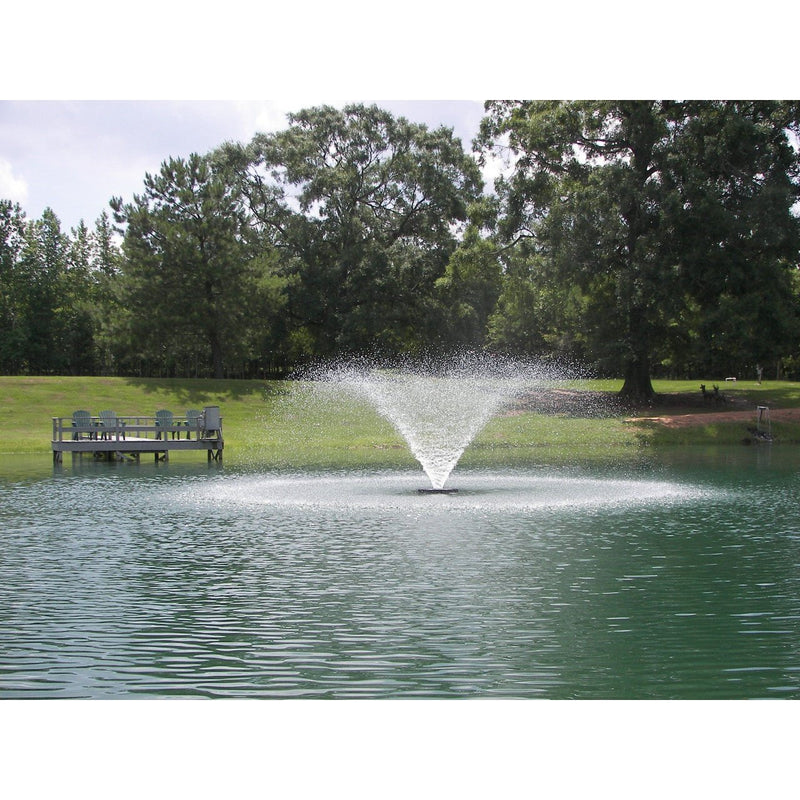
The most common error in pond management is the "visual fallacy"—assuming that because the water is moving, it is being sufficiently aerated. Decorative fountains are a prime example. While they create a pleasing spray, they are designed for aesthetics rather than oxygen transfer. Many fountains only move the very top layer of water, providing negligible aeration for the rest of the pond.
Another frequent mistake is undersizing the aeration system. Many retail aerators are rated for "up to 1 acre," but these ratings are often based on ideal conditions and low stocking densities. In a heat wave, with a high bioload of fish and warm water, that same unit may only be effective for a quarter-acre. Failure to account for the AOTR derating often leads to system failure during peak demand.
Starting an aeration system too late is also a common pitfall. If you wait until you see fish gasping at the surface, the oxygen debt in the water is already critical. It is much easier to maintain a stable DO level than it is to recover a crashing pond. Furthermore, starting a bottom diffuser for the first time in mid-summer can be dangerous, as it may cause a sudden turnover of cold, oxygen-depleted, and methane-rich bottom water, leading to an immediate fish kill.
Limitations of Mechanical Aeration
While aeration is highly effective, it is not a cure-all. In extremely small, shallow ponds, a heat wave can raise water temperatures to levels that are physically lethal for certain species, regardless of oxygen content. For example, most trout species cannot survive prolonged exposure to temperatures above 75°F, even if the water is at 100% oxygen saturation. Mechanical cooling (chillers) is the only solution in such cases, which is rarely practical for large ponds.
Environmental factors like barometric pressure also impose limitations. When a storm front approaches, barometric pressure drops, which further reduces the solubility of oxygen. This is why many fish kills occur immediately after a summer thunderstorm. Even a high-output aeration system may struggle to overcome the combined impact of high temperature and low atmospheric pressure.
Finally, power reliability is a significant constraint. Heat waves often correlate with peak electrical demand and power outages. If a pond is 100% dependent on mechanical aeration for fish survival, a four-hour power failure during the night can result in a total loss. Implementing battery backups or solar-powered emergency units can mitigate this risk, but it adds significant cost and complexity.
Practical Tips for Heat Wave Management
To maximize the effectiveness of your aeration system during the summer, follow these best practices:
- Run Aeration 24/7: Do not turn off aerators during the day to "save energy." While photosynthesis adds oxygen, the aeration system is needed to vent CO2 and maintain circulation. Constant operation prevents the buildup of an oxygen debt.
- Monitor DO and Temperature: Invest in a digital Dissolved Oxygen meter. Check your levels at sunrise, which is the lowest point of the diurnal cycle. If DO is consistently below 5 ppm, your aeration capacity is insufficient.
- Reduce Feeding: Fish metabolism and waste production increase with temperature. During a heat wave, reduce feeding by 50% or stop entirely. Digestion consumes significant amounts of oxygen, and uneaten food adds to the BOD.
- Maintain Equipment: Check air filters on compressors and ensure diffusers are not clogged with algae or calcium deposits. A 20% reduction in airflow due to a dirty filter can be the difference between survival and a fish kill.
- Add Emergency Surface Units: If your bottom-diffused system isn't keeping up, consider adding a temporary surface agitator. These units are easier to deploy quickly and provide high-rate oxygen transfer to the surface layers where fish will congregate if the bottom becomes hypoxic.
The "Squeeze" Phenomenon and Stratification
In deep ponds, heat waves create a structural problem known as thermal stratification. The sun heats the surface layer (epilimnion), making it less dense. This warm layer floats on top of the colder, denser bottom water (hypolimnion). Because the layers do not mix, the bottom water becomes stagnant and quickly loses its oxygen through decomposition.
This creates a "squeeze" for the fish. The surface water is rich in oxygen but is too hot for comfort or survival. The bottom water is cool but contains zero oxygen. As the heat wave progresses, the warm surface layer thickens, and the oxygen-free bottom layer rises. The fish are forced into a narrow band of water that is both hot and marginally oxygenated. A properly sized diffused aeration system eliminates this problem by breaking the thermal barrier (thermocline) and forcing the pond to stay at a uniform temperature and oxygen level from top to bottom.
Scenario: Sizing an Aeration System
Consider a 1-acre pond with an average depth of 8 feet and a heavy load of koi. In the spring (60°F), the oxygen demand is relatively low, and a 1/2 HP compressor might be sufficient to maintain 8 ppm DO.
However, during a July heat wave, the water temperature hits 88°F. The saturation point of oxygen has dropped from 10 mg/L to roughly 7.3 mg/L. To keep the koi healthy, you want to maintain at least 5 mg/L. This leaves a "driving force" (the difference between saturation and actual level) of only 2.3 mg/L. In the spring, the driving force was 10 - 5 = 5 mg/L.
Because the driving force has been cut in half, the aeration system must work twice as hard to move the same amount of oxygen into the water. Furthermore, the BOD has doubled due to the Q10 effect. In this scenario, the pond now requires four times the aeration capacity it needed in the spring. A manager who relies on the 1/2 HP system will likely see DO levels drop below 3 ppm, resulting in significant fish stress or mortality.
Final Thoughts
Maintaining a pond through a summer heat wave is an exercise in mechanical and biological balance. The fundamental law of oxygen solubility ensures that as temperatures rise, the environment becomes increasingly hostile to aquatic life. Aeration is the only reliable tool available to counteract these physical limitations, providing a steady supply of dissolved oxygen when natural processes fail.
Success requires more than just "bubbles." It demands an engineering mindset that accounts for SOTR/AOTR derating, biological oxygen demand scaling, and the mechanics of thermal stratification. By proactively sizing systems for peak summer loads rather than average conditions, pond managers can ensure the long-term health and stability of their ecosystems.
If you are currently managing a pond, take the time to audit your aeration capacity before the next thermal spike. Calculate your pond's volume, assess the bioload, and ensure your mechanical systems are operating at peak efficiency. Understanding the physics of your pond today is the only way to prevent a total fish kill tomorrow.