

What's The Best Way To Aerate My Pond?
Is your pond a breeding ground for mosquitoes or a thriving ecosystem? A still pond is a dying pond. Without oxygen circulation, algae takes over and aquatic life suffocates. Discover the most efficient ways to keep your water moving—from passive wind-driven systems to high-efficiency solar bubblers.
What's The Best Way To Aerate My Pond?
Pond aeration is the mechanical process of increasing dissolved oxygen (DO) levels within a water body. In an unmanaged pond, oxygen enters the water primarily through atmospheric diffusion at the surface and as a byproduct of photosynthesis from aquatic plants. However, these natural processes often fail to meet the biological oxygen demand (BOD) of a closed ecosystem, leading to hypoxic conditions.
The best method for aeration depends strictly on the pond’s depth, surface area, and biological load. For deep ponds exceeding 6 feet, diffused aeration systems are technically superior due to their ability to induce total water column circulation. In shallower environments, surface aerators or agitators are more effective at promoting gas exchange and preventing the formation of surface films.
Effective aeration is measured in parts per million (ppm) or milligrams per liter (mg/L). Most freshwater fish species require a minimum of 5 ppm to maintain metabolic health. When DO levels drop below 3 ppm, aquatic life experience significant physiological stress, and levels below 2 ppm typically result in mass mortality events.
The Mechanics of Oxygen Transfer and Gas Exchange
Oxygen transfer is governed by the gas transfer equation: dC/dt = KL(A/V)(Cs – Cm). This formula describes how the rate of oxygen movement depends on turbulence, the ratio of surface area to water volume, and the saturation deficit. Mechanical systems work by optimizing these variables to force atmospheric oxygen into the liquid phase.
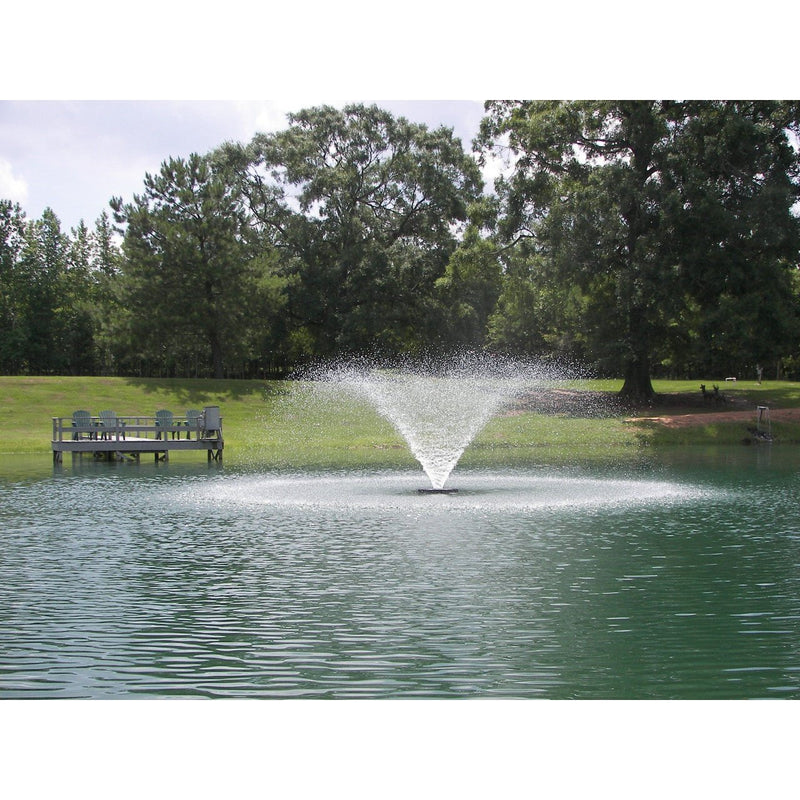
Surface aeration systems prioritize the (A/V) ratio by splashing water into the air, creating millions of small droplets. This massive increase in surface area allows for rapid gas exchange before the water falls back into the pond. These systems are highly effective at venting off toxic gases like methane and hydrogen sulfide, which accumulate in stagnant water.
Sub-surface or diffused aeration systems utilize a different mechanism known as the "airlift" effect. Compressed air is pushed through a diffuser membrane at the pond bottom, creating a column of fine bubbles. As these bubbles rise, they displace water, dragging oxygen-depleted bottom water to the surface where it can interact with the atmosphere. This process facilitates thermal destratification, ensuring that oxygen and temperature are uniform throughout the water column.
Benefits of Optimized Aeration Systems
Installing a high-efficiency aeration system provides measurable improvements to water chemistry and biological stability. One primary advantage is the stimulation of aerobic bacteria. These microbes are far more efficient than anaerobic bacteria at breaking down organic "muck" and nutrient loads like phosphorus and nitrogen.
Aeration also mitigates the risk of sudden pond turnover. In summer, ponds often stratify into a warm, oxygen-rich top layer (epilimnion) and a cold, anoxic bottom layer (hypolimnion). A sudden weather event can cause these layers to mix rapidly, stripping oxygen from the entire pond. Constant aeration prevents this stratification, maintaining a homogenized and stable environment.
Furthermore, moving water disrupts the lifecycle of several pests. Mosquitoes require stagnant water surfaces to lay eggs and for larvae to breathe through surface-reaching siphons. Constant agitation from a surface aerator or the circular currents from a diffuser makes the environment inhospitable for these insects, providing a chemical-free method of pest control.
Challenges and Common Technical Mistakes
Undersizing the compressor is the most frequent error in pond management. Operators often choose systems based solely on surface acreage without accounting for depth or fish density. A baseline of 1 to 1.5 Cubic Feet per Minute (CFM) per surface acre is standard for moderate loads, but heavily stocked ponds may require 2.5 CFM or more to maintain 5 ppm DO.
Ignoring backpressure is another significant pitfall. Every foot of water depth adds approximately 0.43 PSI of resistance against the compressor. A system rated for 3 CFM at the surface may only deliver 1.8 CFM at a depth of 15 feet. Failure to account for this drop in efficiency leads to insufficient oxygenation and premature compressor wear.
Improper diffuser placement can leave "dead zones" in irregular or kidney-shaped ponds. If air stations are only placed in the center of a long pond, the ends may remain stagnant and anoxic. Strategic placement using a multi-port manifold system is required to ensure that the entire volume of water is moved at least once every 24 hours.
Limitations and Environmental Constraints
Aeration is not a universal solution for all water quality issues. In hyper-eutrophic ponds with extreme nutrient loading, mechanical aeration may initially cause an algae bloom by bringing phosphorus-rich sediment into the photic zone. In these scenarios, aeration must be paired with nutrient binders or biological additives to achieve long-term clarity.
Depth presents a hard physical limit for certain technologies. Linear diaphragm compressors, while quiet and efficient, typically cannot push air deeper than 6 or 7 feet. For deeper applications, rocking piston compressors are required to overcome high head pressure. Conversely, surface fountains are largely ineffective in water deeper than 10 feet because they fail to circulate the bottom-most layer.
Power availability also dictates the feasible options. Running 110V or 220V lines to a remote pond can be cost-prohibitive. While solar and wind options exist, they introduce variability. A solar system without battery backup stops aerating exactly when the pond needs it most: at night, when plant respiration and decomposition consume the most oxygen.
Stagnant & Suffocated vs Oxygenated & Alive
The technical differences between an unmanaged pond and an aerated one are quantifiable through Standard Aeration Efficiency (SAE) and Standard Oxygen Transfer Efficiency (SOTE) metrics.
| Metric | Stagnant System | Oxygenated System |
|---|---|---|
| Dissolved Oxygen (DO) | 0.5 – 3.0 ppm (Variable) | 5.0 – 9.0 ppm (Stable) |
| Thermodynamics | Thermally Stratified | Destratified / Homogenized |
| Dominant Bacteria | Anaerobic (Slow/Odorous) | Aerobic (Fast/Clean) |
| Muck Accumulation | 1–3 inches per year | Net reduction over time |
| Algae Risk | High (Nutrient Sinks) | Low (Nutrient Processing) |
Systems that prioritize SOTE, like fine-bubble diffusers, achieve oxygen transfer rates of approximately 6.9% per meter of depth. In contrast, surface-only systems have lower SOTE but higher SAE in shallow water where they can move massive volumes of water with less energy.
Practical Tips and Best Practices
Always calculate the total pond volume in gallons or acre-feet before purchasing equipment. For round or oval ponds, the formula (Length x Width x Average Depth x 7.48) provides a reliable estimate of total gallons. Ensure the chosen compressor is rated to turnover that entire volume at least once every 12 to 24 hours.
Install a pressure gauge on the compressor manifold. This allows for real-time monitoring of system health. A sudden rise in pressure usually indicates a clogged diffuser membrane or a kinked weighted airline, while a drop in pressure suggests a leak in the system or a failing compressor seal.
Operate the system 24/7 during the peak summer months. Many owners try to save electricity by running aerators only during the day, but oxygen levels are naturally at their lowest just before dawn. Continuous operation ensures that the biological oxygen demand is met throughout the entire 24-hour cycle, preventing "morning-after" fish kills.
Advanced Considerations: BOD and Alpha Factors
Serious practitioners must consider Biological Oxygen Demand (BOD) when sizing professional systems. BOD measures the amount of oxygen required by bacteria to break down organic matter. If a pond has a high influx of leaf litter or fish waste, the aeration system must be sized 50% larger than the surface-area baseline to compensate for this constant "oxygen tax."
Alpha factors are another critical variable in technical applications. The alpha factor is the ratio of oxygen transfer in pond water versus clean tap water. In ponds with high surfactant levels or significant dissolved solids, the efficiency of a diffuser can drop by 30% or more. This is why professional lake managers often "over-spec" systems to ensure performance under real-world water conditions.
Thermal cooling is a secondary effect of surface aeration. Because surface aerators create a large spray pattern, they facilitate evaporative cooling. In regions with extreme summer temperatures, this can lower the water temperature by 2–4 degrees Celsius compared to a stagnant pond, which further increases the water's natural capacity to hold dissolved oxygen.
Scenario: Aerating a 1-Acre Farm Pond
Consider a 1-acre pond with a maximum depth of 12 feet and a moderate fish load. A surface fountain would only circulate the top 4–6 feet, leaving the bottom 6 feet anoxic. This would result in "dead water" that cannot support fish and accumulates organic sludge.
The optimal technical solution is a 1/4 HP rocking piston compressor connected to two dual-disc fine-bubble diffusers. One diffuser should be placed at the deepest point to maximize the bubble rise time (SOTE), and the second should be placed in a shallower area (approx. 6-8 feet) to ensure lateral circulation.
This configuration would provide approximately 2.5 CFM of airflow. At a 12-foot depth, the bubbles would move approximately 2,000 to 3,000 gallons of water per minute to the surface. This ensures a total volume turnover multiple times per day, maintaining DO levels above 6 ppm even during a mid-summer heatwave.
Final Thoughts
Maintaining a healthy pond requires a shift from viewing water as a static feature to managing it as a dynamic biological reactor. Mechanical aeration is the most effective tool for this management, providing the necessary oxygen to fuel the aerobic processes that keep water clear and life thriving. By understanding the relationship between depth, pressure, and oxygen transfer efficiency, a practitioner can select a system that provides long-term stability with minimal energy consumption.
Choosing between diffused and surface systems should be a data-driven decision. Depth remains the primary filter: use diffusers for deep-water circulation and surface agitators for shallow-water gas exchange. When these systems are sized correctly and maintained appropriately, the risk of fish kills, algae blooms, and stagnation is virtually eliminated.
Experiment with different diffuser placements and monitor your dissolved oxygen levels using a reliable DO meter. Consistent data collection will allow you to tune the system for maximum efficiency, ensuring that your pond remains an oxygenated, vibrant ecosystem for years to come.