

What Is A Safe Dissolved Oxygen Level For Pond Fish?
Are your fish just surviving, or are they actually thriving? Most guides tell you 3 mg/L is 'safe,' but that is just the edge of survival. To see true growth, color, and health, you need to aim for the Pro level. Managing dissolved oxygen (DO) in a pond ecosystem is a matter of precision engineering and fluid dynamics rather than simple guesswork.
Dissolved oxygen represents the volume of non-bonded oxygen molecules (O2) within a water body. These molecules are essential for the aerobic metabolism of teleost fish and the nitrification processes of autotrophic bacteria. While water is composed of oxygen atoms, fish cannot access the oxygen bound in the H2O molecule; they rely entirely on the gas dissolved within the liquid phase.
Optimizing DO levels requires a deep understanding of gas solubility, partial pressure, and the metabolic demands of the biological load. This guide examines the technical requirements for maintaining a high-performance pond environment where oxygen is treated as a critical resource rather than a secondary variable.
What Is A Safe Dissolved Oxygen Level For Pond Fish?
A safe dissolved oxygen level is defined as the concentration required to prevent physiological stress, allow for efficient feed conversion, and support the total biological oxygen demand (BOD) of the pond. In technical terms, DO is measured in milligrams per liter (mg/L) or parts per million (ppm), with 1 mg/L being equivalent to 1 ppm.
The "survival standard" is typically cited as 3.0 mg/L. At this threshold, most warm-water fish like koi and goldfish can maintain basic respiratory functions, but their metabolic efficiency is severely compromised. Biological systems, such as the nitrifying bacteria in the biofilter, begin to fail as DO drops toward this level, leading to a secondary crisis of ammonia accumulation.
The "Professional Edge" begins at 6.0 mg/L and ideally targets 7.0 to 9.0 mg/L. Maintaining these higher concentrations ensures that fish are not diverting energy away from growth and immune function toward the mechanical effort of increased ventilation (pumping more water over the gills). Higher DO levels also facilitate more aggressive feeding schedules, as the digestion of proteins—specifically the deamination of amino acids—requires a significant oxygen investment.
Real-world application of these levels varies by temperature and species. Cold-water species, such as trout, require much higher DO levels (minimum 9.0 mg/L) compared to carp species. Furthermore, because the solubility of oxygen decreases as temperature increases, a "safe" level is harder to maintain during summer peaks, precisely when the fish's metabolic demand is at its highest.
Thermodynamics and the Physics of Gas Solubility
Understanding how oxygen enters and stays in water requires an analysis of Henry's Law. This law states that at a constant temperature, the amount of a given gas that dissolves in a given type and volume of liquid is directly proportional to the partial pressure of that gas in equilibrium with that liquid.
Temperature is the primary driver of oxygen saturation. As water temperature rises, the kinetic energy of the water molecules increases, which allows dissolved oxygen molecules to escape more easily into the atmosphere. This inverse relationship means that a pond at 10°C (50°F) can hold approximately 11.29 mg/L at 100% saturation, whereas a pond at 30°C (86°F) can only hold 7.53 mg/L at the same saturation point.
Atmospheric pressure also plays a critical role. At higher altitudes, the partial pressure of oxygen is lower. For every 300 meters (approx. 1,000 feet) of elevation gain, the solubility of oxygen decreases by roughly 2%. Professionals managing ponds in mountainous regions must adjust their aeration capacity upwards to compensate for this physical limitation.
Salinity is a third, though often overlooked, factor. While most ornamental ponds are freshwater, the use of salt for therapeutic purposes (e.g., 0.3% to 0.5% concentration) slightly reduces the oxygen-carrying capacity of the water. High-density systems using salt must be monitored more closely, as the combined effect of high temperature and salinity can create a narrow window of safety.
Biological Oxygen Demand and Nitrification Mechanics
The total oxygen requirement of a pond is the sum of fish respiration, microbial respiration, and the chemical oxidation of organic matter. This is known as the Total Oxygen Demand (TOD).
Nitrifying bacteria (Nitrosomonas and Nitrobacter) are heavy oxygen consumers. In a balanced system, these bacteria oxidize toxic ammonia into nitrite and then into nitrate. This process is stoichiometrically demanding. For every 1.0 gram of ammonia-nitrogen (NH3-N) oxidized to nitrate, approximately 4.57 grams of dissolved oxygen are consumed.
If a pond is heavily fed, the resulting ammonia spike triggers a massive surge in microbial oxygen consumption. If the aeration system is sized only for the fish, the biofilter may "steal" the oxygen from the water column, leaving the fish in a state of hypoxia. Professional pond design accounts for this by allocating roughly 60% of the oxygenation capacity to the biofilter and 40% to fish respiration.
Organic sludge at the bottom of the pond also exerts a Chemical Oxygen Demand (COD). Heterotrophic bacteria breaking down fish waste and decaying plant matter consume oxygen at the sediment-water interface. In ponds with poor circulation, this can create an "anoxic zone" at the bottom, where anaerobic bacteria take over, producing toxic hydrogen sulfide gas.
Aeration Systems: Mechanical Optimization
Transferring oxygen from the atmosphere into the water is an engineering challenge governed by the Standard Oxygen Transfer Rate (SOTR). This metric measures how many kilograms of oxygen a device can transfer per hour under standard conditions.
Diffused aeration is the most efficient method for deep ponds. By pumping air through porous membranes (diffusers), billions of micro-bubbles are created. Small bubbles have a much higher surface-area-to-volume ratio than large bubbles, allowing for more efficient gas exchange as they rise. Furthermore, the rise of the bubbles creates an "airlift" effect, pulling oxygen-poor water from the bottom to the surface for atmospheric contact.
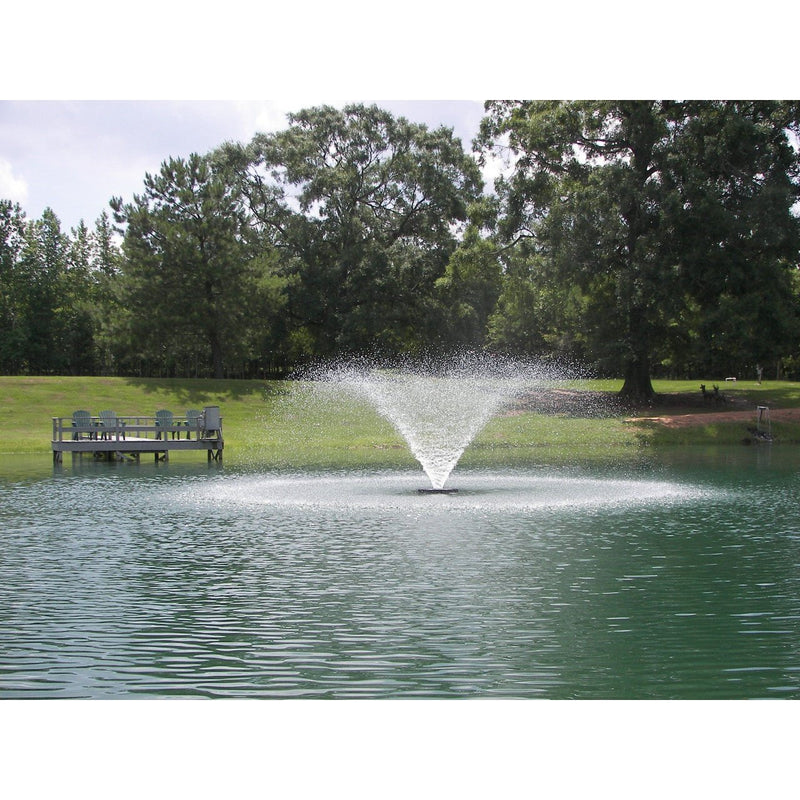
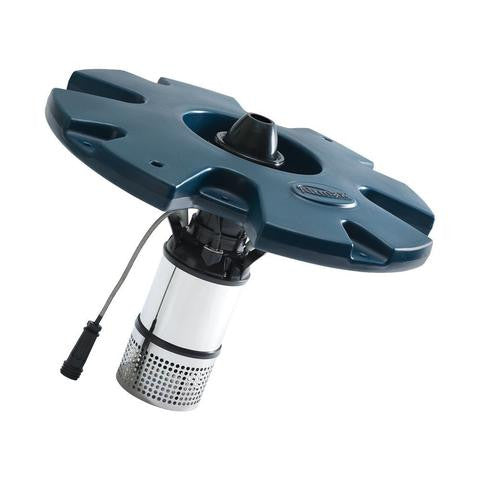
Surface aerators or "agitators" work by splashing water into the air. These are measured by Standard Aeration Efficiency (SAE), usually expressed as kg of O2 per kilowatt-hour (kg O2/kWh). Surface aerators are highly effective at venting carbon dioxide (CO2) but are generally less efficient than bottom-mounted diffusers at transferring oxygen to the entire water column in deeper systems.
Venturi injectors utilize the Bernoulli principle to draw air into a pressurized water stream. These are often integrated into the return lines of filtration systems. While effective, they increase the "head pressure" on the water pump, potentially reducing the overall flow rate. Professionals often prefer dedicated air pumps to ensure oxygenation is independent of water filtration flow.
Benefits of High Dissolved Oxygen Concentrations
Maintaining DO levels at the "Pro Level" (7.0+ mg/L) yields measurable improvements in pond performance and fish physiology.
The most significant benefit is the improvement in Feed Conversion Ratio (FCR). Fish are poikilothermic (cold-blooded), meaning their metabolic rate is determined by the environment. In high-oxygen environments, fish can process high-protein diets more efficiently. When DO is low, fish may still eat, but they cannot fully oxidize the nutrients, leading to wasted feed and increased ammonia production.
Immune system optimization is another critical advantage. Hypoxia (low oxygen) triggers the release of cortisol, a stress hormone that suppresses the immune response. Fish kept in oxygen-rich water are significantly more resistant to common pathogens such as *Aeromonas* or *Ichthyophthirius multifiliis*.
High DO levels also promote "vibrant color" by ensuring that the fish has the metabolic surplus required to produce and maintain skin pigments. Additionally, the rapid oxidation of organic wastes in high-oxygen environments leads to superior water clarity, as the "DOC" (Dissolved Organic Carbon) that stains water yellow is broken down more effectively by aerobic microbes.
Challenges and Common Pitfalls
The most frequent mistake in pond management is relying on "visual cues" rather than digital measurement. By the time fish are "piping" (gasping at the surface), they have already suffered significant physiological damage and possible permanent gill tissue scarring.
Biofilm accumulation on diffusers is a common mechanical failure. Over time, calcium carbonate and bacterial slime can clog the pores of air stones, increasing the back-pressure on the air pump and reducing the SOTR. Regular acid washing or replacement of diffusers is necessary to maintain system efficiency.
Power outages represent a catastrophic risk for high-density ponds. Because the "Professional Edge" allows for higher stocking densities, the margin for error is smaller. In a heavily stocked pond with high BOD, oxygen levels can drop from 8.0 mg/L to lethal levels in under two hours if the aeration fails. Redundant power supplies or 12V backup air systems are mandatory for professional setups.
Another pitfall is "short-circuiting" the water flow. If the aerator is placed too close to the filter intake, the oxygen-rich water is pulled immediately back into the filter, leaving the far side of the pond in a stagnant, low-oxygen state. Proper placement requires an understanding of the pond's circular or axial flow patterns.
Limitations: When High Oxygen Is Not Ideal
While rare, it is possible to have "too much" of a good thing. Supersaturation occurs when the total dissolved gas pressure (TDG) exceeds 100% of atmospheric pressure. This typically happens if air is sucked into the intake side of a high-pressure pump (a "venturi effect" on a leak) or if there is a massive algal bloom in bright sunlight.
Supersaturation can lead to Gas Bubble Disease (GBD). In this condition, gas comes out of solution inside the fish's tissues, forming bubbles in the bloodstream, fins, and eyes. This is mechanically similar to "the bends" in human divers. Monitoring Total Dissolved Gas (TDG) is essential when using pure oxygen injection or high-pressure venturis.
Temperature also acts as a physical ceiling. No amount of aeration can force water to hold more oxygen than its saturation point unless the partial pressure is increased (e.g., through pure oxygen injection). Attempting to "over-aerate" a warm pond only wastes electricity once the saturation point is reached. At that point, the only solution is to lower the water temperature or reduce the biological load.
Comparison: Survival Standard vs. Professional Edge
| Metric | Survival Standard | Professional Edge |
|---|---|---|
| DO Concentration | 3.0 - 5.0 mg/L | 7.0 - 9.0+ mg/L |
| Metabolic State | Stress / Maintenance only | Growth / Peak Vitality |
| Nitrification Efficiency | 40% - 60% capacity | 95% - 100% capacity |
| Feed Conversion (FCR) | Poor (High waste) | Excellent (Low waste) |
| Risk Level | Critical (High mortality risk) | Stable (Safety buffer) |
Practical Tips for Oxygen Management
- Measure at Dawn: Dissolved oxygen levels are always lowest just before sunrise. This is because plants and algae consume oxygen through respiration all night long without producing any through photosynthesis. If your dawn levels are above 6.0 mg/L, your system is robust.
- Optimize Bubble Size: If you can see large, "boiling" bubbles at the surface, you are wasting energy. Switch to fine-pore EPDM diffusers that produce a "mist" of bubbles for maximum SOTE.
- Monitor Temperature/DO Correlation: Keep a log of your water temperature and DO levels. As the temperature crosses 25°C (77°F), increase your aeration duration or reduce feeding.
- Install a DO Sensor: While chemical titration kits (Winkler Method) are accurate, they are too slow for real-time management. Invest in a continuous monitoring system with an optical probe.
Advanced Considerations: Sensor Technology and Pure Oxygen
Serious practitioners often move beyond traditional air pumps. Pure oxygen injection involves using an oxygen concentrator or liquid O2 cylinders to deliver 90-100% pure oxygen. Because the partial pressure of pure oxygen is roughly five times higher than that of atmospheric air (which is only 21% O2), it is possible to achieve much higher DO concentrations even in warm water.
Sensor selection is another advanced topic. Older "Polarographic" sensors require a constant flow of water over the membrane and frequent calibration. "Optical" sensors (using fluorescence quenching) are the modern standard. They do not consume oxygen during measurement, are not affected by flow rate, and can remain accurate for months without recalibration.
Integrating DO sensors into a PLC (Programmable Logic Controller) allows for "Aeration on Demand." The system can automatically ramp up air pump speeds when it detects a drop in DO, optimizing electricity usage and extending the life of the aeration equipment.
Example Scenario: The Summer Night Crash
Consider a 10,000-liter pond with a heavy stocking of koi and a significant algae load. During a 30°C summer day, the water is at 100% saturation (7.5 mg/L) thanks to active photosynthesis and a standard air pump.
As the sun sets, photosynthesis stops. The algae, which produced oxygen all day, now begin to consume it. The fish, highly active due to the warm water, are consuming O2 at peak rates. The nitrifying bacteria are also working overtime to process the ammonia from a large evening feeding.
Without professional-grade aeration, the DO levels can drop by 1.0 mg/L every hour. By 3:00 AM, the pond has reached 2.5 mg/L. The largest, most valuable fish—which have the highest oxygen demand—begin to die first. A professional system, equipped with a DO-triggered backup, would have detected the trend at 5.0 mg/L and engaged secondary diffusers to arrest the fall.
Final Thoughts
Maintaining dissolved oxygen at the "Professional Edge" is the single most effective way to improve the health and longevity of pond fish. While the "survival standard" of 3 mg/L might keep fish alive in the short term, it creates a high-stress environment that limits growth and invites disease.
By applying the principles of Henry's Law, optimizing aeration efficiency, and monitoring the biological oxygen demand, pond owners can create a stable, high-performance ecosystem. Precision measurement and mechanical redundancy are not luxuries; they are the foundation of modern aquaculture.
Experimenting with different diffuser placements and monitoring the diurnal cycles of your pond will provide the data needed to fine-tune your system. Aiming for 7.0 to 9.0 mg/L ensures that your fish are not just surviving the edge of existence but are operating at their full biological potential.