

What Does High pH Really Mean in a Pond?
What Does High pH Really Mean in a Pond?
A pond owner tests the water in the afternoon and gets a pH of 9.1.
Is that a problem?
Maybe—but the number alone doesn't tell us enough.
One of the biggest mistakes in interpreting pond water tests is treating pH as a fixed number. In reality, pH in a pond can change throughout the day, sometimes considerably.
So when someone tells us their pond has a high pH, some of the first questions we want to ask are:
-
What time of day was the water tested?
-
What is the pH early in the morning?
-
Is there a heavy algae or phytoplankton bloom?
-
What is the pond's alkalinity?
-
Is ammonia present?
-
Are fish showing any signs of stress?
Those answers tell us much more than a single pH reading.
What Does pH Actually Tell You?
pH is a measurement of how acidic or alkaline the water is.
A pH of 7 is considered neutral. Numbers below 7 are increasingly acidic, while numbers above 7 are increasingly alkaline.
Most common warmwater pond fish tolerate a fairly broad pH range, and many healthy ponds naturally spend at least part of the day on the alkaline side of the scale.
That's why seeing a pH reading of 8.5—or even somewhat higher—doesn't automatically mean something is wrong.
The bigger question is:
Is the pond naturally maintaining a relatively stable alkaline pH, or is the pH changing dramatically between morning and afternoon?
Those are very different situations.
Why Pond pH Changes During the Day
To understand high pH, it helps to understand what plants and algae are doing in the pond.
During daylight, algae and aquatic plants photosynthesize.
As part of that process, they remove carbon dioxide from the water.
Carbon dioxide dissolved in water influences its acidity. As algae and plants remove CO₂ during the day, the water generally becomes less acidic and the pH rises.
After sunset, photosynthesis stops.
Fish, algae, plants, bacteria, and other organisms continue respiring and releasing carbon dioxide.
As CO₂ accumulates overnight, pH falls again.
The result is a natural daily cycle:
Lower pH in the early morning → rising pH during daylight → highest pH later in the day → falling pH overnight.
Every pond won't experience the same size change, but the pattern itself is normal.
A High Afternoon pH May Be Telling You About Algae
Suppose you test a pond at 4:00 p.m. on a sunny summer day and get a pH of 9.2.
Then you test the same pond shortly after sunrise the next morning and get 7.6.
That's very different from a pond that measures around 8.5 in the morning and 8.8 in the afternoon.
The first pond is experiencing a substantial daily swing.
The second is relatively stable.
A large afternoon increase is often associated with strong photosynthetic activity, particularly from a dense phytoplankton bloom.
In that situation, the high pH may be less of a problem by itself than it is a clue about what's happening biologically in the pond.
A heavy bloom is removing large amounts of carbon dioxide during daylight.
And that tells us something else worth remembering: the same algae producing oxygen and driving pH upward during the day are also respiring and consuming oxygen at night.
That's one reason heavily blooming ponds can experience large daily changes in both pH and dissolved oxygen.
Test pH in the Morning and Afternoon
If you get an unexpectedly high pH reading, one of the simplest things you can do is test again at a different time.
Ideally, compare:
Early morning, around sunrise
with
Late afternoon
Use the same test method and, as much as practical, sample from the same location.
This gives you a much better picture of the pond than one isolated reading.
If pH remains relatively high but stable throughout the day, the pond may simply have naturally alkaline water.
If pH changes dramatically, we start looking more closely at alkalinity, algae growth, nutrient levels, and other biological activity.
The pattern can be more informative than the afternoon number alone.
Where Does Alkalinity Fit In?
pH and alkalinity are related, but they are not the same thing.
This causes a lot of confusion.
pH tells us how acidic or alkaline the water is at that moment.
Alkalinity tells us how well the water can resist changes in pH.
Think of alkalinity as the pond's buffering capacity.
Water with adequate alkalinity generally resists rapid changes in pH better than poorly buffered water.
A pond with very low alkalinity can experience surprisingly large pH swings as carbon dioxide concentrations change throughout the day.
That's why we often learn more from testing pH and alkalinity together than from testing pH alone.
High Alkalinity Does Not Automatically Mean a pH Problem
It's also important not to assume that high alkalinity is bad.
Many ponds naturally have moderately or highly alkaline water because of the geology and soils in their watershed.
Limestone-rich areas, for example, often produce water containing substantial carbonate and bicarbonate alkalinity.
That buffering can actually make pH more stable.
So if your pond has a pH in the 8s and good alkalinity but doesn't experience large daily swings, that may simply be the natural chemistry of the water.
Trying to force that pond down to a particular pH number may accomplish very little—and potentially create a less stable environment.
When Does High pH Become More Concerning?
There isn't one number that automatically means every pond is in trouble.
Instead, we become more concerned when high pH occurs along with other warning signs.
These might include:
-
Very large morning-to-afternoon pH changes
-
An extremely dense algae bloom
-
Fish behaving abnormally
-
Measurable ammonia
-
Recent heavy fertilization or nutrient input
-
A major change in water color
-
Very low alkalinity and unstable water chemistry
The duration of exposure also matters.
A brief peak is different from water remaining at an extreme pH for long periods.
This is another reason a single test doesn't always tell the whole story.
High pH Makes Ammonia More Important
This is one of the most important reasons to pay attention to high pH.
When we measure ammonia in pond water, we're generally measuring total ammonia, which exists primarily in two forms:
-
Ammonium (NH4+)
-
Un-ionized ammonia (NH3)
The un-ionized form is much more toxic to fish.
And here's the important part:
As pH increases, a greater percentage of the total ammonia exists in the more toxic un-ionized form.
Temperature also influences this relationship.
So a total ammonia reading that might be relatively less concerning at a lower pH can become considerably more important when the water is warm and the pH is high.
That's why I don't like evaluating an ammonia test without knowing the pond's pH and water temperature.
If your pond has both measurable ammonia and unusually high pH, look at the entire situation rather than evaluating either number in isolation.
Don't Chase pH With Chemicals
When people see a high pH reading, the natural reaction is often:
"What can I add to lower it?"
For most recreational ponds, that's usually not the first question we should ask.
A pond is not a swimming pool.
It's a living biological system continuously interacting with its watershed, bottom sediments, plants, algae, atmosphere, and aquatic life.
Adding an acidifying chemical may lower pH temporarily without addressing why the pH was high in the first place.
And if the pond has poor buffering capacity, aggressively adjusting pH can potentially make water chemistry even less stable.
Before trying to change the pH, determine:
Is there actually a problem that needs correcting?
Then determine:
What is causing it?
Look at the Algae and Nutrient Load
If pH is rising dramatically every afternoon because of a heavy phytoplankton bloom, simply lowering pH doesn't address the bloom.
Instead, we should be asking why the pond is producing that much algae.
Possible nutrient sources include:
-
Fertilizer runoff
-
Livestock manure
-
Waterfowl
-
Fish feeding
-
Grass clippings
-
Leaves and other organic debris
-
Septic or wastewater inputs
-
Nutrient-rich sediment
-
Runoff from surrounding property
In these situations, high afternoon pH may be one more sign that the pond is biologically very productive.
Long-term management may need to focus on reducing nutrient inputs and managing excessive algae rather than treating pH itself.
Where Does Aeration Fit In?
Aeration can be helpful, but it shouldn't be marketed as a chemical pH adjustment system.
Its role is broader.
Aeration improves water movement and gas exchange and can help reduce the strong separation between surface and bottom water that develops in deeper ponds.
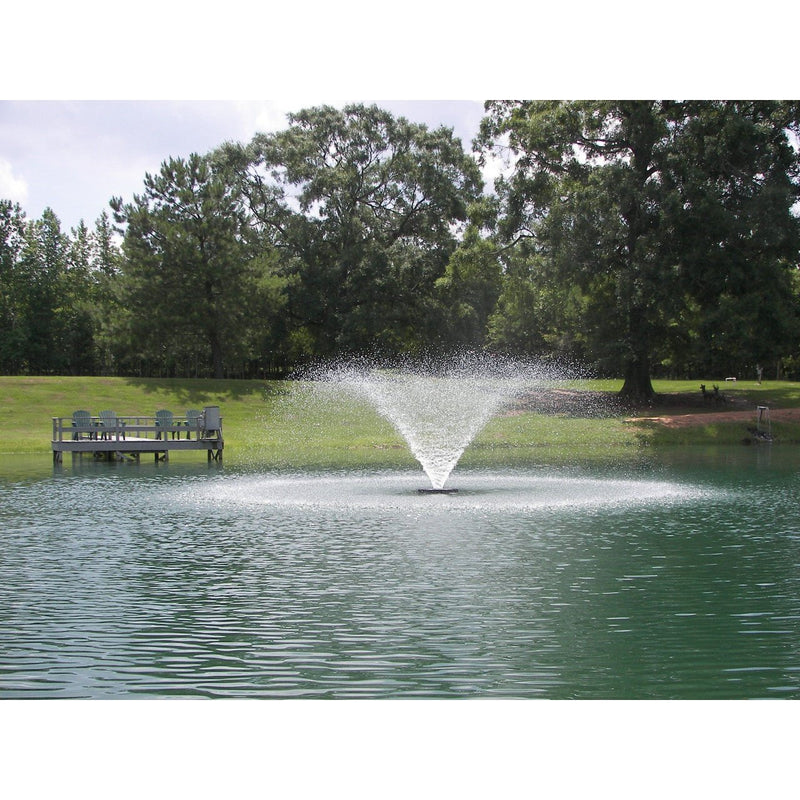
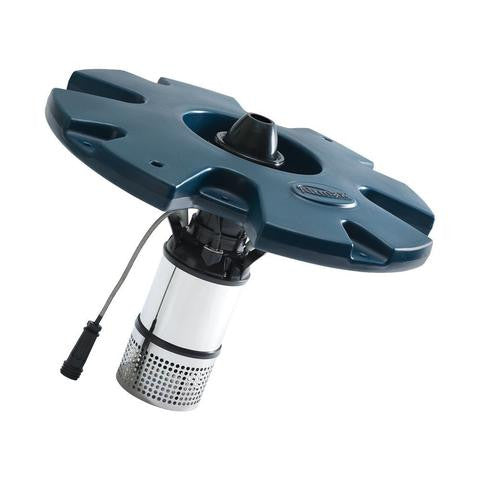
Bottom-diffused aeration can circulate deeper water toward the surface, while surface aerators and fountains increase surface mixing and interaction between water and the atmosphere.
Good circulation can help create a more stable pond environment.
But if excessive nutrients are producing a dense algae bloom, aeration doesn't remove those incoming nutrients.
The best results usually come from looking at the pond as a complete system rather than expecting one piece of equipment to correct every water-quality problem.
What About a Pond With Naturally High pH?
Some ponds simply have naturally alkaline water.
If the pH is relatively stable, alkalinity is adequate, fish are healthy, ammonia isn't a concern, and there are no other obvious water-quality problems, intervention may not be necessary.
This is particularly important because pond owners sometimes become fixated on achieving a specific "ideal" number.
Healthy natural ponds don't all have identical water chemistry.
The goal isn't to make every pond test exactly the same.
The goal is to maintain conditions that are stable and suitable for the organisms living there.
A Better Way to Investigate High Pond pH
If you get a surprisingly high reading, don't panic and don't immediately add something to the water.
Start with a few basic steps.
1. Record the pH and the time of day.
An afternoon reading means something different from an early-morning reading.
2. Test again around sunrise.
Compare the two measurements.
3. Test total alkalinity.
This tells you how well buffered the pond is.
4. Look at the water.
Is there a heavy green phytoplankton bloom or extensive aquatic plant growth?
5. Check ammonia if there's reason for concern.
This becomes particularly important when pH and water temperature are high.
6. Watch the fish.
Normal fish behavior is useful information. So are fish congregating near aeration, gasping at the surface, refusing feed, or behaving unusually.
7. Look for the cause before treating the number.
If excessive photosynthesis is driving the pH upward, ask what's supporting that biological activity.
The Number Is Only Part of the Story
A pH test is useful.
But one isolated pH measurement is only a snapshot of a pond that is changing continuously.
If someone tells us:
"My pond pH is 9.2. What should I add?"
Our answer shouldn't automatically be a chemical.
Our first response should be:
"What time did you test it?"
Then:
"What is it early tomorrow morning?"
Those two readings may immediately tell us whether we're looking at naturally alkaline water or a large biological pH swing.
Add an alkalinity test, water temperature, ammonia when appropriate, and a good look at the pond itself, and suddenly that single pH number becomes much more meaningful.
That's the real lesson with high pond pH:
Don't just test the number. Understand why the number is there.