

How To Tell If Your Pond Has Low Oxygen Before Fish Start Dying
Is your pond holding its breath? Spot the silent signs of oxygen loss before it's too late. Oxygen levels can plummet long before you see a single dead fish. Learn the subtle visual cues of a pond in distress and how to restore the flow of life.
Aquatic ecosystems operate on a razor-thin margin of dissolved gas concentration. While atmospheric air contains approximately 21% oxygen (210,000 ppm), water at standard saturation levels rarely holds more than 8 to 12 ppm. This disparity makes the management of Dissolved Oxygen (DO) the single most critical parameter for pond stability.
Maintaining a dynamic state of vitality requires an understanding of the mechanical and biological loads placed on a water body. When these loads exceed the system's re-aeration capacity, the environment shifts toward a stagnant hazard, characterized by anaerobic decomposition and chemical toxicity. This article examines the technical indicators of oxygen depletion and the engineering solutions required to maintain a high-performance aquatic environment.
How To Tell If Your Pond Has Low Oxygen Before Fish Start Dying
Low oxygen levels are often invisible until they reach a critical threshold. However, early detection is possible by monitoring specific biological, chemical, and physical markers. The standard technical measurement for pond health is the Dissolved Oxygen (DO) concentration, typically expressed in milligrams per liter (mg/L).
In a healthy, productive pond, DO levels fluctuate daily due to the diurnal cycle of photosynthesis and respiration. Levels are highest in the late afternoon and lowest just before dawn. If your pre-dawn levels consistently drop below 5.0 mg/L for warmwater species or 6.5 mg/L for coldwater species, the system is entering a state of chronic stress.
Biological Indicator: Snail and Macroinvertebrate Migration
One of the earliest indicators of anoxia (zero oxygen) at the pond floor is the upward migration of benthic organisms. Snails that typically inhabit the substrate may be observed clustered at the waterline or climbing stems of emergent vegetation. This behavior is a survival mechanism to escape the "dead zone" created by thermal stratification.
Visual Cue: Algal Bloom Discoloration
A sudden shift in water color is a high-priority warning sign. Healthy phytoplankton blooms are generally bright or olive green. If the water turns gray, brown, or milky black, it indicates a massive algal die-off. As billions of microscopic organisms decompose, they create an immense Biochemical Oxygen Demand (BOD), which can strip the water of oxygen in a matter of hours.
Chemical Indicator: Hydrogen Sulfide Odors
The "rotten egg" smell near the pond edge indicates that anaerobic bacteria are breaking down organic muck in the absence of oxygen. This process releases hydrogen sulfide (H2S), a gas that is toxic to fish even at low concentrations. The presence of this odor confirms that the pond's "Dynamic Vitality" has been replaced by stagnant, anaerobic processes.
The Physics of Gas Transfer: How Oxygenation Works
Oxygen enters pond water through two primary mechanisms: atmospheric diffusion and photosynthesis. Diffusion occurs at the air-water interface and is governed by Henry’s Law, which states that the amount of dissolved gas in a liquid is proportional to its partial pressure in the gas phase above it.
The efficiency of this transfer is determined by the surface area of the water and the degree of turbulence. In a stagnant pond, only the top few inches of water are oxygenated by the atmosphere. Mechanical aeration systems are designed to overcome this limitation by increasing the contact area between air and water or by physically moving deoxygenated bottom water to the surface.
Thermal stratification acts as a physical barrier to oxygen distribution. During summer, warm surface water (the epilimnion) becomes less dense and floats on top of colder, denser bottom water (the hypolimnion). Without mechanical intervention, these layers do not mix, and the bottom layer quickly becomes anoxic as organic matter decomposes.
Calculating the Oxygen Demand and Turnover Rates
To design an effective aeration system, one must calculate the pond's specific requirements based on volume and biological load. The standard engineering target for a healthy pond is a minimum of two full volume turnovers per 24-hour period. In high-density aquaculture or heavily loaded ornamental ponds, this may increase to three or four turnovers per day.
The required airflow for a bottom-diffused system is typically measured in Cubic Feet per Minute (CFM). A baseline industry standard is 1.5 CFM per acre-foot of water. To calculate the acre-feet of your pond, multiply the surface acreage by the average depth. For example, a 1-acre pond with an average depth of 6 feet contains 6 acre-feet of water and requires approximately 9 CFM of air delivery at the diffuser.
| Parameter | Standard Target | Critical Threshold |
|---|---|---|
| Dissolved Oxygen (DO) | 5.0 - 9.0 mg/L | < 3.0 mg/L (Stress) |
| Turnover Rate | 2x per 24 hours | < 1x per 24 hours |
| Biochemical Oxygen Demand (BOD) | < 10 mg/L | > 30 mg/L (High Risk) |
| Temperature (Warmwater) | 70°F - 80°F | > 85°F (Reduced Solubility) |
The Technical Benefits of Optimized Aeration
Properly engineered aeration provides measurable improvements in water chemistry beyond simple oxygen concentration. High DO levels facilitate the nitrification process, where aerobic bacteria (Nitrosomonas and Nitrobacter) convert toxic ammonia into nitrite and then into relatively harmless nitrate. This process is oxygen-intensive; for every 1 mg of ammonia oxidized, approximately 4.5 mg of oxygen is consumed.
Furthermore, aeration prevents the buildup of muck by supporting aerobic decomposition. Aerobic bacteria are up to 20 times more efficient at breaking down organic waste than anaerobic bacteria. By maintaining oxygen at the substrate-water interface, you significantly reduce the accumulation of "black sludge" and the associated release of phosphorus, which fuels algae blooms.
In deep ponds, the primary benefit is the elimination of thermal stratification. By moving cold water from the bottom to the surface, the aeration system creates a uniform temperature and oxygen profile throughout the water column. This expands the habitable volume of the pond, allowing fish to utilize the cooler, deeper areas during extreme summer heat.
Common Challenges and Operational Pitfalls
One of the most frequent mistakes in pond management is under-sizing the aeration equipment. A system that provides enough oxygen for a 1/4-acre pond will fail if applied to a 1/2-acre pond, especially during a heatwave. When oxygen demand exceeds supply, the system can actually become more dangerous if it intermittently fails, causing a rapid "crash" in DO levels.
Another pitfall is the failure to account for seasonal oxygen solubility. Cold water can hold significantly more dissolved oxygen than warm water. At 32°F (0°C), fresh water saturates at 14.6 mg/L, but at 86°F (30°C), the saturation point drops to 7.5 mg/L. Pond owners often ignore their systems in the summer when the water's ability to hold oxygen is at its lowest, and the metabolic demand of fish is at its highest.
Over-feeding is a primary driver of high BOD. Any uneaten fish food settles to the bottom and becomes a fuel source for decomposition. This decomposition consumes oxygen that should be available for the fish. In a technical sense, every pound of wasted food represents a specific "oxygen debt" that the aeration system must pay back.
Limitations and Environmental Constraints
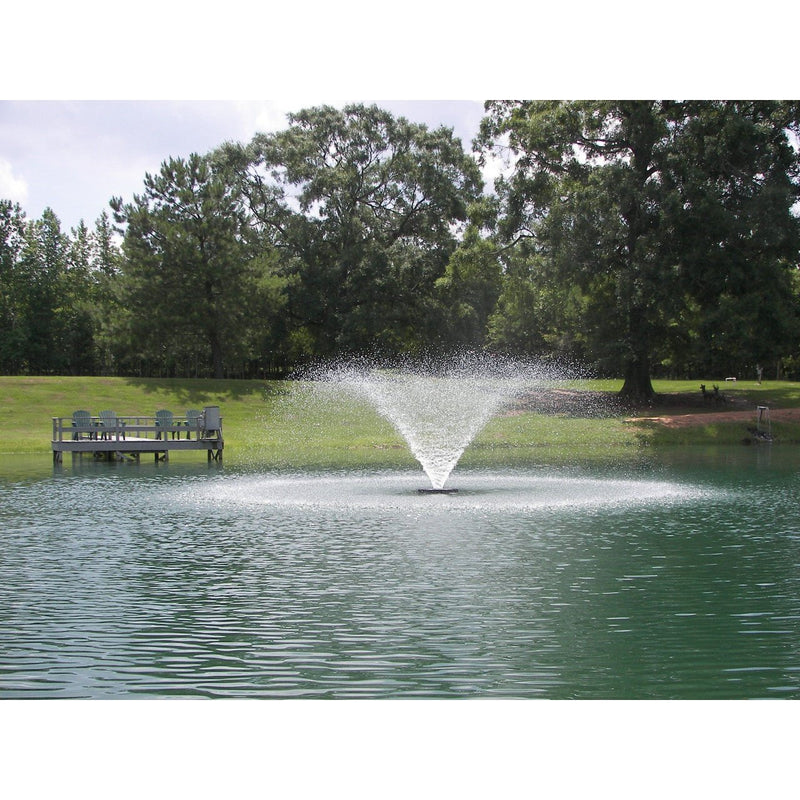
While aeration is highly effective, it has physical and environmental limits. In very shallow ponds (less than 4 feet deep), bottom-diffused aeration is inefficient because the air bubbles do not have enough "hang time" in the water column to transfer significant oxygen. In these scenarios, surface agitation or fountains are often more practical.
Additionally, aeration cannot compensate for extreme overstocking. Every fish added to a pond increases the baseline oxygen consumption. There is a "carrying capacity" for every water body, and once the biological load exceeds the mechanical capacity of the aerators and the natural capacity of the pond, the system becomes inherently unstable.
High altitude also limits oxygen availability. Because atmospheric pressure is lower at higher elevations, the partial pressure of oxygen is reduced, leading to lower saturation levels in the water. A pond at 5,000 feet elevation will naturally hold approximately 20% less oxygen than a pond at sea level at the same temperature.
Diffused Aeration vs. Surface Agitation
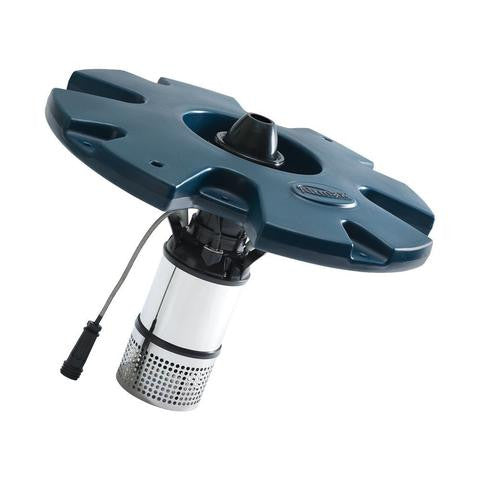
Choosing the right hardware depends on pond geometry and depth. Diffused aeration uses an on-shore compressor to pump air to diffusers on the pond floor. Surface aerators (or fountains) use a floating motor to splash water into the air.
Diffused aeration is the superior choice for ponds deeper than 8 feet. It is more energy-efficient because it uses the natural buoyancy of air bubbles to move massive volumes of water. This process, known as "airlift," can move thousands of gallons of water for every CFM of air injected. Surface aerators, conversely, are excellent for shallow ponds where they provide rapid gas exchange and an aesthetic spray pattern but fail to de-stratify deeper water.
From a maintenance perspective, diffused systems are often preferred because the electrical components (the compressor) are located on shore, protected from the water. Surface aerators require submersible power cables and motors, which are subject to seals failing and corrosion over time.
Practical Best Practices for Monitoring and Maintenance
Successful pond management requires a rigorous monitoring schedule. At a minimum, DO and temperature should be checked weekly during the summer months. Use a digital DO probe for the most accurate results, and always take measurements at the same time of day—ideally just before sunrise to capture the "worst-case" scenario.
- Sizing Baseline: Ensure your compressor provides at least 1.5 CFM per acre-foot.
- Diffuser Placement: Place diffusers at the deepest point of the pond to maximize the volume of the vertical circulation cell.
- Compressor Maintenance: Clean or replace air filters every 3 to 6 months. Clogged filters reduce CFM output and cause the motor to overheat.
- Visual Checks: Monitor the bubble pattern on the surface. A "boil" that has moved or diminished indicates a leak in the weighted tubing or a clogged diffuser membrane.
Advanced Considerations: Oxidation-Reduction Potential (ORP)
For high-end systems or industrial-scale ponds, monitoring Oxidation-Reduction Potential (ORP) provides a deeper insight into the pond's "cleaning" capacity. ORP is measured in millivolts (mV) and indicates the water's ability to chemically oxidize contaminants. A healthy, well-aerated pond typically maintains an ORP between 250 mV and 400 mV.
If the ORP drops below 150 mV, it indicates that the system is overwhelmed by organic matter and is likely in an anaerobic state, even if the DO levels appear acceptable. Advanced practitioners use ORP sensors to automate their aeration systems, triggering high-output blowers only when the oxidative capacity of the water starts to decline, thereby optimizing energy consumption.
Example Scenario: Managing a 1-Acre Pond in a Heatwave
Consider a 1-acre pond with a maximum depth of 10 feet and an average depth of 6 feet. The total volume is 6 acre-feet (approximately 1.95 million gallons). In the spring, at 60°F, the water can hold 9.8 mg/L of oxygen. As a July heatwave hits and water temperatures rise to 85°F, the saturation point drops to 7.6 mg/L.
Simultaneously, the metabolic rate of the fish doubles with every 18°F increase in temperature. The "oxygen gap"—the difference between the fish's needs and the water's supply—widens dangerously. If this pond lacks mechanical aeration, it will stratify, leaving the bottom 4 feet anoxic. By deploying a 9 CFM diffused aeration system, the owner ensures the full 6 acre-feet are circulated twice daily, maintaining DO levels above the 5.0 mg/L stress threshold despite the high temperatures.
Final Thoughts
Pond management is essentially a battle against the physics of stagnation. Oxygen is the primary currency of this ecosystem, and its depletion is the catalyst for almost every major pond failure, from fish kills to toxic algae blooms. By understanding the metrics of DO, BOD, and turnover rates, you can move from a reactive stance to a proactive engineering approach.
Success lies in the details: the CFM of your compressor, the depth of your diffusers, and the timing of your water tests. A pond that is properly aerated does not just survive; it processes waste efficiently, supports higher stocking densities, and remains chemically stable year-round. Prioritize the flow of oxygen, and you prioritize the health of the entire system.