

How Long Should You Run a Pond Aerator Each Day?
Running 24/7 isn't always the smartest move. It's about timing the 'Oxygen Gap'. Do you really need to run your aerator all day and night? In the spring, maybe not. In the dead of summer? Absolutely. We break down the 'Aeration Schedule' by season so you can save money while keeping your ecosystem thriving.
Efficient pond management requires a departure from "set and forget" mentalities. Data suggests that dissolved oxygen (DO) levels are not static but follow a rigorous diurnal cycle influenced by solar radiation, temperature, and biological respiration. Strategic aeration aligns mechanical intervention with these natural fluctuations to optimize energy consumption and mechanical longevity.
Pond owners frequently weigh the benefits of Expensive Constant-Run systems against the efficiencies of Strategic Free-O2 Flow. The former provides a safety margin but increases utility costs and mechanical wear. The latter leverages natural photosynthesis to maintain DO levels during daylight hours, focusing electrical expenditure on the critical pre-dawn window when biological demand peaks.
How Long Should You Run a Pond Aerator Each Day?
Aeration run time is fundamentally determined by the relationship between oxygen production and oxygen consumption within a closed aquatic system. Standard industry recommendations range from 6 to 24 hours per day, depending on biomass density and water temperature. Most aquaculture operations utilize a targeted approach, often running systems for 10 to 12 hours during the nocturnal phase when photosynthesis is absent.
Dissolved oxygen enters the water through two primary pathways: atmospheric diffusion at the surface and photosynthesis by aquatic plants and phytoplankton. During daylight, plants convert carbon dioxide and sunlight into oxygen, often leading to "supersaturation" where DO levels exceed 100% of the theoretical capacity based on temperature. Aerators running during this period may actually "strip" oxygen from the water, as the mechanical agitation encourages the gas to return to the atmosphere.
Biological Oxygen Demand (BOD) increases significantly as water temperatures rise. Cold water at 0°C (32°F) can hold approximately 14.6 mg/L of dissolved oxygen, whereas water at 30°C (86°F) can only hold 7.5 mg/L at 100% saturation. Because metabolism in ectothermic organisms like fish doubles for every 10°C increase in temperature, the system faces a "double squeeze": decreasing supply meets increasing demand. This necessitates longer run times during summer months to prevent hypoxia.
The Diurnal Oxygen Cycle
Data from the Southern Regional Aquaculture Center indicates that the lowest DO levels typically occur between 02:00 and 07:00. This "oxygen gap" happens because plants stop producing oxygen at sunset but continue to consume it through respiration. Mechanical aeration is most critical during this window to bridge the deficit until photosynthesis resumes after sunrise.
The Mechanics of Seasonal Aeration
Operational requirements shift as the thermal profile of the pond changes. A rigid schedule fails to account for the physical properties of water, specifically its density and gas-holding capacity at different temperatures. Strategic adjustments ensure the system addresses the specific threats of each season, from summer stratification to winter de-icing.
Spring: Managing Turnover Risks
Spring aeration focuses on breaking thermal stratification before the temperature gradient becomes too steep. As surface water warms, it becomes less dense than the cooler water below, creating a "thermocline" that prevents vertical mixing. Bottom-diffused aeration systems should be started gradually in the spring—running for 1 hour the first day, 2 hours the second, and doubling thereafter—to avoid a "turnover kill" where anoxic bottom water is suddenly mixed throughout the pond.
Summer: Maximum Biological Demand
Summer operations demand the highest run times, often 24/7 for heavily stocked ponds. High temperatures accelerate the decomposition of organic matter, a process that consumes vast quantities of oxygen. If the system is not run continuously, a minimum of 12 hours starting at dusk is required to offset the respiration of algae and fish. Systems should be sized to provide a full water turnover at least once every 24 to 48 hours during this period.
Fall: Organic Load Management
Fall aeration supports the activity of aerobic bacteria as they process the seasonal influx of organic debris, such as falling leaves and dying aquatic plants. Maintaining high DO levels ensures that decomposition remains aerobic. Aerobic breakdown is up to 10 times faster than anaerobic decomposition and prevents the buildup of hydrogen sulfide and methane gases.
Winter: Gas Exchange and De-icing
Winter run times are often reduced, focusing on maintaining an opening in the ice rather than full-pond circulation. In regions where ponds freeze, an aerator prevents "winter kill" by allowing toxic gases to escape and oxygen to enter. Diffusers should be moved to shallower water (half the maximum depth) to prevent "super-cooling" of the deeper, warmer water where fish overwinter.
Benefits of Strategic Scheduling
Adopting a data-driven aeration schedule provides measurable advantages in both system performance and financial overhead. While 24/7 operation is the safest default, targeted run times offer specific optimizations for the serious practitioner.
- Energy Cost Mitigation: Reducing run time from 24 hours to 12 hours during the shoulder seasons (Spring/Fall) can reduce electrical costs by 50%. For a 1/2 HP rocking piston compressor drawing 400 watts, this translates to significant annual savings depending on local kWh rates.
- Extended Component Life: Mechanical wear on diaphragms, pistons, and bearings is a direct function of operational hours. Strategic rest periods can extend the service interval for maintenance kits.
- Temperature Stability: In the peak of summer, running a bottom-diffused aerator during the hottest part of the day can actually warm the entire water column by mixing hot surface water with the cooler depths. Nighttime-only aeration preserves a cooler "refuge" for temperature-sensitive species like trout or large koi.
- Nutrient Cycling: Consistent oxygenation at the sediment-water interface prevents the release of phosphorus from the muck. This limits the nutrient availability for algae blooms, effectively using oxygen as a biological control mechanism.
Challenges and Common Mistakes
Errors in aeration timing or system sizing often lead to catastrophic failures. Understanding the physical limitations of the equipment and the biological limits of the pond is essential for avoiding common pitfalls.
Undersizing the Compressor: A common error is using a low-CFM (cubic feet per minute) pump for a deep or large pond. If the system cannot move enough water to achieve a full turnover within the targeted run time, the "oxygen gap" will not be closed. The water near the diffuser will be oxygenated, but "dead zones" will persist in the rest of the pond.
Sudden Startup in Stratified Ponds: Starting an aeration system for the first time in mid-summer after it has been off for weeks is highly dangerous. The bottom water (hypolimnion) is likely anoxic and contains high levels of ammonia and hydrogen sulfide. Rapidly mixing this water can cause an immediate DO crash and total fish mortality.
Ignoring Diffuser Depth: Air compressors face increased "back pressure" as depth increases. A pump rated for 2.0 CFM at the surface may only deliver 1.2 CFM at 10 feet of depth. Failing to account for this leads to insufficient aeration even if the run time is set to 24 hours.
Limitations of Timed Aeration
Timed or strategic aeration is not suitable for every environment. Certain variables mandate a continuous 24/7 operation to ensure system stability. Professional-grade aquaculture and high-density ornamental ponds fall into this category.
High stocking densities create a baseline oxygen demand that exceeds natural diffusion rates even during the day. In these scenarios, the risk of a timer failure or a sudden cloudy day (reducing photosynthesis) makes 24/7 aeration a mandatory insurance policy. If the pond has a "heavy muck" layer of more than 6 inches, the constant sediment oxygen demand (SOD) usually necessitates continuous circulation to prevent the water from becoming anoxic at the bottom.
Environmental factors like heavy canopy cover also limit the effectiveness of strategic timing. Ponds that receive less than 6 hours of direct sunlight have limited photosynthetic potential. These systems cannot rely on "Free-O2 Flow" during the day and must be treated as mechanically dependent ecosystems requiring near-constant intervention.
Comparison: Constant-Run vs. Strategic Timing
The following table compares the two primary operational philosophies based on technical and economic metrics.
| Feature | Constant-Run (24/7) | Strategic Timing (Nocturnal) |
|---|---|---|
| Safety Margin | High - Buffer against weather changes | Moderate - Requires monitoring |
| Electricity Cost | Baseline (100%) | Optimized (40-60% Savings) |
| Motor Life | Stable - Fewer start/stop cycles | Variable - Increased cycling wear |
| Thermal Impact | Higher water temps in summer | Maintains cooler bottom layers |
| Maintenance | Standard annual kit | Bi-annual checks on timers |
Practical Tips for Optimizing Run Time
Implementing an efficient aeration schedule requires precise control and monitoring. These best practices allow for fine-tuning based on real-time pond conditions rather than generic estimates.
- Use a Heavy-Duty Outdoor Timer: Mechanical timers are often more reliable than digital ones in high-humidity environments. Ensure the timer is rated for the amperage of your compressor, particularly for rocking piston motors which have high "startup" current draws.
- Invest in a DO Meter: A handheld dissolved oxygen meter is the only way to accurately determine your pond's specific "Oxygen Gap." Measure at 05:00 and 16:00 to see the full range of fluctuation. If 05:00 readings are consistently above 5 mg/L, you may be able to reduce run times.
- Monitor Water Clarity: A sudden "pea soup" algae bloom indicates high photosynthetic production by day but massive respiration by night. If visibility drops below 12 inches (Secchi disk depth), increase nocturnal aeration immediately.
- Adjust for Cloud Cover: Photosynthesis is severely limited on overcast days. If a multi-day storm is forecast, bypass the timer and run the aerator 24/7 until the sun returns to ensure the oxygen levels do not crash.
Advanced Considerations: The Physics of Gas Transfer
Serious practitioners should understand the coefficients of oxygen transfer. Fick’s Law of Diffusion states that the rate of gas transfer is proportional to the concentration gradient. This means that aeration is actually more efficient when DO levels are low. As the water approaches saturation, the "transfer efficiency" of the bubbles drops significantly.
Standard Oxygen Transfer Rate (SOTR) is calculated in clean water at standard conditions. In a pond, we use the Actual Oxygen Transfer Rate (AOTR), which accounts for temperature, altitude, and "alpha" factors (impurities in the water). A pond at 2,000 feet of elevation has lower atmospheric pressure, meaning the aerator must work longer to achieve the same ppm of oxygen compared to a sea-level pond.
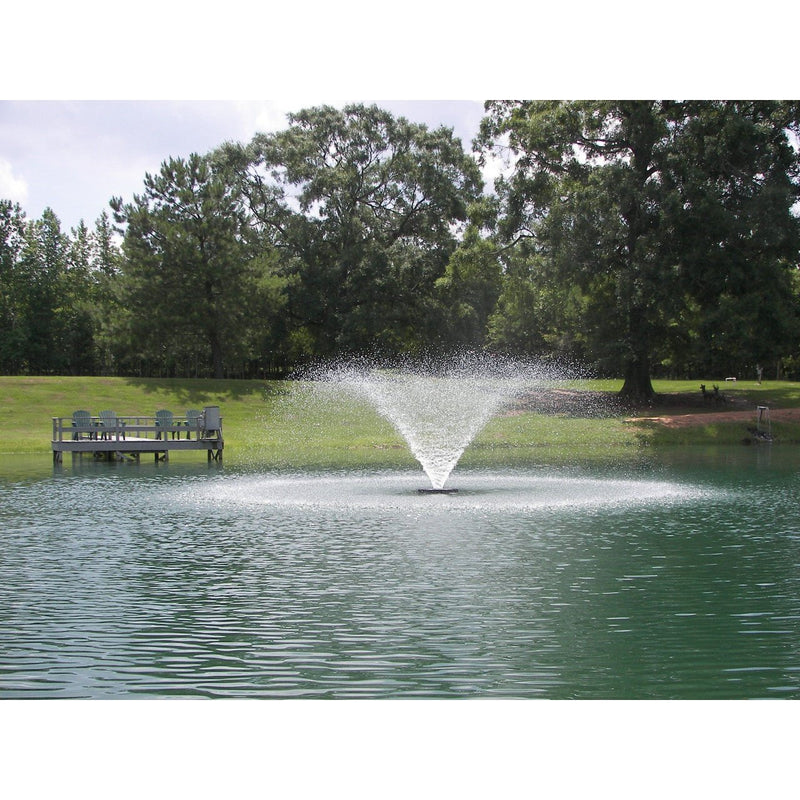
Nitrogen supersaturation is another advanced concern. While rare in standard diffused aeration, high-pressure surface fountains can sometimes trap nitrogen gas in the water column. If levels exceed 110%, fish can develop "gas bubble disease." Bottom diffusers with fine-bubble membranes are the preferred mechanical choice for minimizing this risk while maximizing oxygen transfer efficiency (OTE).
Scenario: 1-Acre Ecosystem Optimization
Consider a 1-acre pond with an average depth of 8 feet and a moderate population of largemouth bass. The volume is approximately 3.2 million gallons. To achieve a turnover rate of 1.0 (circulating the entire volume once per 24 hours), the system must move 2,222 gallons per minute.
Using a 1/2 HP rocking piston compressor with two diffusers, each moving approximately 1,500 GPM via the airlift effect, the total circulation is 3,000 GPM. In this scenario, running the system for 18 hours per day provides a turnover rate of 1.35. This creates a sufficient safety margin. During the peak of July, the owner might run 24/7, but during May and September, they could reduce the schedule to 12 hours (21:00 to 09:00), maintaining a turnover rate of 0.9 and reducing energy consumption by 50% for those months.
Final Thoughts
Managing pond aeration is an exercise in balancing biological demand with mechanical efficiency. While the default setting of 24/7 provides the highest level of safety, it often overlooks the nuances of the diurnal oxygen cycle and the thermal properties of water. By understanding the 'Oxygen Gap', pond managers can implement schedules that protect aquatic life while optimizing electrical and mechanical resources.
Seasonal adjustments are the hallmark of a sophisticated pond management strategy. Moving from a static operation to a dynamic, temperature-responsive schedule allows the ecosystem to benefit from natural processes during the day and mechanical support during the night. This approach not only saves money but also creates a more stable environment by preventing unnecessary temperature fluctuations and maximizing gas transfer efficiency.
Success in aeration timing is ultimately verified through data. Periodic testing with a DO meter and regular observation of fish behavior remains the best way to validate any schedule. For those looking to deepen their understanding, investigating the specific oxygen requirements of their fish species and the nutrient loading of their watershed will provide the final pieces of the optimization puzzle.