

Can You Over Aerate a Pond? Risks, Myths, and Best Practices
You can't 'over-breathe,' but you can over-stir. Most people worry about over-aerating. The reality? It is almost impossible to have too much oxygen, but the way you move the water matters for the biology. Dissolved oxygen (DO) is the primary driver of all aerobic life within an aquatic system, from the largest teleost fish to the microscopic nitrifying bacteria colonizing the substrate. While a higher DO concentration generally correlates with a more robust biological engine, the mechanical delivery of that oxygen introduces variables that can, if mismanaged, destabilize the environment.
Understanding the distinction between oxygen saturation and mechanical turbulence is the first step toward optimizing a pond’s performance. Aeration is not merely about blowing bubbles into the water; it is a sophisticated exercise in gas exchange, thermal regulation, and fluid dynamics. When these forces are balanced, the pond functions as an Oxygen-Rich Engine, efficiently processing organic loads. When they are unbalanced, the system risks mechanical or biological failure.
Can You Over Aerate a Pond? Risks, Myths, and Best Practices
Technically, a pond cannot be over-aerated in terms of dissolved oxygen concentration under standard atmospheric conditions. Water follows the principles of Henry’s Law, which dictates that the amount of dissolved gas in a liquid is proportional to its partial pressure above the liquid. Once water reaches 100% saturation at a given temperature and pressure, any additional oxygen introduced simply vents back into the atmosphere. The "risk" of over-aeration is almost never the oxygen itself, but rather the physical and chemical side effects of excessive water movement.
Real-world "over-aeration" typically manifests as high-velocity turbulence or rapid thermal destratification. In managed environments like aquaculture or high-density koi ponds, over-powered systems can create "washing machine" effects where the current exceeds the fish’s ability to maintain position without excessive energy expenditure. Furthermore, in deep ponds that have been stagnant, the sudden introduction of high-volume aeration can cause a catastrophic turnover, bringing up anaerobic, hydrogen-sulfide-rich water from the hypolimnion (the bottom layer) before the system has time to neutralize it.
Common myths suggest that "too much air" will burn the gills of fish or lead to a collapse of the ecosystem. These are largely misinterpretations of Gas Bubble Disease or sudden pH shifts. Under normal diffused aeration setups, oxygen levels will stabilize at saturation, and the primary concerns remain mechanical efficiency and sediment stability.
How Mechanical Aeration Drives Gas Exchange
Aeration systems operate on the principle of increasing the surface area of the water-to-air interface. This occurs through two primary mechanisms: the surface of the rising bubbles themselves and the ripple effect created at the pond's surface.
The efficiency of this process is measured by the Standard Oxygen Transfer Efficiency (SOTE). In a diffused air system, a compressor pushes air through a membrane or stone at the bottom of the pond. As millions of tiny bubbles rise, they create a "lifting" effect called an airlift. This upward column of water draws oxygen-depleted water from the bottom and carries it to the surface where it can shed carbon dioxide (CO2) and absorb oxygen (O2).
Fine-bubble diffusers are significantly more efficient than coarse-bubble versions. Fine bubbles have a higher surface-area-to-volume ratio and a slower rise velocity, which increases the "residence time"—the duration the bubble is in contact with the water. Data shows that fine-bubble diffusers can achieve an SOTE of approximately 6.9% per meter of depth, whereas coarse-bubble systems often peak at around 3.0%.
Benefits of High-Efficiency Aeration
The primary advantage of a high-output, well-regulated aeration system is the stabilization of the pond’s Redox potential. An oxygen-rich environment ensures that aerobic bacteria can perform nitrification, converting toxic ammonia (NH3) into nitrite (NO2) and then into nitrate (NO3). Without sufficient oxygen, these processes stall, and the system may pivot toward anaerobic decomposition, which is slower and produces harmful byproducts like methane and hydrogen sulfide.
A well-aerated system also reduces the Biological Oxygen Demand (BOD). By maintaining high DO levels, the pond can more effectively "burn off" organic muck (sludge) at the bottom. This process, known as aerobic digestion, prevents the accumulation of nutrient-rich sediment that otherwise fuels algae blooms. In many cases, increasing aeration capacity is a more sustainable solution than chemical treatments for clarity, as it addresses the underlying organic load rather than just the symptoms.
Challenges and Mechanical Pitfalls
The most significant challenge in high-volume aeration is sediment resuspension. If a diffuser is too powerful or placed too close to a soft, silty bottom, the resulting turbulence can stir up "muck." This resuspends phosphorus and nitrogen into the water column, which can trigger the very algae blooms the owner was trying to avoid. This is often referred to as "over-stirring."
Another mechanical risk is Gas Bubble Disease (GBD). This occurs when water becomes "supersaturated" with gases, typically nitrogen. GBD is rarely caused by standard diffusers but is frequently a result of pump cavitation—where a leak on the intake side of a centrifugal pump sucks in air and crushes it into the water under high pressure. When this water enters the pond, the gas comes out of solution inside the fish’s tissues, causing embolisms similar to "the bends" in human divers.
Limitations and Environmental Constraints
Environmental factors strictly limit the effectiveness of aeration. Temperature is the most significant variable; cold water can hold significantly more dissolved oxygen than warm water. For example, at sea level, freshwater at 40°F (4.4°C) can hold roughly 12.6 mg/L of oxygen at saturation, while at 80°F (26.7°C), it holds only about 8.0 mg/L.
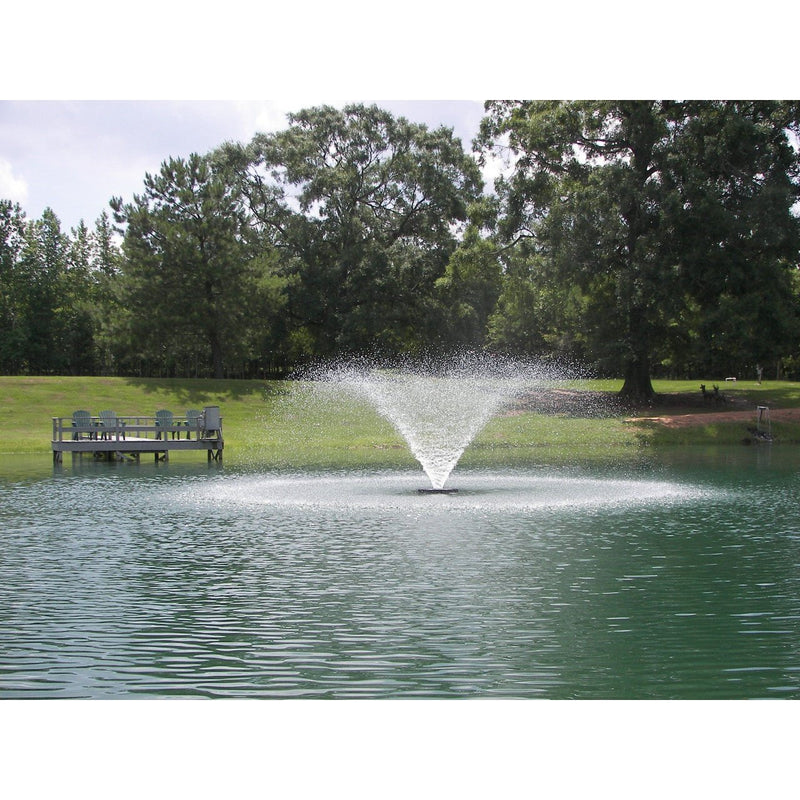
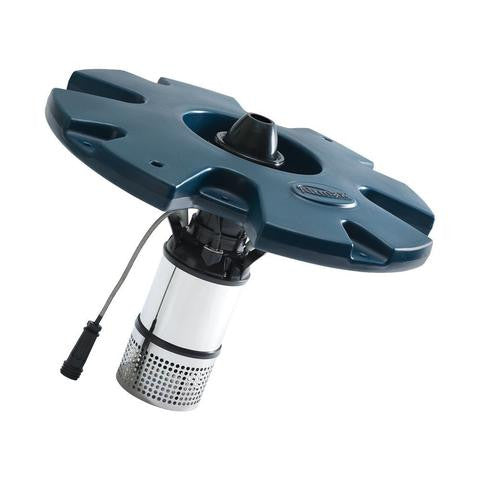
In extremely shallow ponds (less than 4 feet), bottom-diffused aeration loses its efficiency because the bubbles do not have enough residence time to transfer significant oxygen before hitting the surface. In these scenarios, surface aerators or fountains are often more effective as they physically break the water into droplets, exposing a massive amount of surface area to the atmosphere in a short period. Conversely, in very deep ponds (over 15 feet), the pressure required to push air to the bottom (PSI) increases, requiring more robust, industrial-grade compressors.
Comparing Aeration Methods: Technical Efficiency
The choice between surface and diffused aeration depends on depth and the specific goals of the system. The following table illustrates the performance metrics of common aeration technologies.
| Technology Type | Optimal Depth | SOTE (Efficiency) | Primary Application |
|---|---|---|---|
| Fine-Bubble Diffused | 8–20 feet | 25% – 35% | Deep ponds, muck reduction |
| Coarse-Bubble Diffused | 5–15 feet | 15% – 25% | High-solids water, mixing |
| Surface Aerator | 2–8 feet | 8% – 15% | Shallow ponds, emergency DO |
| Fountain (Decorative) | 3–6 feet | 1% – 5% | Aesthetics only |
Practical Tips for System Optimization
To avoid the "over-stirring" phenomenon while maximizing oxygenation, implement a gradual startup procedure. This is especially critical for established ponds that have not previously been aerated. A sudden full-power startup can cause an "anoxic flip," where the sudden rise of low-oxygen water kills the fish.
Follow this 7-day startup schedule for new or seasonal systems:
- Day 1: Run the system for 30 minutes, then turn it off.
- Day 2: Run for 1 hour.
- Day 3: Run for 2 hours.
- Day 4: Run for 4 hours.
- Day 5: Run for 8 hours.
- Day 6: Run for 16 hours.
- Day 7: Begin 24/7 continuous operation.
Additionally, consider the "turnover rate." A healthy pond should have its total volume moved at least once every 24 hours. For high-density fish populations, this rate may need to be 2 to 3 times per day. Calculating the CFM (Cubic Feet per Minute) of your compressor against the pond's volume is essential for technical accuracy.
Advanced Considerations: The Physics of Solubility
Serious practitioners must account for altitude and salinity when tuning an aeration system. At higher elevations, the atmospheric pressure is lower, which reduces the partial pressure of oxygen. Consequently, a pond in the Rocky Mountains will have a lower oxygen saturation point than a pond at sea level, even at the same temperature.
Mechanical optimization also requires matching the compressor's output to the diffuser's "sweet spot." Every diffuser has a rated CFM range. Pushing too much air through a small diffuser creates larger bubbles, reducing efficiency and increasing backpressure on the compressor, which leads to premature motor failure. Conversely, running too little air through a large diffuser may result in "dead spots" on the membrane where sediment can settle and harden, eventually clogging the unit.
Example Scenario: A 1-Acre Pond Calculation
Consider a 1-acre pond with an average depth of 6 feet. This pond contains approximately 1.95 million gallons of water. To achieve one full turnover per day, the aeration system must move roughly 1,350 gallons per minute (GPM).
A standard 1/4 HP rocking piston compressor connected to two dual-disc diffusers at a 6-foot depth can typically move 1,500 to 2,000 GPM through the airlift effect. This setup provides an efficient turnover rate while maintaining a "gentle" current that does not stress the fish or resuspend heavy sediment. If the owner were to install a 1 HP industrial blower in the same space, the GPM would triple, likely causing significant turbidity and high metabolic stress for the fish—this is where "over-aeration" becomes a reality.
Final Thoughts
Optimizing a pond's oxygen levels is a foundational requirement for any healthy aquatic ecosystem. While it is virtually impossible to over-saturate the water with oxygen through standard diffused aeration, the mechanical forces involved can create unintended consequences if misapplied. The focus should always be on maximizing the Oxygen-Rich Engine while minimizing the disruption to the pond's physical structure and thermal layers.
Efficiency is found in the details of bubble size, turnover rates, and gradual adjustments. By prioritizing fine-bubble diffusion and a measured startup approach, practitioners can ensure that their system supports the biological processes of nitrification and aerobic digestion without the risks of sediment resuspension or gas-related illnesses.
Experimenting with diffuser placement and monitoring the pond’s response to different flow rates will provide the best long-term results. For those looking to deepen their technical knowledge, investigating the relationship between BOD and SOTE in specific climates can offer even greater control over water quality and fish health.