

Aerating Vs Decorative Fountains: Which Is Best For Your Pond?
Is your fountain just for show, or is it actually keeping your pond alive? Most pond owners choose a fountain based on looks, but that’s a mistake. A decorative fountain is a pretty face, but an aerating fountain is a life-support system. One allows algae to thrive in stagnant water; the other oxygenates every drop to keep your ecosystem clear and healthy. Discover which one your pond actually needs.
Aerating Vs Decorative Fountains: Which Is Best For Your Pond?
Pond management requires a technical understanding of fluid dynamics and gas exchange. While the terms "fountain" and "aerator" are often used interchangeably in casual conversation, they represent fundamentally different mechanical approaches to water quality management. A decorative fountain prioritizes aesthetic display through high-pressure, low-volume water movement, whereas an aerating fountain prioritizes ecological health through high-volume, low-pressure circulation.
Choosing between these two systems depends on the Biological Oxygen Demand (BOD) of the water body and the specific goals of the property owner. In a managed pond environment, dissolved oxygen (DO) is the primary metric for success. Scientific data suggests that fish populations require DO levels above 5 parts per million (ppm) to remain healthy. When levels drop below 3 ppm, aquatic life experiences significant stress, and levels below 2 ppm typically result in immediate fish kills.
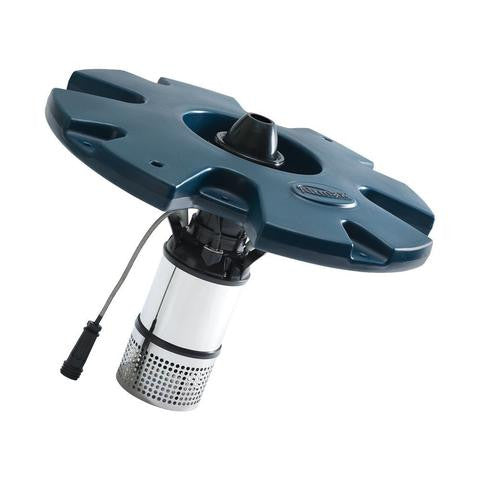
Decorative fountains utilize centrifugal impellers to force water through restrictive nozzles, creating intricate spray patterns like tiers or trumpets. This restriction significantly reduces the total Gallons Per Minute (GPM) the pump can move. Conversely, aerating fountains employ high-pitched propellers to move a massive volume of water into a simple "V" shaped pattern. This design maximizes the surface area of water exposed to the atmosphere, facilitating superior gas exchange and nutrient processing.
Mechanical Principles: Impellers vs. Propellers
The core difference between these two systems lies in the internal drive mechanism and the resulting hydraulic output. Understanding the mechanics of these components is essential for optimizing pond efficiency.
Impeller-Driven Decorative Systems
Decorative fountains are engineered to produce head pressure. The pump uses an impeller—a rotating component with vanes—to accelerate water toward the center of rotation and then outward into a housing. This design allows the water to be pushed through narrow nozzle orifices to achieve heights of 20 to 30 feet or more. However, this pressure comes at a cost of volume. A 1-horsepower (HP) decorative unit may only move approximately 100 GPM because the nozzle acts as a flow restrictor.
Propeller-Driven Aerating Systems
Aerating fountains are designed for flow rather than pressure. They utilize a propeller, similar to a boat motor, which is designed to move as much water as possible with minimal resistance. Because there is no restrictive nozzle, a 1-HP aerating fountain can move upwards of 500 to 800 GPM. This high-volume movement is what drives the Standard Oxygen Transfer Rate (SOTR) higher. The goal is not height, but the total mass of water tossed into the air and the subsequent "boil" created on the surface when it falls back.
The Role of GPM in Aeration
Gallons Per Minute is the most critical metric for pond health. Aeration occurs primarily through two mechanisms: the physical impact of water droplets hitting the surface (breaking surface tension) and the atmospheric exposure of the water while in the air. A system moving 500 GPM will theoretically cycle the entire volume of a 30,000-gallon pond in one hour. A decorative unit moving 100 GPM would take five hours to achieve the same circulation, allowing more time for stagnation and thermal stratification to occur.
Biological Benefits and Ecosystem Impact
Oxygenation is a mechanical process with chemical consequences. Proper aeration affects the nitrogen cycle, muck decomposition, and algae suppression.
Aerating fountains prevent thermal stratification. In many ponds, water separates into layers: a warm, oxygen-rich top layer (epilimnion) and a cold, oxygen-depleted bottom layer (hypolimnion). Without circulation, the bottom of the pond becomes anoxic. Anoxic conditions trigger the release of phosphorus and nitrogen from the bottom sediment, which fuels massive algae blooms. High-volume aerators break the thermocline, mixing the layers and ensuring that aerobic bacteria can survive at the bottom to consume organic muck.
Dissolved oxygen also aids in the reduction of harmful gases. Stagnant ponds often trap hydrogen sulfide and methane in the lower depths. When an aerating fountain pulls water from the middle of the water column and sprays it into the air, these gases are vented into the atmosphere. This process eliminates the "rotten egg" smell common in neglected ponds and improves the overall oxidation-reduction potential (ORP) of the water.
Operational Efficiency: SOTR and SAE Metrics
Professional pond managers evaluate equipment based on Standard Oxygen Transfer Rate (SOTR) and Standard Aeration Efficiency (SAE). These metrics provide a data-driven way to compare the performance of various units.
SOTR measures the amount of oxygen a unit can add to a body of water per hour under standard conditions (20°C, 1 atm pressure, and 0 ppm initial DO). High-end aerating fountains from manufacturers like Kasco Marine or Otterbine often boast SOTR values significantly higher than decorative counterparts. For example, a dedicated surface aerator (the most aggressive form of aerating fountain) can deliver up to 3.0 lbs of oxygen per horsepower per hour.
SAE is a measure of how much oxygen is transferred per kilowatt-hour of electricity consumed. Decorative fountains are notoriously inefficient in this regard because much of the energy is wasted overcoming nozzle friction. If your primary goal is to lower your electricity bill while maintaining high DO levels, an aerating fountain is the mathematically superior choice. Running a decorative fountain 24/7 for aeration purposes is an expensive and inefficient use of power.
Common Maintenance Challenges and Pitfalls
No mechanical system is immune to failure, but the types of failures differ between decorative and aerating models. Understanding these risks allows for better preventative maintenance schedules.
Clogging is the primary issue for decorative fountains. Because they use fine-mesh intake screens and narrow nozzles to create beautiful patterns, they are highly susceptible to "blinding" by floating algae, duckweed, or organic debris. A clogged intake starves the pump of water, which can lead to cavitation and motor burnout. Owners of decorative units must be prepared for frequent manual cleaning of the intake screen, especially during peak summer growth periods.
Aerating fountains are designed with larger openings and more robust propellers, making them significantly more resistant to debris. However, they are not invincible. Large branches or thick mats of filamentous algae can still wrap around the propeller shaft, causing a mechanical bind. Most modern units include a GFCI (Ground Fault Circuit Interrupter) in the control panel to shut down the motor before permanent damage occurs, but repeated trips indicate a need for physical inspection.
Limitations of Surface-Based Systems
While fountains are effective tools, they have physical limits based on pond depth. A common mistake is assuming a fountain can aerate any pond regardless of its profile.
Fountains typically only circulate the top 6 to 8 feet of water. In ponds deeper than 10 or 15 feet, a surface fountain will not reach the bottom. The water at the bottom remains stagnant and anaerobic, leading to muck accumulation. For deep-water applications, pond owners should consider diffused aeration—a system that uses a land-based compressor to pump air to diffusers on the pond floor. If aesthetics are still required, the best practice is to pair a decorative fountain with a sub-surface diffuser system to ensure the entire water column is managed.
Environmental factors also play a role. In very large lakes, a single 1-HP fountain will have a negligible effect on total DO levels. The sizing requirement for proper aeration is generally 1.5 to 2.0 horsepower per surface acre. Attempting to aerate a 5-acre lake with a 1/2-HP decorative fountain is a waste of capital and energy; the biological impact will be statistically zero.
Technical Comparison: Aerating vs. Decorative
The following table summarizes the key performance indicators for each system type based on a standard 1-HP motor configuration.
| Metric | Decorative Fountain | Aerating Fountain |
|---|---|---|
| Primary Mechanism | Centrifugal Impeller | High-Pitch Propeller |
| Flow Volume (GPM) | 80 - 150 GPM | 500 - 800+ GPM |
| Oxygen Transfer (SOTR) | Low (<1.0 lbs O2/hr) | High (2.0 - 3.0 lbs O2/hr) |
| Visual Display | Interchangeable Patterns | Fixed "V" Shape |
| Clog Resistance | Low | High |
| Recommended Depth | < 6 Feet | 4 - 8 Feet |
Practical Tips for System Deployment
Optimization of a pond system requires more than just picking the right pump. Placement, timing, and electrical considerations are equally important for long-term reliability.
Position the unit in the center of the pond to ensure symmetrical circulation. If the pond is irregular or "L-shaped," you may need multiple smaller units rather than one large unit. This prevents "dead zones" where water remains stagnant despite the presence of a fountain. Ensure the power cable is properly weighted or buried in a trench along the pond bottom to prevent it from floating into the propeller or being damaged by boat traffic.
Timing is also a critical factor. For maximum aeration benefit, the unit should run 24 hours a day during the summer months. Oxygen levels are lowest at dawn because plants consume oxygen through respiration overnight when photosynthesis is not occurring. If you only run your fountain during the day for "show," you are turning it off exactly when your fish need it most. If noise or cost is an issue, prioritize nighttime operation over daytime operation.
Advanced Considerations: BOD and COD
Serious practitioners must understand the concepts of Biological Oxygen Demand (BOD) and Chemical Oxygen Demand (COD). These determine the "load" on your pond and dictate how much aeration is actually required.
BOD measures the amount of oxygen consumed by bacteria and other microorganisms while they decompose organic matter. A pond with a high "muck" layer or a heavy fish load has a very high BOD. If the fountain's oxygen transfer rate is lower than the BOD, the pond will slowly deteriorate despite the appearance of moving water. COD measures the oxygen required to chemically oxidize organic and inorganic compounds. Together, these two factors represent the total oxygen "debt" of the pond.
When selecting a system, calculate the pond's volume and estimate the nutrient load. If the pond receives runoff from fertilized lawns or has a dense population of waterfowl, you must over-size the aeration system. In these high-load scenarios, a decorative fountain will almost certainly fail to maintain healthy parameters, leading to "turnover" events where the pond suddenly becomes anoxic and kills everything inside.
Real-World Example: The 1-Acre Retention Pond
Consider a 1-acre retention pond with an average depth of 5 feet and a high nutrient load from surrounding turf grass. The pond is experiencing early signs of eutrophication: green water and a slight odor. A property owner is choosing between a 1-HP decorative fountain and a 1-HP aerating fountain.
The decorative fountain offers a 20-foot tall "Trumpet" display. It moves 110 GPM. While it looks impressive, it only cycles 158,400 gallons per 24-hour period. In a 1-acre pond (roughly 1.3 million gallons at 4 feet deep), this unit would take over 8 days to move the entire volume of the pond once. The oxygen transfer rate is likely less than 0.8 lbs per hour, which is insufficient to combat the high BOD from fertilizer runoff.
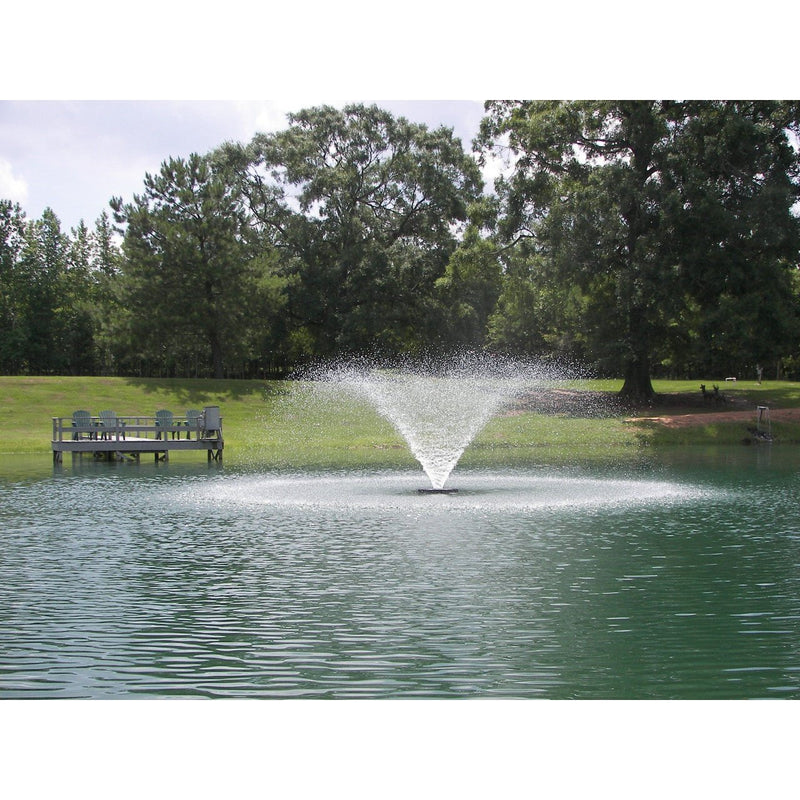
The aerating fountain offers a wider, 6-foot tall "V" pattern but moves 650 GPM. This unit cycles 936,000 gallons per day, moving nearly the entire pond volume through the atmosphere every 33 hours. With an SOTR of 2.2 lbs of oxygen per hour, it provides nearly triple the aeration capacity for the same electrical cost. Within two weeks, the higher DO levels would stimulate aerobic bacteria, clearing the water and eliminating the odor. The choice here is clear: aesthetics cannot replace the physical requirement for volume and gas exchange.
Final Thoughts
The decision between an aerating fountain and a decorative fountain is fundamentally a choice between function and form. While decorative units provide undeniable visual appeal and are suitable for small, healthy water features where aesthetics are the only priority, they are mechanically limited in their ability to manage complex ecosystems. Their reliance on high-pressure impellers and restrictive nozzles makes them inefficient at moving the volume of water necessary for deep-cycle aeration.
Aerating fountains are the workhorses of pond management. By utilizing high-volume propellers and maximizing the surface area of water-to-air contact, they provide the necessary dissolved oxygen to prevent fish kills, reduce muck, and suppress algae growth. For any pond larger than a few thousand gallons or any system containing a significant fish population, an aerating unit is the only responsible choice for long-term stability.
Ultimately, the health of a pond is measured in parts per million of dissolved oxygen, not the height of its spray. Property owners should assess their pond's depth, nutrient load, and biological needs before investing in equipment. In many cases, the most effective strategy is a hybrid approach—installing a decorative fountain for the visual center and supplementing it with sub-surface aeration to handle the heavy lifting of ecosystem maintenance. Application of these technical principles ensures a clear, healthy, and sustainable water body for years to come.